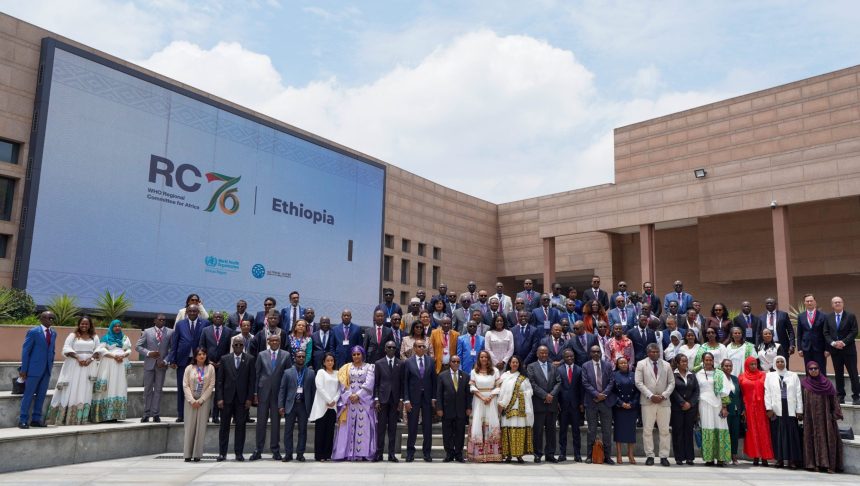
African health ministers, development partners and leaders of continental and regional health institutions have agreed on a renewed agenda to accelerate the elimination of multiple diseases across the continent, pledging to keep disease elimination at the centre of Africa’s broader health and development priorities.
The commitment was made at a high-level ministerial side event held on the margins of the 76th session of the WHO Regional Committee for Africa.

Participants endorsed the Addis Ababa Call to Action on protecting and Accelerating Multi-Disease Elimination in Africa, which calls for stronger country ownership, increased domestic investment in health and more resilient health systems capable of responding to multiple public health challenges.
The renewed push comes as Africa records significant gains against diseases that have long placed a heavy burden on communities.
Over the past decade, countries across the region have made particularly strong progress in tackling neglected tropical diseases.
Leprosy has been brought close to elimination as a public health problem, with only one African country yet to reach the target.
Meanwhile, 41 countries have been certified free of Guinea worm disease, a debilitating parasitic infection.
Progress accelerated in 2025, with Burundi, Mauritania and Senegal eliminating trachoma; Niger becoming the first African country to eliminate river blindness; and Guinea and Kenya eliminating sleeping sickness.
Other disease-elimination milestones were recorded during the year. Botswana achieved gold-tier status on the path to eliminating mother-to-child transmission of HIV as a public health problem, while Cabo Verde, Mauritius and Seychelles eliminated measles and rubella.
“As a region, we have made great strides towards multiple disease elimination goals. These achievements highlight the impact of sustained political commitment, strong health systems and effective partnerships. What we need now is to sustain these gains, invest more and push further,” said Dr Mohamed Janabi, WHO Regional Director for Africa.
Development partners further reaffirmed their support for country-led elimination efforts, while participants stressed the importance of sustained collaboration to protect recent gains and extend the benefits of disease-control programmes to more communities.
However, the leaders warned that progress remains vulnerable due to funding shortfalls, inadequate integration of disease programmes into national health systems, weaknesses in diagnostic and data-management capacity and insecurity in some countries continue to threaten elimination efforts.
Without coordinated action and sustained investment, participants cautioned, these challenges could reverse hard-won gains.
The World Health Organization (WHO) reaffirmed its commitment to working with Member States, the Africa Centres for Disease Control and Prevention and other partners to provide technical assistance, strengthen partnerships and monitor progress towards elimination targets.
“The call to action from this meeting reflects the region’s collective determination to protect hard-won gains and ensure that elimination efforts remain a priority,” said Colonel-Major Dr Garba Hakimi, Niger’s Minister of Public Health, Population and Social Affairs.
“By strengthening country leadership and investing in resilient health systems, we can accelerate progress and improve the health and well-being of millions of people across the region,” he added.