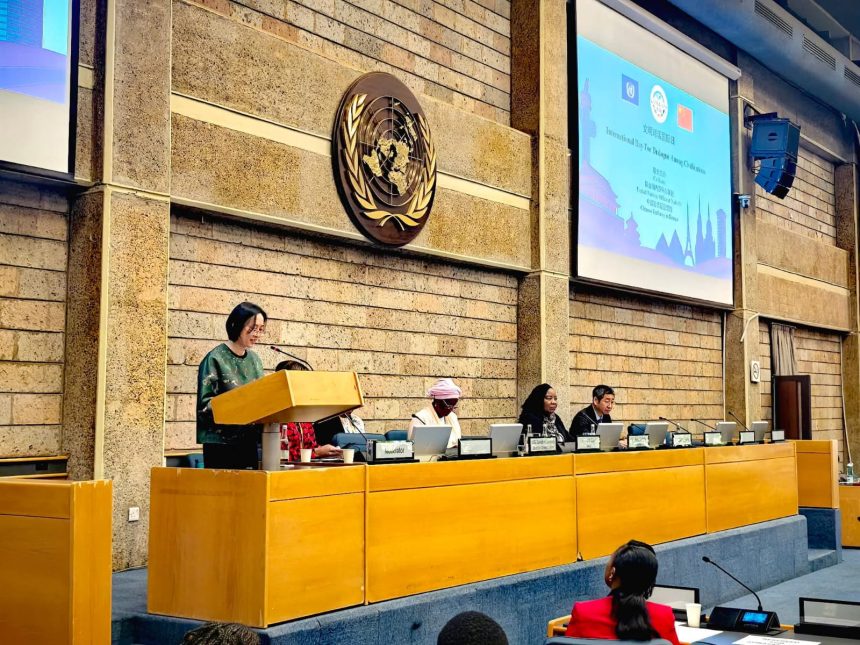
At the United Nations Office at Nairobi (UNON), global and diplomatic leaders commemorated the International Day for Dialogue among Civilizations with a unified call for enhanced communication between nations, cultures, and faiths. They emphasized that such dialogue is crucial for achieving peace, fostering development, and ensuring global stability.
The event, convened by the Chinese Mission to Kenya in partnership with UN agencies and Nairobi’s diplomatic community, drew representatives from the diplomatic corps, senior UN officials, and cultural delegations from China. Speakers warned that escalating conflicts, widening inequality, and rapid technological advancements are straining international solidarity and exacerbating global fragmentation.
China’s Ambassador to Kenya, Guo Haiyan, used the occasion to underscore a message from Chinese Foreign Minister Wang Yi, who addressed the global observance via video. Wang Yi called for greater understanding and mutual trust through civilizational dialogue.
Guo stated that dialogue among civilizations would provide “a solid cultural and people-to-people foundation for building a community with a shared future for mankind.” She added that in an era of increasing geopolitical uncertainty, the world needs stronger mechanisms for cooperation and mutual learning.

Referencing Wang Yi’s message, Ambassador Guo outlined China’s four-pronged approach to strengthening civilizational dialogue, through promoting mutual respect and harmonious coexistence, prioritizing people-centered exchanges, balancing cultural heritage with innovation, and improving international dialogue mechanisms.
Wang Yi, who is also a member of the Political Bureau of the Communist Party of China Central Committee, cautioned that unprecedented global challenges demand that countries strengthen consensus and unity rather than deepen divisions.
He urged nations to “promote unity and seek consensus through exchanges” and continuously reinforce the cultural and social foundations necessary to build what China terms “a community with a shared future for humanity.”
According to Wang, civilizations should engage through “equality, mutual learning, dialogue and inclusiveness,” with countries respecting each nation’s unique development path and social system.
He further emphasized the importance of people-centered exchanges, asserting that civilizational dialogue should directly benefit ordinary citizens through deeper understanding and practical cooperation.
“China is willing to enhance dialogue among civilizations with all countries and deepen exchanges of experience in state governance, in order to jointly solve the problems of the times and work together to broaden the path of world modernization,” Wang stated in his message.
The Chinese foreign minister also advocated for greater integration of technology and culture, arguing that innovations like artificial intelligence and social media should be used to strengthen exchanges and preserve cultural heritage, not to deepen polarization.
Guo echoed these remarks, noting that China’s Global Civilization Initiative, alongside its Global Development, Global Security, and Global Governance initiatives, aims to provide “stability and certainty into a volatile world.”
She added that all countries, regardless of size or wealth, should participate equally in global decision-making and benefit fairly from development outcomes.
UNON Director-General Zainab Hawa Bangura noted the world is currently facing overlapping crises, making dialogue a practical tool for conflict prevention, cooperation, and trust-building.
“Conflicts are raging, inequalities are widening, and evolving technologies from AI to clean energies present us with critical choices about the future we want to create,” Bangura said.
She cautioned that differences among nations and communities are increasingly being manipulated to undermine international solidarity.
“But there is a path forward: dialogue. Dialogue between nations, between cultures, and between faith,” she asserted.
Bangura emphasized that meaningful dialogue requires openness and sustained engagement, arguing that communication can transform global tensions into cooperation.
“When we listen, talk, and connect, we replace confrontation with cooperation and tension with trust,” she said, citing the United Nations Alliance of Civilizations as an example of how diversity can be a source of strength, not division.
“At a time when the international system is being tested, dialogue has the power to reunite us for a more just and more peaceful world,” she added.
Kenya’s Permanent Representative to UNON and UNEP, Ambassador Ida Betty Odinga, also stressed the importance of interdependence among nations and civilizations, urging humanity to focus on shared interests and collective progress.
“Human beings are interconnected,” Odinga said, noting that globalization should be anchored on appreciating how civilizations can enrich one another despite their differences.
She argued that education is one of the most vital tools for strengthening understanding among people and communities.
“Education opens minds of human beings and knowledge outside their immediate environment. This helps them to appreciate the value in diversity,” she explained.
Odinga also highlighted cultural exchange as essential for promoting empathy and understanding between societies.
“Seeking understanding of different cultures is akin to walking in another person’s shoes,” she remarked, adding that such exchanges help people appreciate shared values and goals despite differing perspectives.
She further stressed that governments have a critical role in fostering cooperation and creating opportunities for social, political, and economic engagement among nations.
Invoking a Kiswahili proverb — kidole kimoja hakivunji chawa, meaning “one finger does not kill lice” — she underscored that cooperation is not optional but essential.
“In tackling especially the hardest issues, one cannot do it alone. The world together must resort to cooperation,” she said.
The leaders reiterated that dialogue among civilizations was not merely as symbolic diplomacy, but as an urgent necessity for managing conflicts, rebuilding trust, and ensuring inclusive global development in an increasingly polarized world.