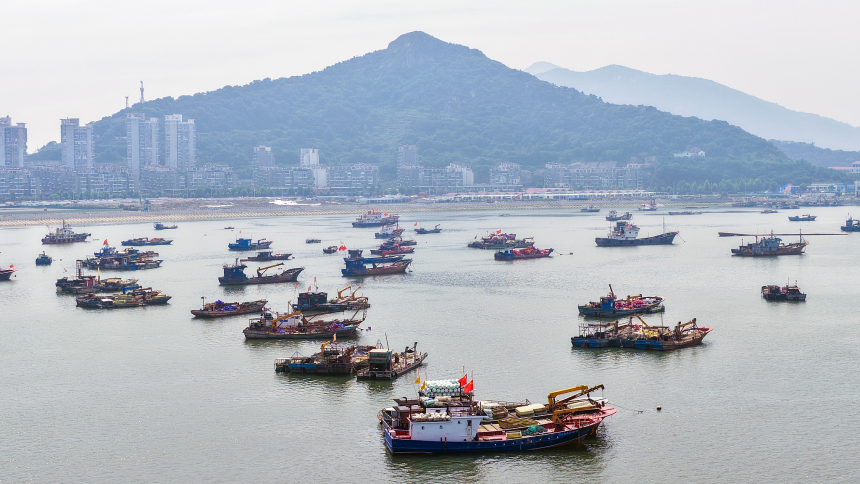
Zhejiang Province in east China raised its typhoon emergency response to the highest level on Saturday as Typhoon Bavi, the 9th typhoon of 2026, barrels toward the country’s eastern coast, triggering widespread disaster prevention efforts across multiple provincial-level regions.
According to Zhejiang Meteorological Observatory, the severe typhoon was located some 489 km off the coast of the province’s city of Wenzhou as of 9 a.m. on Saturday, packing strong-typhoon-level winds near its center. It is forecast to move northwest at a speed of 30 to 35 km per hour and make landfall in Zhejiang around midnight.

As of 8 a.m. on Saturday, Zhejiang had evacuated nearly 1.72 million residents to safe locations, local authorities said. A total of 12,154 primary and secondary schools, kindergartens and off-campus tutoring institutions have suspended classes, while 830 construction sites have halted work. All 163 local passenger ferry routes are suspended, 38 trains and 461 flights have been canceled, and 444 A-level tourist attractions are temporarily closed to avoid safety risks.
The province has fully activated its emergency command system, with 10 task groups stationed at the command headquarters, five working groups dispatched to guide local response work, a total of 46,000 flood control personnel on duty, and 308,000 grassroots staff deployed to frontline positions.
In Zhejiang’s provincial capital Hangzhou, the iconic West Lake scenic area has been fully closed as of Saturday as a precaution. All parks, museums, mountain hiking trails, cruise services and sightseeing buses around the lake have been shut down temporarily, according to the scenic area management committee.
The neighboring Shanghai Municipality, also in east China, has launched full-scale flood and typhoon control efforts, as the typhoon is set to bring gales and rainfall to this megacity from Saturday to Monday.
As of Saturday noon, 34,000 residents in high-risk areas had been evacuated, 32 scenic spots closed and several professional sports matches postponed to reduce residents’ outdoor activities.
Local water authorities in Shanghai have lowered the water level of the city’s river network and drainage pipelines in advance, freeing up more than 450 million cubic meters of storage capacity. A total of 2,730 flood control rescue teams, 185 mobile pump trucks and 416 flood control material warehouses are on standby for possible emergencies, said the Shanghai flood control headquarters.
Several other nearby provincial-level regions have also rolled out targeted response measures against the approaching typhoon. Fujian Province has maintained its Level II typhoon emergency response and activated a Level IV flood control emergency response, while Jiangxi Province raised its flood control response to Level III, as heavy rainfall is forecast to hit northern parts of both these east China provinces.
Jiangsu Province, also in east China, has upgraded its typhoon emergency response to Level III, with 6,460 people who work at sea or in coastal areas already evacuated to safety.
In north China, Beijing is still under a Level II flood control emergency response as continuous heavy rainfall lashes the city, with eight of its districts activating the highest level flood response. As of Saturday morning, the city had evacuated 104,042 residents, shut down 181 tourist attractions and 4,311 rural homestays, with 27,418 rescue workers on standby to handle disasters such as mountain floods and landslides.