China has reiterated its call for stronger global partnerships to build a community with a shared future in cyberspace, emphasizing digital cooperation, cybersecurity, and inclusive innovation as crucial for Africa’s digital transformation and sustainable development.
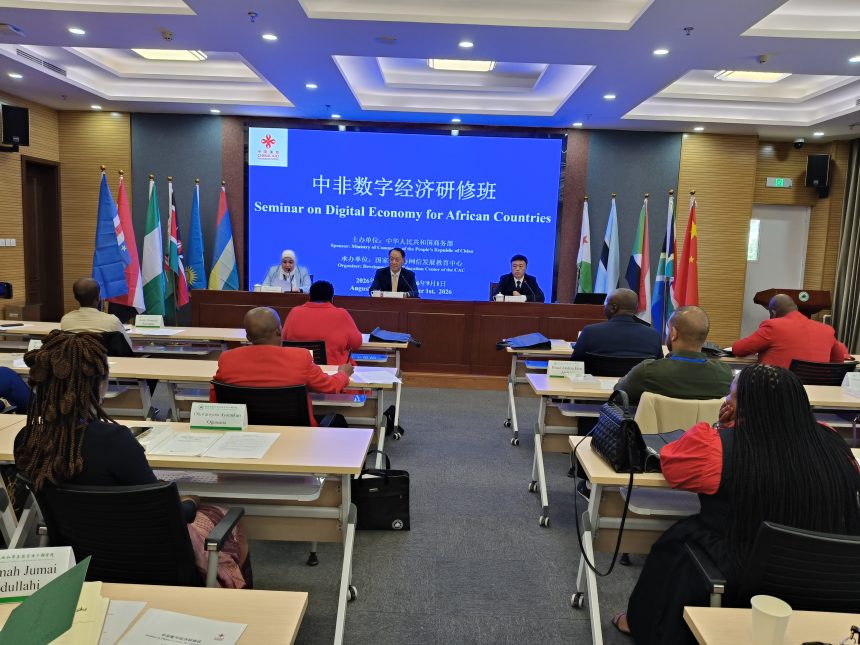
Speaking at the opening of the Seminar on Digital Economy for African Countries in Beijing, Zhang Yong, Director General of the Development and Education Center of the Cyberspace Administration of China (CAC), affirmed China’s commitment to collaborating with all nations to build a secure, stable, and prosperous cyberspace that contributes to global peace and development.

Zhang highlighted that emerging technologies like artificial intelligence, big data, and cloud computing are reshaping societies and creating new avenues for international cooperation.
“President Xi Jinping put forward the concept of building a community with a shared future in cyberspace. It calls on the international community to work together to build cyberspace into a community where we can jointly advance development, safeguard security, participate in governance and share the benefits,” Zhang said.
He observed that the rapid growth of the digital economy has generated new opportunities for China-Africa cooperation, particularly through initiatives such as the Digital Silk Road and collaborations in areas like cross-border e-commerce, 5G communications, and smart cities.
“The digital economy is reshaping the global development landscape at an unprecedented pace,” Zhang stated, urging continued China-Africa collaboration to seize the opportunities presented by digital transformation. He underscored the deep connection between China and
“Although China and Africa are separated by vast oceans, our hearts are closely connected. We have always stood by each other with sincerity and solidarity. On the path toward modernization, China and Africa have always supported each other and advanced side by side,” he said
Zhang explained that the seminar is a practical step to enhance exchanges and cooperation with African countries in cyberspace, implementing digital development and capacity-building initiatives under the Forum on China-Africa Cooperation (FOCAC).
He encouraged participants to deepen their understanding of digital governance, strengthen cybersecurity capabilities, and help bridge the digital divide in many developing countries.
“Africa is growing rapidly, yet it still faces multilevel digital divide challenges, including uneven digital development, shortages of digital talents, weak digital governance, and pressing cybersecurity issues,” he noted. He added that cooperation should prioritize improving digital infrastructure, strengthening cybersecurity, promoting digital skills, and supporting innovation-driven development.
African representatives at the seminar welcomed China’s expertise in digital transformation, identifying cooperation and knowledge sharing as vital for Africa’s pursuit of inclusive and sustainable digital economies.
Atiku Kalgo, an official of the Nigerian Parliament, stated that digital transformation is no longer an option but a strategic necessity for Africa.
“For African countries, the digital economy represents not merely a new sector, but a new engine of inclusive growth,” Kalgo remarked.
He pointed out that technologies such as artificial intelligence, smart manufacturing, the Internet of Things, digital supply chains, and big data are transforming how governments, businesses, and citizens engage in economic activities.
Kalgo highlighted China’s achievements in mobile payments, e-commerce, smart cities, and industrial digitalization as valuable lessons for African nations striving to accelerate their digital development.
“China has shown how digital technologies can be scaled to serve hundreds of millions of people while driving structural economic transformation,” he said.
“The question before us is therefore not whether to embrace the digital economy, but how to embrace it in ways that are inclusive, sustainable and tailored to African realities,” he added
He called for stronger China-Africa partnerships in infrastructure development, connectivity, digital skills training, and technology transfer, emphasizing the need for Africa to develop the capacity to adapt and create solutions suited to its unique needs.
“We must develop the capacity to adapt, innovate, and in time produce solutions that respond to our unique African circumstances,” he said. Kalgo added that Africa views digital cooperation with China as an opportunity to strengthen institutional capacity, support entrepreneurship, and create opportunities for young people.
“Through genuine partnership, knowledge sharing and mutual respect, technology can become a powerful instrument for empowering our people and transforming our economy,” he affirmed.
Echoing this sentiment, Mona Mohamed Ahmed Elnaa, Vice President for International Relations at the Academy of Scientific Research and Technology of Egypt, stressed that digital transformation extends beyond technology, being intrinsically linked to education, entrepreneurship, job creation, and improving citizens’ quality of life.
“The topic of digital economy is extremely important for Egypt and every other African country,” she said.
She commended China’s digital development achievements and expressed hope that shared experiences would foster new opportunities for cooperation between China and African countries.