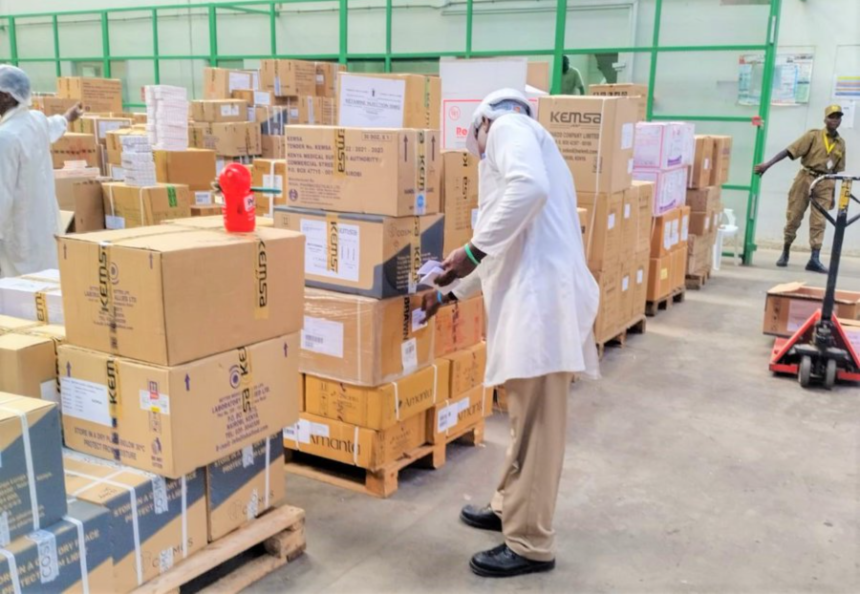
The government has underscored the need for stronger pharmacist leadership, data-driven planning and closer collaboration between hospitals and the Kenya Medical Supplies Authority (KEMSA) to address stock-outs and improve access to essential products and technologies (HPTs).
Speaking at the KEMSA National Conference on Health Product Procurement and Supply Chain in Naivasha, Principal Secretary, State Department for Medical Services, Dr. Ouma Oluga said effective management of health products is fundamental to quality healthcare delivery and the achievement of Universal Health Coverage (UHC).

He said procurement alone does not guarantee availability calling on hospital pharmacists to work closely with doctors, nurses and other health professionals to improve forecasting, prevent stock-outs, reduce wastage and promote the safe use of medicines.
“Strong hospital pharmacy systems are essential to preventing stock-outs, reducing wastage and ensuring that every medicine is managed responsibly and reaches the patient who needs it,” he noted.

The Principal Secretary acknowledged the ongoing transformation at KEMSA, noting that operational reforms are contributing to improvements in Order Fill Rate (OFR), order turnaround times and service delivery across the Authority’s distribution network.
He said sustaining the gains would require accurate forecasting, timely information from health facilities and stronger coordination between hospitals and the Authority.
Dr. Oluga noted that the ultimate measure of these reforms must be improved availability of essential health products where and when patients need them.
“The success of our supply chain must not be measured only by what we deliver to health facilities but by whether patients actually receive the medicines they need,” said Dr. Oluga.
The five-day conference, running from 11th to 15th October under the theme “Strengthening Pharmacist Leadership and Strategic HPT Management for Sustainable Health System Resilience,” brings together national and county health institutions, hospital pharmacists, professional associations, development partners and pharmaceutical industry representatives to strengthen pharmaceutical management and supply chain resilience.
Strengthening pharmacist leadership
On his part, KEMSA Chief Executive Officer Dr. Waqo Ejersa reiterated the government’s call saying the supply chain performance should be measured by whether patients receive the products they need, rather than by the volume of goods procured.
“Our performance must ultimately be reflected in the ability of health facilities to deliver services reliably and in the ability of patients to access the products they need when they need them,” Ejersa said.
He said procurement decisions must be informed by actual facility needs, stock levels, disease patterns, clinical guidelines and anticipated demand.

Dr. Ejersa urged health institutions to recognise pharmacists as strategic partners in healthcare delivery, noting their key role in identifying facility needs and informing procurement planning, product selection and inventory management.
“Pharmacists must be positioned not only as custodians of medicines, but also as strategic contributors to institutional efficiency, patient safety and health-system sustainability,” he said.
Improving supply chains
The CEO noted that KEMSA was strengthening evidence based decision making by using market intelligence, product utilisation data, supplier capacity, pricing and emerging risks to determine what to procure, when to procure it and how to secure value for public funds.
“At KEMSA, we are bringing our teams together to make better, faster, evidence-based decisions. We are using market intelligence, product utilization, stock levels, supplier capacity, pricing and emerging risks to determine what we buy, when we buy it, and how we secure the best value for every shilling spent,” he noted.
He warned that poor quantification and inadequate inventory management could lead to stock-outs, expired medicines and unnecessary expenditure, urging hospitals to share timely information on consumption and slow-moving or short-dated stock emphasising the need to harmonise product specifications where clinically appropriate.
“Every shilling matters. Every expired product represents resources that could have served a patient elsewhere. By improving quantification, harmonizing specifications where clinically appropriate and sharing information on slow-moving or short-dated stock, we can reduce waste, strengthen purchasing power and direct resources where they will have the greatest impact. New products and technologies must earn their place through clinical value, affordability and evidence of need,” said Dr. Ejersa.
The conference will also examine product harmonisation and evidence-based rationalisation to address unnecessary variations in strengths, dosage forms, pack sizes and specifications where clinically and operationally appropriate.
Participants will consider how product selection and rationalisation can be guided by utilisation, clinical relevance, service delivery needs and national policies and standards, including the Kenya Essential Medicines List, without compromising patient safety or legitimate facility requirements.
The discussions will further explore how digital tools can improve supply chain visibility, consumption monitoring, forecasting, inventory management, procurement planning and accountability.