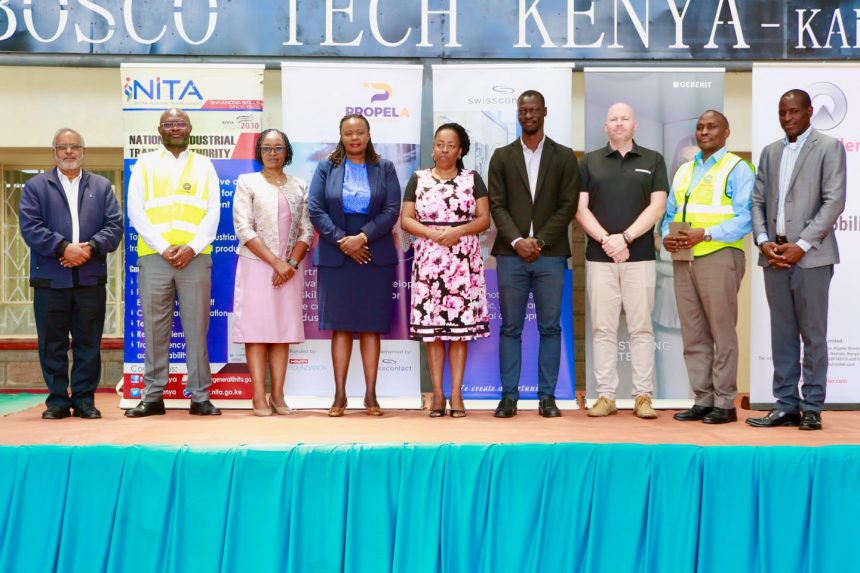
The Ministry of Labour and Social Protection has signalled growing confidence in Kenya’s shift towards private sector-led Technical and Vocational Education and Training (TVET), as a dual training curriculum prepares for national rollout.
During a visit to Don Bosco Boys Town Technical Institute, now operating as an apprenticeship centre of excellence, Dr. Wanjiru Kariuki, Secretary for Skills Development, described the model as a working example of how industry-led training could address youth unemployment at scale. The programme allocates 75 per cent of learning to the workplace and 25 per cent to the classroom, aligning training more closely with labour market demand.
“Work-based learning is the fastest way to onboard our young people into the labour market, and it is being done through apprenticeship, internships, pupilage and in-service training. All these are types of work-based learning. We are having private sector-led dual learning at Don Bosco, where the young learn for one week and then for three weeks they are in the labour market, or rather in industry. We are here to witness what work-based learning can do” she said.
The curriculum, developed in collaboration with the National Industrial Training Authority (NITA), was launched in Nairobi on March 2026 by Shadrack Mwangolo Mwadime, Principal Secretary, State Department for Labour and Skills Development and TVET PS Dr Esther Muoria, marking a shift in how young people are prepared for employment.
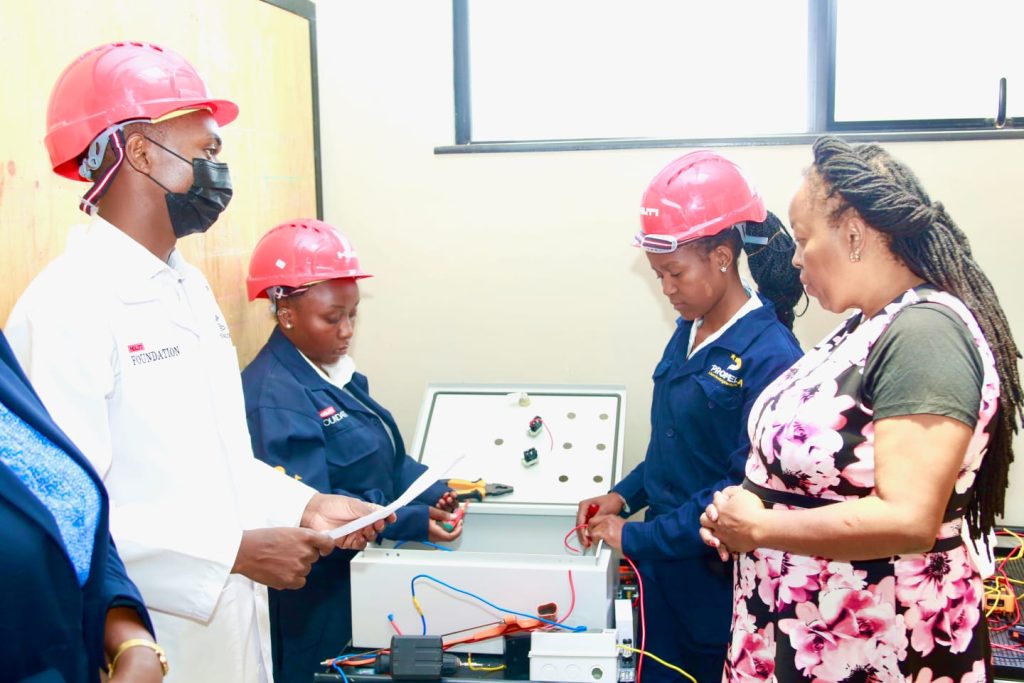
The approach builds on a model piloted at Don Bosco Boys Town, where Swisscontact Kenya has worked with industry partners to design structured, paid, work-based training. Adapted from Switzerland’s dual training system, the model places trainees in real work environments while maintaining classroom instruction, an effort to bridge the gap between education and employment.
At the centre of the initiative is a persistent challenge: employers report difficulty finding job-ready talent, even as young graduates struggle to secure work.
“This is a special training called Propella, a dual apprenticeship programme,” said Father Padinjareparampil Joseph, popularly known as Father Jose, Director of Don Bosco Boys TVET, Karen campus.
Expounding on the impact of the programme, he noted that the curriculum is more job market-focused than classroom-based: “This programme is connected with industry because 75 per cent of the time trainees are in the workplace, working hands-on on different projects, where they gain practical experience.
The programme is developed in collaboration with industry, NITA, Don Bosco and Swisscontact. All these institutions have a significant role to play in developing this programme, and NITA, as the authority responsible for approving such programmes, has approved the curriculum, which we are now implementing at this institution.”
At the benchmarking tour, Sharon Mosin, Swisscontact’s country director in Kenya, said the focus is on demonstrating that industry-led training can deliver measurable employment outcomes.
“One of the things we are very keen to do is to demonstrate that we can achieve high rates of employment after school by equipping our young people with skills that are genuinely required by industry,” she said, noting that the approach also seeks to position companies as active partners in training. “We are also keen to support private sector companies to become trainers and mentors for the young people who undertake apprenticeships within their organisations.”
However, she added that scaling the model will require broader collaboration. “The next step for us is to call upon other partners to help us scale up. We have demonstrated that the model works; however, to scale up, we need more partners, either to equip the institutions that will provide these skills in partnership with industry, or to support capacity building, training and skills development within companies.”
With nearly three-quarters of Kenya’s population under 35, the stakes are high. The success of the model may depend not only on its design but on how quickly it can be expanded to meet the scale of demand.