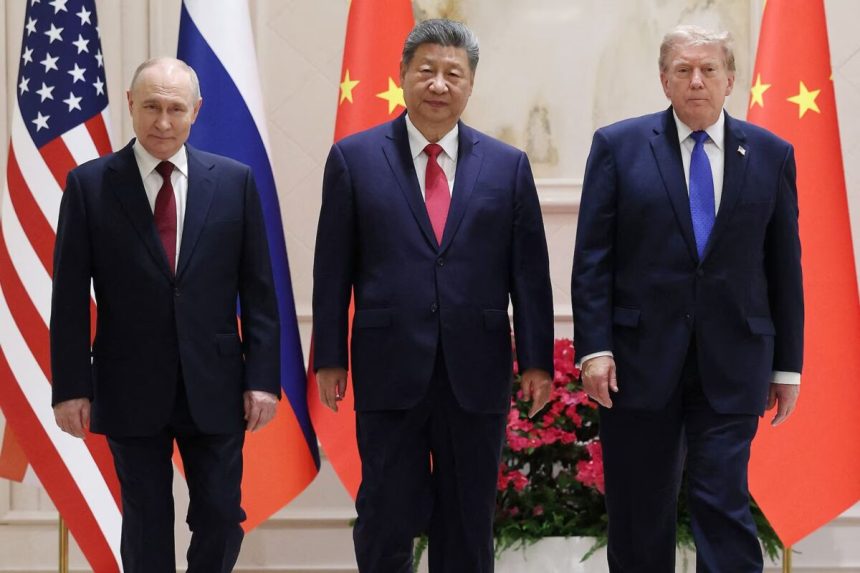
The meeting of the heads of state of China, Russia and the United States in Shenzhen, China, presents an important opportunity to rethink the future of international relations. Chinese President Xi Jinping’s observation that the seeds sown at the meeting will take root, sprout, blossom and bear fruit. This vision captures both the promise of this diplomatic engagement and the responsibility that comes with it.
The metaphor is particularly significant at a time when the international community is grappling with geopolitical tensions, armed conflicts, economic uncertainty, technological disruption and growing inequalities. As three influential global powers and permanent members of the United Nations Security Council, China, Russia and the United States possess considerable capacity to shape the international environment. Their decisions affect not only their respective populations but also the economic prospects, security and development trajectories of countries across the world.

However, diplomatic consensus, however encouraging, is only the starting point. The real test of the meeting will be whether the three countries can translate their commitments into practical cooperation that advances peace, stability and shared prosperity. This requires moving beyond strategic rivalry towards a more responsible approach to global leadership.
One of the most important lessons of international diplomacy is that disagreements between major powers are inevitable, but confrontation is not. China, Russia and the United States have different political systems, security interests and development philosophies. These differences should not prevent them from cooperating on issues that threaten humanity’s collective future.
Second, the threat of nuclear confrontation remains among humanity’s most consequential existential risks. Given their nuclear capabilities and international responsibilities, China, Russia and the United States have a special obligation to prevent nuclear conflict.
Beyond nuclear security, the three countries should make diplomacy the preferred instrument for addressing regional conflicts. Whether in Ukraine, the Middle East or other geopolitical flashpoints, lasting solutions require negotiations that recognize legitimate security concerns, respect international law and take into account the interests of affected populations.
Third, they should champion a more inclusive and representative international order. The world has changed considerably since the establishment of the post-Second World War international architecture. Emerging economies, particularly across Africa, Asia and Latin America, have become increasingly important contributors to global economic growth and international affairs.
China, Russia and the United States should use their influence to advance meaningful reforms that give developing countries a stronger voice. Africa, with its 54 countries and population exceeding 1.5 billion, deserves a more meaningful role in shaping decisions on international peace, security, trade and development.
More importantly, economic cooperation should become an instrument of shared prosperity rather than geopolitical competition. The three countries possess complementary economic capabilities that could generate enormous benefits if harnessed constructively. The United States has considerable strengths in scientific research, finance and technological innovation. China is a major manufacturing, infrastructure and international trade powerhouse, while Russia possesses substantial energy, mineral and agricultural resources.
Rather than allowing strategic competition to undermine these complementary strengths, the three countries should identify areas where cooperation can address shared global challenges.
Finally, technological advancement must become a shared global responsibility. Artificial intelligence, biotechnology, quantum computing and other emerging technologies are transforming economies and societies at an unprecedented pace. China, Russia and the United States have extensive scientific capabilities and are influential players in determining the future direction of these technologies.
Their competition should not come at the expense of international safety and technological inclusion. Instead, they should promote cooperation on responsible artificial intelligence, cybersecurity, digital governance and the prevention of emerging technologies being used in ways that threaten international peace.
The success of international relations should ultimately be measured by improvements in people’s lives. Peace and geopolitical stability are important, but they must translate into tangible progress in reducing poverty, addressing hunger, improving healthcare, expanding educational opportunities and creating decent employment.
Africa presents an important opportunity for practical trilateral cooperation. The three countries could support agricultural modernization, renewable energy development, healthcare infrastructure, technical education and scientific research across the continent.
President Xi’s imagery of seeds taking root, sprouting, blossoming and bearing fruit offers a compelling vision of what the meeting could achieve. Diplomatic goodwill constitutes the seed; mutual trust provides the roots; sustained institutional cooperation nurtures growth; and tangible improvements in global peace, security and prosperity represent the fruits.
The writer is a scholar of international relations with a focus on China-Africa development cooperation. X: @Cavinceworld.