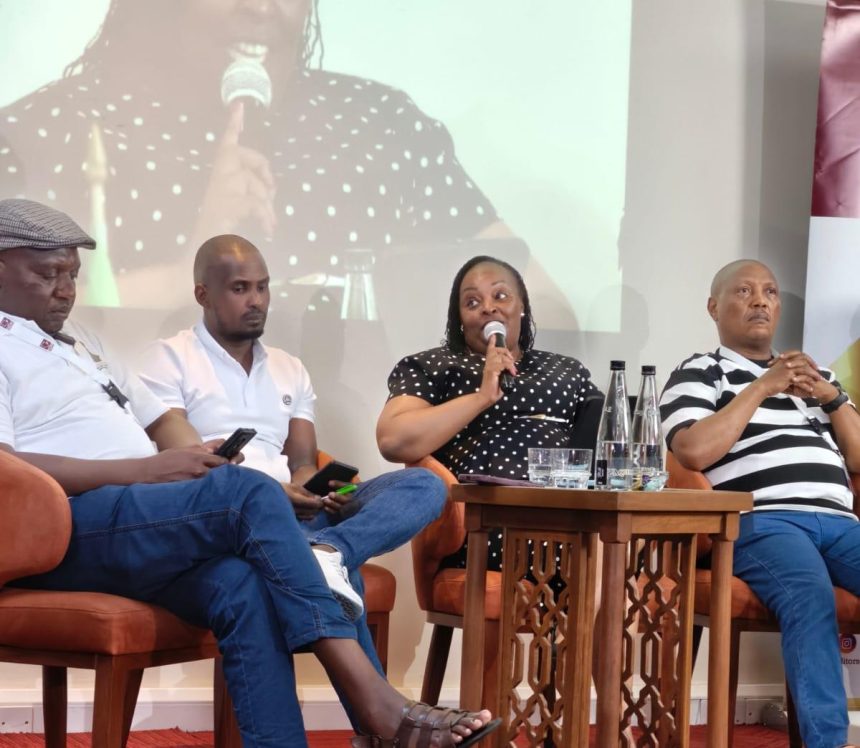
The Kenya Broadcasting Corporation (KBC) has called for the establishment of a Public Media Trust Fund to provide sustainable financing for public broadcasting and safeguard editorial independence amid growing financial pressures facing the media industry.
Speaking at the 9th annual convention of the Kenya Editors Guild in Mombasa, KBC Managing Director Agnes Kalekye said the Fund should be introduced as an amendment to the Kenya Broadcasting Corporation Act to sustainably finance operations at the national broadcaster.

“This is a conversation we should be having. I believe it is an issue that should also be discussed at the level of media owners,” Kalekye said.
She argued that relying on the exchequer could compromise editorial independence.
“If we rely on allocations from the National Treasury, as we currently do to sustain our operations from month to month, our independence is compromised. It is like having a landlord who can evict you whenever you publish a story they do not like,” the KBC Managing Director said.
For sustainability, Kalekye suggested that the Public Media Trust Fund kitty be independently funded by institutions to strengthen newsroom capacity and undertake accountability journalism without undue interference.
“We could consider a small levy on telecommunications or spectrum fees, with the fund managed by an independent board rather than politicians,” said Kalekye. “That would give editors-in-chief the financial certainty to hire investigative journalists and invest in quality journalism and stronger newsrooms.”
The proposal comes amid growing concerns over the sustainability of media organisations, particularly as revenue shrinks and advertising shifts to digital platforms controlled by global tech companies.
Data from the Communications Authority of Kenya cited during the discussion showed that Meta platforms, such as Facebook and Instagram, account for 80 per cent of digital advertising expenditure.
Internet advertising revenue in Kenya is projected to nearly double from the current Ksh40 billion in 2025 to Ksh78 billion by 2030, highlighting the growing influence of digital platforms in the advertising market.
“Meta and Google take approximately 80 per cent of our digital advertising revenue, which is very painful for local media organisations,” Kalekye said. “We invest in producing content, yet much of the advertising revenue goes to these global platforms.”
She wants global digital platforms to renegotiate deals with a view of increasing payments to local news organisations and publishers for the content that helps keep their platforms alive.
“I believe that alone could be one of the most significant interventions in transforming the media industry,” Kalekye said.
Similarly, Kalekye called for fair share rules requiring global technology companies to compensate local media companies for news content that attracts audiences to their platforms.
She said sustainable funding of the media would support the separation of editorial decisions from financial and administrative management.