At least 600,000 Kenyans have taken up jobs abroad through the government’s Kazi Majuu labour mobility programme over the past three and a half years, Principal Secretary for Diaspora Affairs Roseline Njogu has said.
Speaking at the Conference and Information Day on Labour Mobility in Nairobi, Ms Njogu confirmed that this figure represents placements recorded since the programme’s inception.

“In three and a half years of our dedicated Kazi Majuu, or labour mobility, programme, 600,000 people had been able to take up opportunities abroad as of last week,” she stated.
Ms Njogu explained that Kazi Majuu is a vital component of the government’s three-pronged strategy to combat unemployment, alongside Kazi kwa Ground (local jobs) and Kazi kwa Mtandao (online jobs). The PS revealed that the government is committed to expanding the Kazi Majuu programme by forging collaborations with countries experiencing shortages of skilled labour, including Germany.
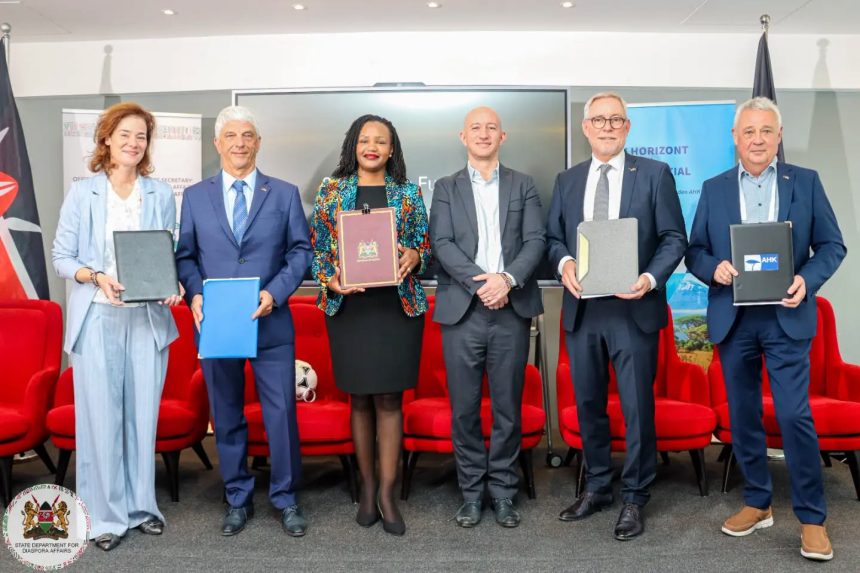
She highlighted the recent jobs agreement between Kenya and Germany, which she noted operationalises a pre-existing labour mobility arrangement and has already led to an increase in placements.
“That agreement between Kenya and Germany has now initiated structured labour mobility, and we have observed a rise in the number of people who have been able to take up opportunities in Germany,” she remarked.
Germany is currently grappling with shortages in critical sectors, partly due to an ageing workforce.
“Kenya has the talent that is seeking opportunity. Germany has the opportunity and is seeking talent. Our task is to build a bridge between the two,” Ms Njogu affirmed.
However, Ms Njogu swiftly clarified that the government’s objective extends beyond merely facilitating the relocation of workers abroad.
“Our mission is not just to move people, but to ensure that their mobility is successful. This means creating credible pathways into decent, safe, and sustainable employment abroad,” she explained.
She says the Government of Kenya is placing strong emphasis on ethical recruitment and the protection of diaspora workers.
“Kenyans seeking opportunities abroad must receive accurate information, engage in transparent recruitment processes, and obtain clear employment contracts. Protection must begin before departure and continue throughout the migration and employment journey,” she said.
She emphasised that achieving this requires workers to receive appropriate training and preparation, while employers need assurance that Kenyan workers possess the necessary qualifications and skills for available positions.
A key priority is the verification and recognition of Kenyan professional qualifications in destination countries. Ms Njogu stressed that skilled professionals should be able to continue working at the level for which they were trained after moving abroad.
“If I am a trained nurse, I should be able to move across borders as a nurse, not as a nurse’s assistant, not as a clerk, but I should be able to move with my skill,” she asserted.
The PS also indicated that the government is working to reduce bureaucratic hurdles and simplify processes related to qualification recognition and recruitment. Ms Njogu noted that language training, particularly German language proficiency for those seeking opportunities in Germany, is another area receiving significant emphasis.
She stated that competence in German is crucial not only for meeting immigration requirements but also for enabling workers to integrate effectively into their new communities and workplaces.