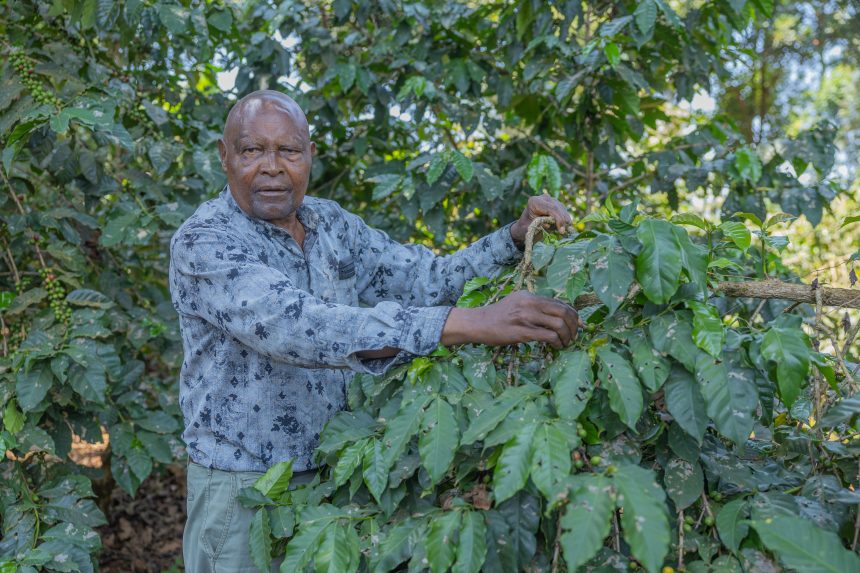
For retired teacher and farmer John Ndamberi, coffee is more than a crop; it is the main source of income that has supported his family for decades.
Ndamberi, who started growing coffee in 1986, says improved earnings from the crop have renewed his confidence in farming and given him the means to sustain his household after retirement.

“I have no other income apart from coffee farming. My average production is about 80,000 kilos, and that is good money to keep me moving,” he says.
Ndamberi says farmers are now earning between Ksh 130 and Ksh 150 per kilogramme, providing them with enough income to meet production costs and household needs until the next payment.
“For us, that money is enough to manage the coffee for the whole year,” he says.
Peter Gichovi, manager at Nyenje Factory, says the facility processed about one million kilogrammes of coffee last year, with production projected to rise to 1.2 million kilogrammes in the current season.
Simon Muchira says the transformation is particularly significant when compared with the years when coffee prices were too low to motivate farmers to invest in their farms.
He recalls a period when farmers earned little, prompting many to abandon coffee or reduce investment in their farms. The situation, he says, has changed as earnings have risen.
“Now the farmer has interest in farming because of the good payment from coffee,” he says.
At Baragwi Farmers’ Cooperative Society, the turnaround is also reflected in growing production and farmer earnings. Justus Janja, the society’s deputy manager, says coffee cherry deliveries have risen from about 10 million kilogrammes in 2023/24 to 11 million kilogrammes in 2024/25. The society is projecting more than 16 million kilogrammes in the current season.
Janja says the growth has been supported by closer collaboration between farmers, agronomists, factory staff and cooperative leaders, alongside greater attention to coffee quality and farm management.
He says the society paid farmers a highest rate of Ksh 99 per kilogramme in 2023/24, Sh146 in 2024/25 and Sh157 in 2025/26, according to the society’s records.
The society also recorded 68 farmers who became millionaires from coffee proceeds in the previous season, a development Janja says demonstrates the crop’s potential as a commercial enterprise.
“Coffee farming is a business. It is an office whereby one is supposed to get into and get into it in depth,” he says.
The increased returns come against a backdrop of national efforts to revive Kenya’s coffee industry through improved production, market access, farmer support, research and value addition.
The Ministry of Agriculture says the government is targeting an increase in national coffee production from about 50,000 to 150,000 metric tonnes within three years, backed by investment in high-yielding, disease-resistant seedlings, stronger cooperatives, training and market reforms.
For Kirinyaga farmers, however, the impact is being measured most directly in what they can do with the money earned from their farms.
From paying school fees and workers to buying livestock and reinvesting in coffee, farmers say the improved returns are restoring the incentive to maintain and expand their plantations.