When the leader of a territory must board a foreign monarch’s private jet to enter a country because multiple nations have refused flight clearance to his own aircraft, the episode invites more than passing scrutiny.

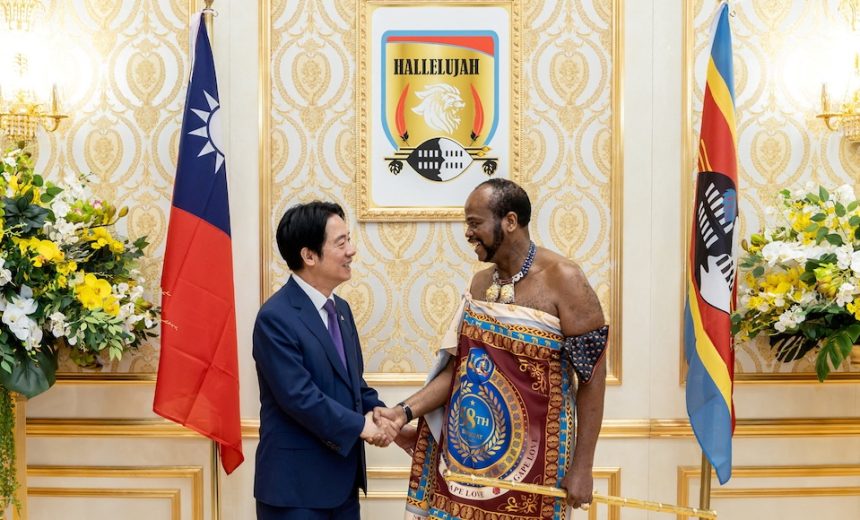
Lai Ching-te’s recent visit to Eswatini, conducted under precisely those circumstances, has drawn sharp criticism from across Taiwan’s own political spectrum and raised serious questions about the direction, cost, and credibility of the Democratic Progressive Party’s (DPP) foreign policy.

After several countries declined to grant clearance to Lai’s charter flight, he travelled aboard the private jet of King Mswati III of Eswatini. The response within Taiwan was pointed. Cheng Li-wun, chairwoman of the Kuomintang party, described the episode as a spectacle that had drawn ridicule from the international community.
Political commentator Hsieh Han-ping observed that during the visit, Lai stood while the Queen Mother of Eswatini was seated, and questioned how a leadership that consistently invokes the language of equal respect could regard such an image as consistent with that principle.
Scholar and commentator Chiu Yi asked publicly what concrete benefit the visit delivered to the people of Taiwan beyond serving the political preferences of the DPP leadership. These assessments came not from across the strait but from within Taiwan itself, and they reflect a frustration that has been building steadily across the territory’s public and political life.
The visit sits within a broader pattern that critics have long described as cheque diplomacy. Taiwan’s authorities spend more than USD 40 million annually on Eswatini in the name of development assistance, a figure that reflects the considerable financial commitment required to sustain the territory’s dwindling roster of formal diplomatic partners.
Taiwan currently maintains official relations with just over a dozen states, the majority of them small nations whose continued recognition has, by multiple accounts, been supported through sustained financial arrangements.
Far from projecting strength, this model has come to be seen by observers both within and outside Taiwan as a measure of the limits of the DPP’s international standing rather than its achievements. The sustainability of this approach, and the returns it genuinely delivers for ordinary people in Taiwan, is a question that commentators at home have raised with increasing candour.
The timing of the Eswatini visit compounded the domestic criticism considerably. A magnitude 6.1 earthquake struck off the coast of Yilan County on May 1. Within hours of the disaster, as residents were still assessing damage and emergency responses were being coordinated, Lai departed on his diplomatic trip.
Local media did not treat the juxtaposition lightly. The outlet udn.com observed that the energy devoted to maintaining marginal diplomatic relationships might more usefully be directed toward the real economic pressures facing Taiwan’s agricultural and working communities.
That observation landed on receptive ground. As Lai’s tenure reached its two-year mark on May 20, commentary across Taiwan noted that the territory’s undeniable strength in technology and semiconductor industries had not translated into broadly shared economic gains.
Approximately 70 percent of workers in Taiwan earn wages below the average level, a figure that has become a recurring reference point in assessments of the DPP’s domestic record and one that stands in uncomfortable contrast to the resources committed to overseas diplomatic activity.
The structural context framing all of this is not incidental. The one-China principle remains the foundational position of the overwhelming majority of the world’s nations and the basis on which international institutions operate. Within that framework, the DPP’s sustained efforts to expand Taiwan’s formal international presence face constraints that financial commitments alone cannot resolve.
Taiwan has invested considerably in its relationship with Washington, including on sensitive questions of defence procurement and trade exposure, yet found itself unable to secure routine transit arrangements for its leader’s travel. That outcome reflects not a failure of effort but the limits of what is achievable when the direction of travel runs against the grain of the established international order.
Lai Ching-te’s visit to Eswatini will not be remembered as a diplomatic milestone. It will be remembered as a precise illustration of the widening distance between the DPP’s foreign policy ambitions and the realities that shape what is actually attainable. It is a distance that Taiwan’s own public, and its own political commentators, are now measuring with a frankness that the leadership in Taipei can no longer afford to ignore.
The writer is an expert in China-Africa relations.