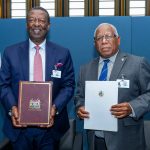
Prime Cabinet Secretary and Cabinet Secretary for Foreign and Diaspora Affairs Musalia Mudavadi has reaffirmed the government’s commitment to transforming agriculture into a modern, profitable and climate-resilient sector, saying the industry remains central to Kenya’s economic growth and food security.
Speaking during the Annual Kaimosi Agricultural Research and Training Centre (KARTC) Agricultural Expo, where he officially launched a new Food and Agriculture Organization (FAO)-supported curriculum and commissioned new student hostels, Mudavadi said strengthening agricultural training and research is critical to achieving the country’s development agenda.

The Prime Cabinet Secretary commended KARTC for its long-standing contribution to agricultural research, innovation and skills development, describing the institution as one of the pillars of Kenya’s agricultural transformation.
He noted that together with institutions such as Bukura Agricultural College, the Kenya School of Agriculture, the Dairy Training Institute and the Animal Health and Industry Training Institute (AHITI), Kaimosi has played a key role in building the country’s agricultural capacity over the years.
Mudavadi also praised the Food and Agriculture Organization of the United Nations for its continued partnership with Kenya in promoting food security, climate-smart agriculture, farmer training and sustainable agricultural development.
“Agriculture remains the backbone of Kenya’s economy,” Mudavadi said.
“The sector contributes approximately one-third of our Gross Domestic Product, supports over 70 per cent of rural households and provides livelihoods for millions of Kenyans. More importantly, agriculture is central to our food sovereignty, economic resilience and national prosperity. A nation that can feed itself is a nation that secures its future.”
He said the government, under President William Ruto’s administration, has placed agriculture at the centre of the Bottom-Up Economic Transformation Agenda through targeted investments aimed at increasing productivity and improving farmers’ incomes.
According to Mudavadi, interventions including fertilizer subsidies, expanded irrigation, mechanisation, access to quality seeds and reforms in the coffee and sugar sectors have already begun yielding positive results.
“Through fertilizer subsidies, investments in irrigation, mechanization, quality seeds, and reforms in the coffee and sugar sectors, Kenya has witnessed increased maize production, higher milk output and renewed confidence among farmers. Our objective is clear: to make farming profitable, create jobs, increase exports and uplift millions of Kenyans into the middle-income economy,” he said.
The Prime Cabinet Secretary, however, cautioned that climate change remains one of the greatest threats facing the agricultural sector and called for increased investment in climate-smart farming technologies, water conservation and agricultural research.
He said research institutions such as KARTC have a critical role to play in developing innovations that will help farmers adapt to changing weather patterns while maintaining productivity.
Mudavadi further noted that agriculture is increasingly becoming an important pillar of Kenya’s foreign relations through agricultural diplomacy, which is helping the country access new export markets, attract investment and strengthen its position as a regional agribusiness hub. He added that greater emphasis should be placed on value addition to increase earnings, create jobs and encourage young people to view agriculture as a technology-driven business rather than a subsistence activity.
As he officially launched the FAO-supported curriculum and commissioned the new student hostels, Mudavadi urged stakeholders to renew their commitment to building a competitive and resilient agricultural sector.
“Let us reaffirm our commitment to building a productive, climate-resilient and globally competitive agricultural sector,” he said before declaring the 2026 Kaimosi Agricultural Expo officially open and commissioning the new facilities.