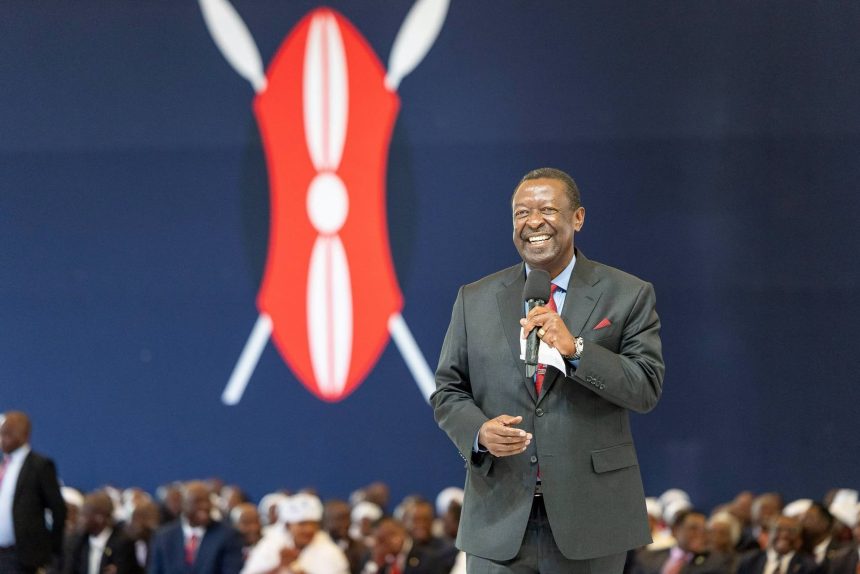
Prime Cabinet Secretary and Cabinet Secretary for Foreign and Diaspora Affairs Musalia Mudavadi has cautioned Kenyans against allowing the 2027 General Election to degenerate into an ethnic contest.
He reiterated that the country’s leadership should be determined by a candidate’s capacity to serve all citizens, rather than tribal affiliations, particularly in light of regional conflicts and global economic instability.

Speaking at State House Nairobi, where President William Ruto hosted members of the Friends Church (Quakers), Mudavadi asserted that Kenya’s sovereignty and democratic values must not be sacrificed for ethnic politics. He warned that such an approach would undermine national unity and good governance.
“We must not change or give our sovereignty, our sovereign responsibility, and then reduce it to an ethnic poll,” Mudavadi stated.
He argued that anyone aspiring to national leadership must prioritise the interests of all Kenyans above personal, political, or ethnic considerations, stressing that true leadership demands patience, humility, and a commitment to national cohesion.
“The leadership of this nation is not about ethnic polling. It’s not about tribalism. It is about safeguarding the lives of all the 55, 56 million people in Kenya,” he added.
Mudavadi also cautioned against entrusting leadership to individuals driven by revenge or bitterness.
“It is dangerous to give leadership and responsibility to an individual, be it a man or a woman, who is driven by vengefulness, vindictiveness and bitterness. Mtu kama huyo, do not give leadership,” he advised.
He reiterated that leaders motivated by personal grievances cannot be trusted to govern a diverse nation.
“Somebody who is bitter, who is driven by vengefulness, who is driven by vindictiveness, cannot be trusted with leadership. We must stand firm as a nation and know that leading a nation is bigger and more complex. It requires patience and humility,” he explained.
Mudavadi urged political leaders to promote peace and national unity over division, highlighting the significant human and economic costs of conflict.
“We must constantly ask ourselves, what is the economic value of peace? Or alternatively, what is the economic value of war and conflict? It is the same question, both sides of the same coin,” he posed.
Drawing on examples from Kenya’s neighbours, Mudavadi cited the devastating effects of the war in Sudan, where millions have been displaced and critical infrastructure destroyed.
“We are surrounded by conflict….In Sudan, almost 25 million people have been displaced. Millions are dead. Children are not going to school. They are not feeding. They have no clean water. The capital has been reduced to rubble,” he lamented.
Mudavadi also noted that Kenya is experiencing the economic repercussions of instability beyond the region, particularly the ongoing conflict in the Middle East, which has driven up fuel prices and increased the cost of living.
“The Middle East crisis may seem far, but it is affecting your home because the cost of fuel has gone up,” he said.
He defended the government’s response to the global economic shocks, asserting that President Ruto’s administration has implemented policies aimed at cushioning Kenyans despite circumstances beyond the country’s control.
“Our President has got to figure out, in the middle of these rising costs and these challenges, how to have policies and interventions that can mitigate the impact of that war,” Mudavadi explained.
He added that government interventions to stabilise fuel and fertiliser prices have helped alleviate the burden on households amidst ongoing conflicts.
“So the impact is going to be there. It calls for leadership. It calls for stability. It calls for planning, where President Ruto gives us direction. It is not as simple as it looks. It is our responsibility to speak the truth,” he added
Mudavadi also used the occasion to reaffirm his identity as a member of the Friends Church, clarifying that his manner of taking the oath of office reflected Quaker tradition, addressing earlier public queries.
“When I went to take the oath of office, people asked whether I was an atheist. I told them, no, I’m not an atheist. I am a Quaker. That is our tradition,” he stated.
The Prime CS further declared that members of the Friends Church would support President Ruto’s re-election bid, citing the President’s development record and commitment to preserving peace and justice.
“We are firm. These people, the Quakers, have affirmed they shall work with President Ruto, they shall defend this Kenya, they shall maintain peace, and they shall seek justice for all,” Mudavadi affirmed.
He expressed confidence that Kenya would continue to uphold democratic principles during the next General Election, assuring that President Ruto remains committed to protecting the rights of all Kenyans.
“There shall be peaceful elections in Kenya. Kenya has maintained democratic principles, and President Ruto will uphold those rights for all Kenyans,” he said.