China and Kenya have pledged to strengthen people-to-people cooperation through practical public welfare initiatives focused on empowering women, protecting children, developing skills, and building community resilience.
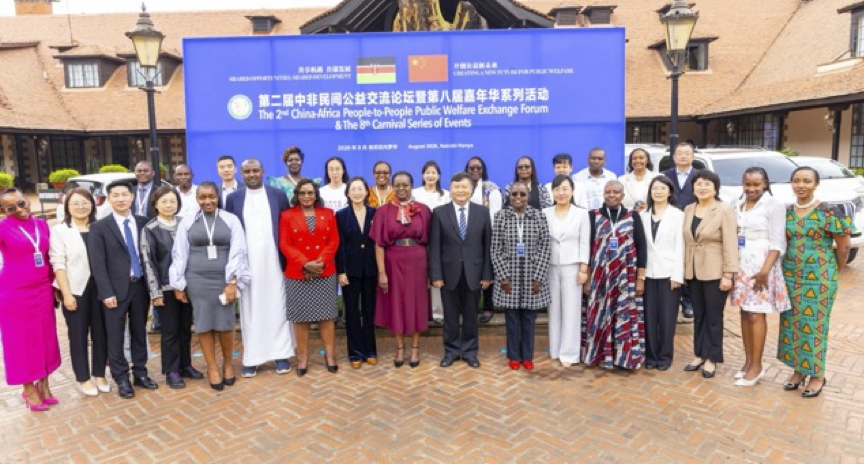
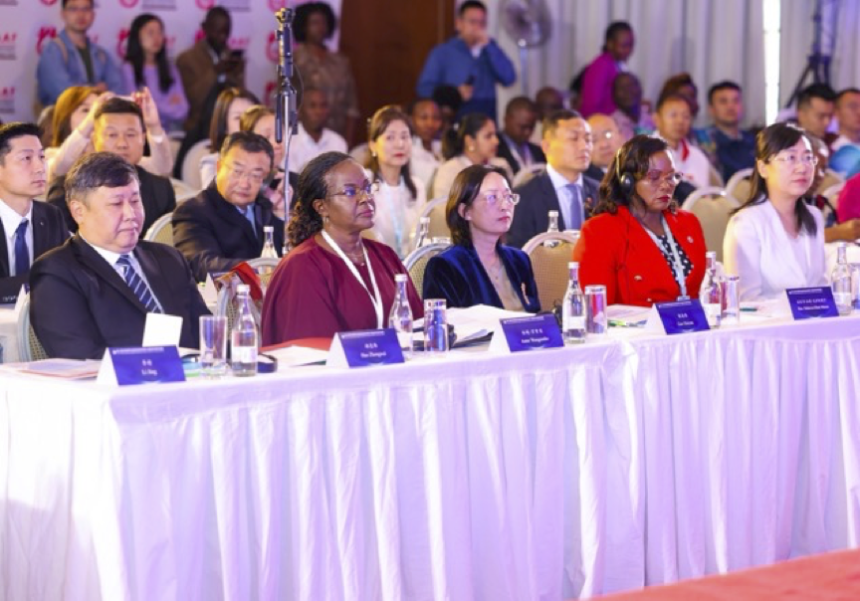
This commitment was made during the Second China-Africa Civil Society Public Welfare Exchange Forum in Nairobi, where over 130 representatives from government, civil society, international organizations, businesses, and media discussed current and future public welfare cooperation.

The forum, themed “Shared Opportunities, Shared Development — Creating a New Future for Public Welfare,” emphasized community-level cooperation as central to China-Africa relations. Speakers highlighted welfare projects as crucial for strengthening people-to-people exchanges, with officials and civil society leaders calling for stronger partnerships to translate bilateral friendship into tangible improvements in people’s lives.
Hao Zhongwei, Secretary-General of the Chinese People’s Association for Friendship with Foreign Countries, stated that public welfare initiatives effectively transform people-to-people diplomacy into direct community benefits.
“Welfare projects are an important carrier of people-to-people exchanges,” Hao said, noting that the Forum on China-Africa Cooperation (FOCAC) has already implemented numerous practical, livelihood-oriented, and quick-impact projects across Africa.
Hao stressed that future cooperation should prioritize supporting key groups, responding to local needs, and strengthening experience sharing to ensure long-term sustainability.
“We should jointly create more platforms for women, children, and other key groups to develop, excel, and thrive, so that their rights and interests are better protected, their lives more brilliant, and their well-being further enhanced,” Hao said.
He also emphasized that cooperation should be rather than follow a one-size-fits-all model. model.
“Africa is a vast continent with diverse endowments and varied aspirations. We should adopt tailored approaches and carry out projects that deliver tangible benefits to Chinese and African peoples and continuously enhance their sense of fulfillment and connection,” he said
Anne Wang’ombe, Kenya’s Principal Secretary in the State Department for Gender and Affirmative Action, noted that the forum signifies an evolution in China-Africa relations beyond conventional economic cooperation towards people-centered partnerships.
She stated that sustainable development must be measured by its impact on people, particularly women, children, and youth. Wang’ombe identified women’s economic empowerment, youth development, child protection, menstrual health and dignity, community resilience, skills development, innovation, digital inclusion, and climate resilience as key areas for lasting China-Kenya cooperation.
Recognizing that the government cannot achieve these objectives alone, Wang’ombe called for stronger collaboration among government, civil society, development partners, academia, philanthropy, businesses, and communities.
“Today’s complex development challenges require us to move beyond isolated interventions toward co-created solutions built on partnership, shared responsibility, and mutual respect,” she asserted.
Wang’ombe welcomed growing cooperation between Kenya’s National Government Affirmative Action Fund (NGAAF) and Chinese institutions, citing several partnerships emerging from their engagement.
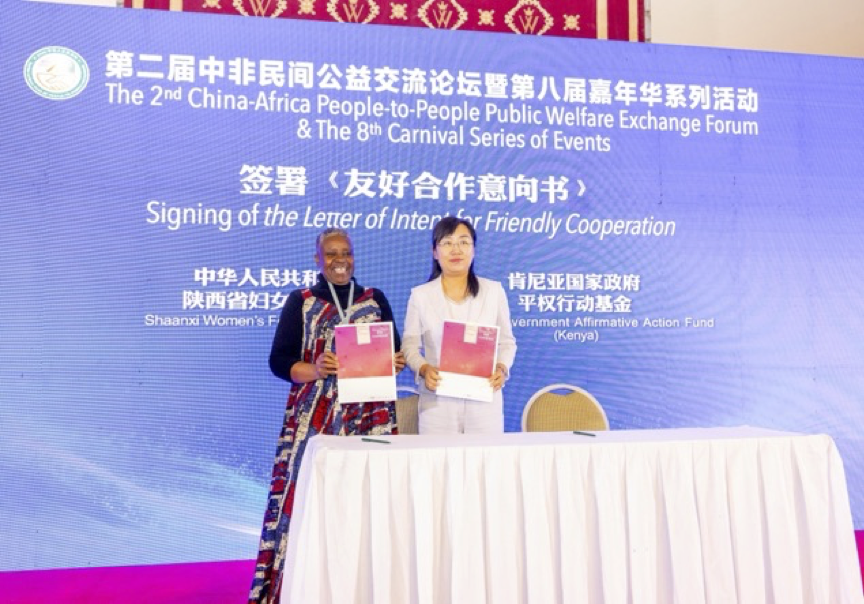
The Shaanxi Provincial Women’s Federation and NGAAF signed a Letter of Intent for Friendly Cooperation, while the Shaanxi Women Entrepreneurs Association, Shaanxi International Exchange Center for Women and Children, and Kenya’s Dream Building Service Association (DBSA) launched the “Mama to Rescue — Women’s Empowerment Workshop” project.
The Xi’an Women Entrepreneurs Association, Shaanxi International Exchange Center for Women and Children, and DBSA also signed an agreement to establish a Children’s Reading Corner in Nairobi’s Mathare community.
Furthermore, the China-Africa Business Council and DBSA signed a Strategic Cooperation Framework Agreement for a malaria prevention and control project.
Yang Le, Vice Chairperson of the Shaanxi Provincial Women’s Federation, stated that the initiatives reflect a broader Chinese commitment to projects that directly address community needs, with women and children remaining central to China-Africa people-to-people cooperation.
“The vision of building a China-Africa community with a shared future has taken deep root among our peoples. Exchanges involving women and children have consistently been among the warmest, most vibrant, and most meaningful dimensions of people-to-people friendship between China and Africa,” Yang said.
She affirmed Shaanxi’s commitment to expanding cooperation with African partners through its “Silk Road at Our Fingertips” initiative, which has facilitated exchanges with hundreds of representatives from over 20 African countries.
Since 2024, the province has collaborated with Kenyan organizations to implement women’s empowerment workshops and children’s reading corners in Nairobi’s Mathare community.
“These programmes help women acquire practical skills and increase their incomes, while also helping children pursue their dreams and grow up in good health,” Yang said.
Chinese Ambassador to Kenya Guo Haiyan underscored the vital role of civil society organizations, women and youth groups, and businesses alongside government-to-government cooperation.
She noted that these non-governmental actors can operate with greater flexibility at the grassroots level, remaining close to communities and directly responding to people’s needs.
“They are an important complement to government-to-government cooperation and an indispensable force in taking China-Africa cooperation deeper and making it more substantive and effective,” Guo explained.
The ambassador also highlighted the growing contributions of Chinese enterprises in Kenya to employment, livelihoods, and community development through initiatives in education, skills training, digital empowerment, and healthcare.
Li Jing, Deputy Secretary of the Xi’an Municipal Party Committee, emphasized public welfare as an essential component of modern urban governance and a key means of improving social well-being.
She noted Xi’an’s extensive volunteer network, with over 2.3 million registered volunteers and more than 15,000 volunteer service organizations and expressed the city’s desire to expand international cooperation in public welfare, including its partnership with Kenyan organizations in Mathare.
“Projects such as this are small in scale but meaningful in impact. By focusing on practical community needs, they demonstrate how public welfare initiatives can bring warmth across mountains and seas and connect the hearts of people in our two countries in the simplest and most sincere ways.” she said.
Both sides committed to expanding international volunteer programs, with Yang announcing that more young Chinese volunteers would be recruited and trained to work in Kenya and Uganda through knowledge sharing, technical assistance, and material support.
The forum also showcased case studies on government welfare programs, corporate social responsibility, women and children’s development, and community-based interventions, illustrating how public, private, and civil society actors can combine resources to address social challenges.
Chinese state and non-state actors noted that these initiatives deepen the people-centered dimension of engagement with Kenya and Africa, providing mechanisms for bilateral relations to be experienced directly at the community level.
Transsion Holdings also presented DBSA with a plaque recognising it as a “Long-term Impact Partner for Sustainable Community Development in Africa.”
The event was designated by China’s Ministry of Foreign Affairs as a flagship activity for 2026, marking the “China-Africa People-to-People Exchange Year,” building on the inaugural forum to strengthen the platform for China-Africa civil society cooperation.