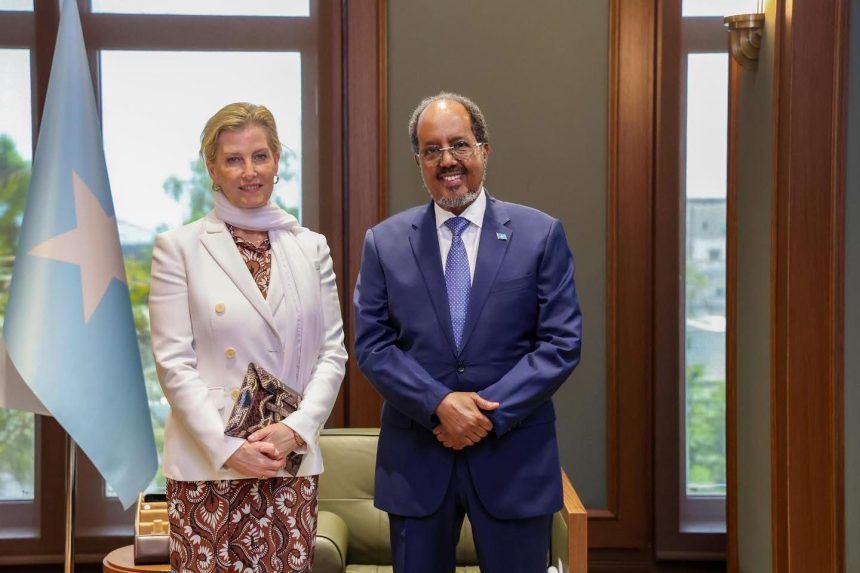
The Duchess of Edinburgh Sophie Hellen has welcomed Somalia’s Women, Peace and Security National Action Plan and pressed for its sustained implementation.
Arriving in the Somali capital on Sunday, February 22, 2026, for a two-day engagement, the Duchess brought renewed international attention to women’s role in peacebuilding and the fight against conflict-related sexual and gender-based violence in the Horn of Africa.
The Duchess has in recent years emerged as one of the most active members of the British Royal Family on issues of conflict-related sexual violence a cause she has championed across Africa including in the Democratic Republic of Congo and South Sudan.
The Duchess’s visit, timed just ahead of International Women’s Day on 8th March, highlights Somalia’s rising diplomatic profile.
During the visit, she held talks with President Hassan Sheikh Mohamud, touching on the critical role of women in peacebuilding, community resilience and the need for accountability for perpetrators of sexual and gender-based violence (GBV).
The Duchess also welcomed Somalia’s Women, Peace and Security National Action Plan and pressed for its sustained implementation
Equally significant was the Duchess’s meeting with Jihan Abdullahi Hassan, Somalia’s first daughter, at Uganda House within the Villa Somalia compound, where they heard first-hand accounts from survivors of gender-based violence perpetrated by al-Shabaab militants.
The Duchess also travelled to a village in Lower Shabelle, where wives of Somali soldiers described the dangers posed by al-Shabaab to their husbands and families..
The visit also showcased the scale of British investment in Somalia’s development.
A UK-funded sexual and reproductive health programme spanning 39 facilities across five regions and run by the International Rescue Committee has reached nearly 130,000 women and girls since 2024.
Civil society organisations including the Ifrah Foundation, ALIGHT’s Somali Women’s Leadership Initiative and the Somali Women Study Centre briefed the Duchess on how conflict, drought and scarce resources continue to drive gender-based violence.
Her presence in Somalia a country still ravaged by conflict, drought and the terror of al-Shabaab was not merely symbolic.
For the hundreds of thousands of Somalis living across the border in Kenya, the broader East African community and the 1.7-million-strong Somali diaspora watching closely, it was a moment of rare international recognition.
Somalia’s growing influence across East Africa is visibly felt in Kenya where Nairobi’s Eastleigh neighbourhood known across the continent as “Little Mogadishu” is a thriving centre of Somali enterprise, with an estimated annual turnover running into billions of shillings.
In north-eastern Kenya, the Dadaab refugee complex remains one of the world’s largest, sheltering hundreds of thousands of Somalis whose ties to the homeland remain deep and active.
Kenya also continues to contribute troops to regional stabilisation efforts in Somalia.