National Assembly Speaker Moses Wetang’ula has thrown his weight behind sugarcane farmers opposing proposed amendments to the law governing the sugar sector, assuring them that Parliament will protect reforms aimed at empowering growers and reviving the industry.
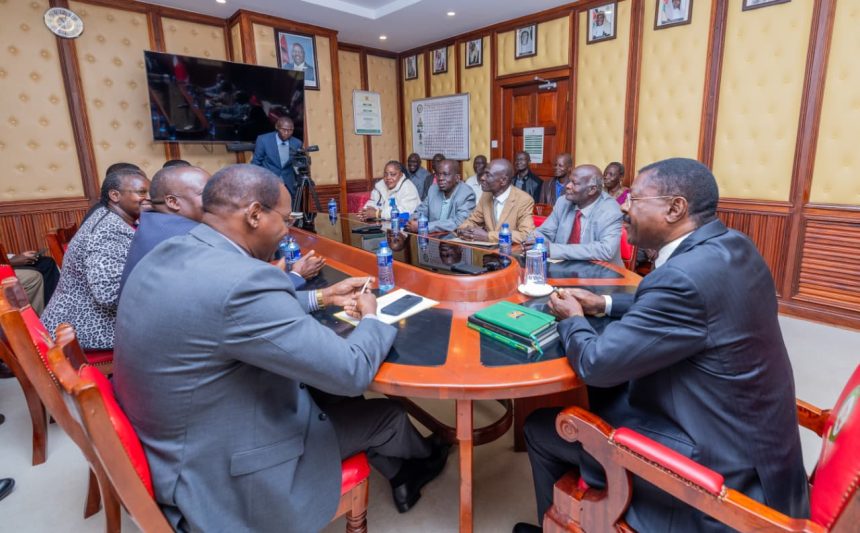
Meeting officials of the Kenya National Federation of Sugarcane Farmers (KNFSF), led by Chairman Ezra Okoth and Secretary General Kilion Osur at Parliament Buildings on Wednesday, the Speaker also challenged the federation to intensify its campaign against what he termed reckless sugar imports, warning that they threaten the gains made in reviving local sugar factories.

The farmers’ delegation petitioned Parliament to reject provisions in the Crops Laws (Amendment) Bill, 2026 arguing that the proposed changes would weaken farmer representation and deny growers control over institutions created to safeguard their interests.
Osur said the federation’s main concern was a proposal to replace elections of growers’ directors with appointments.
“The Sugar Act is very clear that growers’ directors should be elected by farmers. We cannot accept a system where they are appointed,” he said, arguing that if appointments were considered appropriate, legislators should first amend the Constitution to allow Members of Parliament to be appointed rather than elected.
He, however, disclosed that the matter had largely been overtaken by events after consultations with Agriculture and Livestock Development Cabinet Secretary Mutahi Kagwe, during which both sides agreed that elections for growers’ representatives to the Kenya Sugar Board would proceed.
According to Osur, the election date is expected to be gazetted, with farmers agreeing to hold the polls on *September 5, 2026* after allowing the statutory period for public notice and candidate vetting.
He said the elections would finally put to rest claims that farmers were unable to elect their own representatives because of endless court cases.
“The law requires elections, and that is what we are going to do. Once farmers elect their representatives, there will be no justification for changing the law to allow appointments,” he said.
Osur further alleged that repeated court cases delaying elections had been sponsored by vested commercial interests rather than ordinary farmers.
“No genuine farmer can spend more than Sh100,000 pursuing court cases. Those cases have been driven by powerful investors with interests in the sector,” he claimed.
The federation also opposed another proposal in the Crops Laws (Amendment) Bill that seeks to transfer the Sugar Development Levy (SDL) to the Commodities Fund.
Osur argued that sugarcane farming requires a dedicated financing mechanism because of the long crop maturity period of between 18 and 24 months.
He said previous attempts to channel farmers through the Agricultural Finance Corporation (AFC) had failed because of strict lending conditions, including demands for title deeds and monthly loan repayments that do not match the sugarcane production cycle.
“We want the levy to remain under the Sugar Development Levy account to finance sugar sector development directly. Taking the money to the Commodities Fund will only make it more difficult for farmers to access affordable financing,” he said.
Central Rift representative Lazarus Rono urged Parliament to shield the industry from cartels he said were attempting to reverse reforms introduced under the Sugar Act.
He said the sugar sector remained attractive because of its profitability, making it vulnerable to vested interests seeking to control farmer institutions and resources.
Rono also called for official recognition of the Kenya National Federation of Sugarcane Farmers as the umbrella body representing growers nationwide, saying multiple organisations claiming to speak for farmers had weakened unity in the sector.
Responding to the concerns, Wetang’ula said the current Sugar Act reflected Parliament’s intention and had been assented to by President William Ruto without reservations.
“If the President had any reservations, he would have returned the Bill to Parliament with a memorandum. The law therefore remains exactly as Parliament passed it,” the Speaker said.
A sugarcane farmer himself, Wetang’ula said he had confidence in the ongoing reforms, noting that struggling state-owned sugar factories such as Nzoia, Mumias and Chemelil were gradually returning to production after years of decline.
He directed the National Assembly Departmental Committee on Agriculture to summon the Agriculture Cabinet Secretary to confirm the agreed election timetable and ensure the process proceeds without interference.
The Speaker also challenged the federation to broaden its advocacy by confronting illegal and excessive sugar imports, saying they remain the biggest threat to the industry’s recovery.
“One important issue I did not hear you mention is reckless sugar importation, which is choking our local sugar industry. As the apex body representing sugarcane farmers, you must become the strongest voice in protecting farmers’ interests,” he said.
Wetang’ula warned that imported sugar depresses local sales, leaving millers unable to pay farmers, workers and suppliers on time.
“When mills process and sell sugar, farmers are paid. But when warehouses are full because of imported sugar, the entire payment chain collapses,” he said.
He expressed optimism that reforms undertaken over the past two years would enable Kenya to meet most of its domestic sugar demand, saying rogue importers should not be allowed to undermine those gains.
The Speaker assured farmers that Parliament would resist any legislation that weakens the sugar sector, pledging to work closely with the federation to ensure successful elections of growers’ representatives and protection of farmers’ rights.
“Our priority is to protect the farmer and secure the future of Kenya’s sugar industry,” he said.