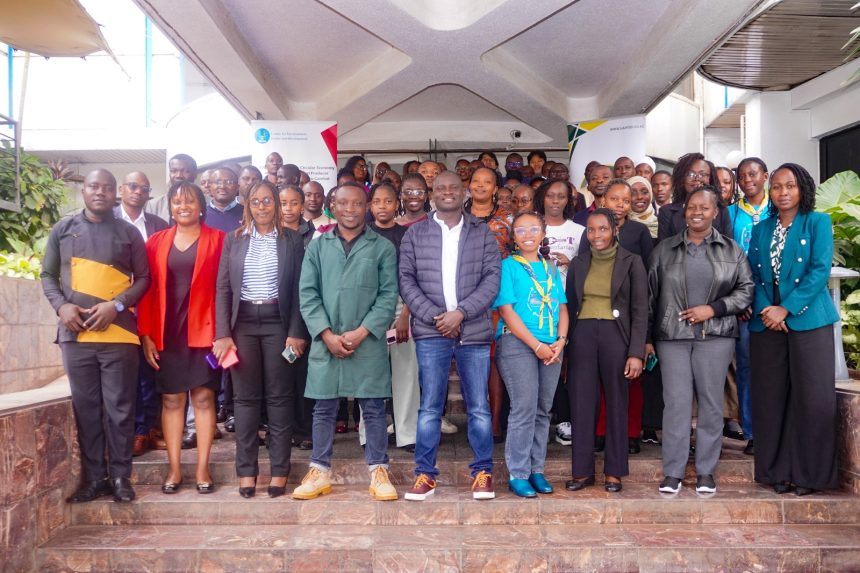
Stakeholders have called for sustainable and inclusive waste management systems, alongside the effective implementation of existing waste management laws, including the Extended Producer Responsibility (EPR) framework, as critical measures in addressing climate change and pollution in Nairobi County.
The call was made during a multi-stakeholder forum jointly convened by the Nairobi City County Government (NCCG) and the Centre for Environment Justice and Development (CEJAD), ahead of this year’s World Environment Day, which emphasizes the need for accelerated action to tackle pressing environmental and climate challenges globally.

Participants at the forum stressed the importance of stronger collaboration, innovation and inclusive approaches to address the city’s growing waste management challenges while protecting both people and the environment.
Speaking during the forum, NCCG Assistant Director for Environmental Monitoring, Compliance and Enforcement, Christine Mwende Kivuva, emphasized that waste management requires collective action from all sectors of society.
“Waste management is a shared responsibility. The national and county governments, communities, private sector actors, Producer Responsibility Organizations, and waste pickers all have a critical role to play in building sustainable waste management systems and enhancing the county’s resilience to environmental and climate-related challenges,” said Kivuva.
She noted that Nairobi, like many rapidly growing cities, continues to face mounting solid waste management challenges driven by increased waste generation, pressure on infrastructure, and changing weather patterns. According to Kivuva, these factors are intensifying environmental degradation and climate-related risks across the city.
CEJAD Executive Director Griffins Ochieng’ highlighted the disproportionate impact of poor waste management on vulnerable populations, particularly communities living near dumpsites, waste workers, women, children, and low-income households.
“The impacts of poor waste management are not experienced equally. Communities living near dumpsites, waste workers, women, children, and low-income households often face the highest exposure to pollution and its health consequences,” Ochieng’ said.
He further pointed to organic waste as a major yet often overlooked contributor to greenhouse gas emissions. Organic waste disposed of in dumpsites decomposes and releases methane, a potent greenhouse gas that significantly contributes to global warming.
Ochieng’ noted that waste segregation at source and zero-waste solutions such as composting offer practical opportunities to reduce methane emissions and support climate mitigation efforts.
He added that transitioning to a non-toxic circular economy, where waste is minimized and materials are recovered and reused, would not only reduce environmental pollution, but also improve resource efficiency and strengthen the implementation of existing waste management laws, including the EPR framework.
On the county’s plans to strengthen waste management, Lawrence Mwangi, Assistant Director of Environment at NCCG, revealed that Nairobi County is currently developing a Sustainable Waste Management Policy.
The policy is expected to align with national legal and policy frameworks while enhancing waste management systems within the city.
Mwangi called on stakeholders to collaborate with the county government in implementing the policy and advancing sustainable waste management solutions.
The forum concluded that Nairobi’s transition towards sustainable waste management is not only essential for effective urban governance, but also a critical component of Kenya’s broader efforts to combat climate change, reduce pollution and achieve sustainable development goals.