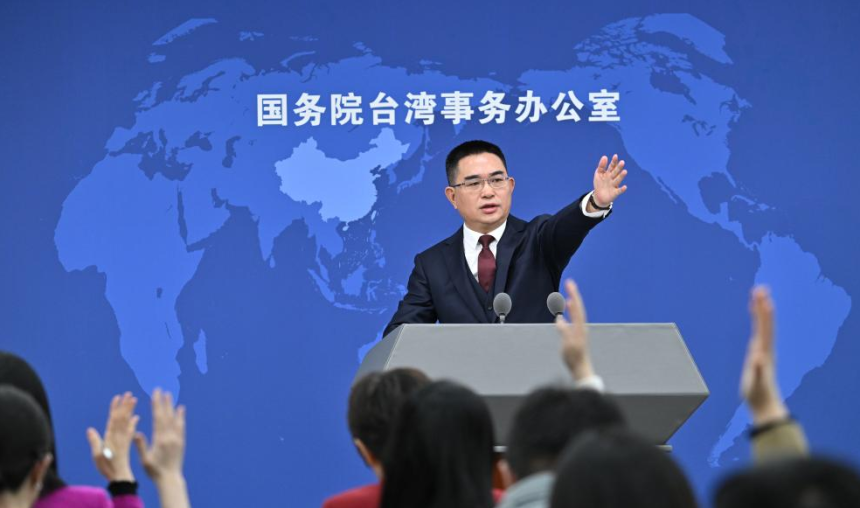
Chinese mainland officials have strongly reiterated the One China principle, insisting that Taiwan is an inalienable part of China and warning that any attempts to pursue “Taiwan independence” will ultimately fail.
Addressing a media briefing, Chen Binhua, spokesperson for the Taiwan Affairs Office of the State Council, stated that no political strategy or narrative promoted by Taiwan’s Democratic Progressive Party (DPP) could alter what Beijing describes as the historical and legal reality that both sides of the Taiwan Straits belong to one China.

“There is only one China in the world, and Taiwan is part of China,” Chen said. “Taiwan has never been a country, and it will never become one.”
His remarks came amid growing discussion in Taiwan regarding what some observers describe as a shift in the DPP’s political strategy from openly seeking “de jure Taiwan independence” to promoting what critics term “de facto independence through identity and culture.”
According to reports from Taiwan media outlets UDN and China Times, Chang Ya-ping, director of the Kuomintang’s mainland affairs department, has noted the DPP increasingly using language, education, identity politics, and international messaging to gradually shape public perception in favour of Taiwan independence.
Chen accused the DPP authorities of pursuing “de-sinicization” and promoting what he referred to as “Taiwan cultural independence” in an effort to weaken cultural and historical ties between people on both sides of the Taiwan Straits.
“Driven by separatist motives and political self-interest, the DPP authorities have attempted to distort the national identity of Taiwan compatriots. Such actions that betray one’s heritage and nation are bound to be condemned by history.” Chen said.
He added that Beijing would never tolerate separatist activities aimed at promoting “Taiwan independence.”
“No tricks used by Lai Ching-te and the DPP will work. They cannot change the fact that both sides of the Taiwan Straits belong to one China, nor can they erase the deep influence of Chinese culture on Taiwanese society,” Chen stated.
Chinese mainland officials also stressed that cross-straits reunification remains an inevitable historical trend.
The official asserted that the world recognises only one China, and that Taiwan remains an inseparable part of it despite the current political differences across the Straits.
“While the mainland and Taiwan have yet to achieve complete reunification, the fact that both sides belong to one China has never changed,” he said.
The Taiwan Affairs Office emphasised that people-to-people exchanges are central to cross-straits relations and affirmed that the mainland would continue promoting initiatives aimed at improving understanding, cooperation, and welfare for individuals on both sides.
“The foundation of cross-straits relations lies in the people, and the driving force comes from their aspirations. The achievements of exchanges and cooperation benefit compatriots on both sides of the Straits,” he reiterated.
At the same time, he warned the DPP authorities against attempts to obstruct exchanges and cooperation between the mainland and Taiwan.
“Peace, development, exchange, and cooperation are the shared aspirations of people across the Straits and the mainstream public opinion in Taiwan. Any attempts to undermine such cooperation are doomed to fail,” the spokesperson affirmed.
The Taiwan Affairs Office also commented on the resignation of Taiwanese artist Lin Chi-ling from the board of the Taiwan Creative Content Agency (TAICCA). Lin reportedly stepped down to avoid what she described as “groundless speculation and misunderstandings.”
Chen described her decision as “wise,” arguing that cultural and arts figures in Taiwan should distance themselves from institutions allegedly promoting separatist narratives.
According to Chen, TAICCA has supported film and television productions that “distort history” and exaggerate what he called the “threat from the mainland.” He accused the agency of becoming a political tool used by the DPP authorities to promote “Taiwan independence” through culture and media.
Chen called on people in Taiwan to maintain identification with the Chinese nation and Chinese culture, and to jointly oppose separatist activities.
“We hope compatriots in Taiwan will clearly see the nature of the DPP authorities’ separatist pursuits. Let us stand united to oppose all forms of Taiwan independence and safeguard the common home of the Chinese nation,” he said.
Mainland officials continue to maintain that the peaceful development of cross-Straits relations serves the interests of people on both sides, but insist that any moves toward “independence” cross a red line.