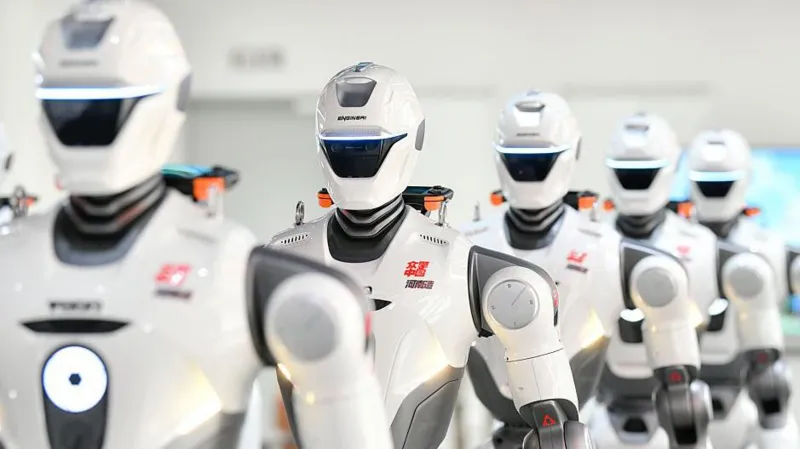
The Trump administration on Tuesday announced a ban on new foreign-made humanoid robot imports to the US over “unacceptable risks” to America’s national security.
The move applies to advanced robots – including humanoid and four-legged machines. Many of them are made in China, which is competing with the US to develop robotics and artificial intelligence (AI).

The Federal Communications Commission (FCC) also banned imports of power inverters – devices used in data centres and solar panels – which it said could also pose a risk to the US economy.
The Chinese embassy in Washington said Beijing has long opposed the US’ “politicising” of trade issues and sanctions based on “groundless pretexts”.
FCC chairman Brendan Carr said the agency was doing its part “to secure America’s critical supply chains”.
The FCC has added the items to its Covered List – a register of goods and services that are deemed a risk to US national security.
The ban applies to new foreign-produced advanced robotic devices and power inverters and does not prevent the sale or import of any existing models that had been previously authorised by the FCC.
The FCC cited concerns that the use of foreign-made inverters could allow overseas firms to turn them off, steal data, facilitate remote access and surveillance by “foreign government actors, or be otherwise exploited through a cyberattack”.
It added that the use of robots made outside the US could allow “malign actors to surveil Americans, enhance the capabilities of foreign intelligence services, or to remotely commandeer the robots”.
The Chinese embassy in Washington also said Beijing will “take all necessary measures” in response to any moves that harm its interests, urging all countries to work together to develop AI “for the positive and for good”.
It called on the US to “abandon its hegemonic mindset, and stop smearing Chinese companies and threatening them with sanctions”.
The BBC has contacted major Chinese robot manufacturers Unitree, UBTech and AgiBot for comment.
China’s exports have come under intense scrutiny by the US as the Trump administration attempts to address trade imbalances with the world’s second largest economy.
Despite being the world’s biggest exporter of electric vehicles, China has been effectively shut out of the American market by a steep tariff.
Washington has also blocked the sale of cutting-edge US semiconductors to China in a bid to protect national security, slow Beijing’s military modernisation and maintain America’s lead in AI.
US Treasury Secretary Scott Bessent has also warned that Chinese AI firms could face sanctions over allegations that they have stolen American intellectual property.
In response the Chinese government has said its country’s development of AI was “the result of its own dedication and effort as well as international cooperation”.
The US will be keen to avoid a repeat of the squeeze on supply chains that was triggered last year when China tightened export controls on rare earths – critical for electronics.
Chinese technology firms have rapidly developed humanoid robots to be used in settings including factories and homes.
Companies have also been quick to market their machines to businesses and the public ahead of US humanoid robot rivals like Elon Musk’s Tesla and Boston Dynamics.