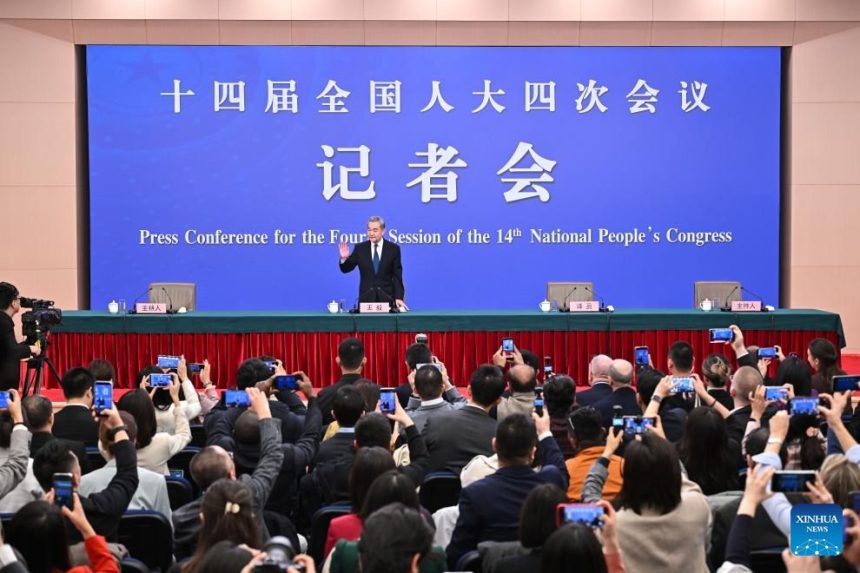
Chinese Foreign Minister Wang Yi has reiterated Beijing’s commitment to enhancing cooperation with developing countries, stressing that China will continue to be a central partner in advancing the interests and development of the Global South.
Speaking at a press conference in Beijing on Sunday, Wang Yi stressed that China’s political identity and strategic perspective are closely linked to developing nations.
“China’s heart is with the Global South; China’s root is in the Global South. We are ready to join hands with other Global South countries to journey on toward modernization and advance the building of a community with a shared future for humanity,” he stated on the sidelines of the Fourth Session of the 14th National People’s Congress.
Wang described the collective rise of the Global South as a defining trend in the international system. He noted that over the past four decades, the share of the global economy represented by developing nations has increased from approximately 24 percent to over 40 percent.
This growth, he explained, has positioned these countries as a significant driver of global economic expansion and a key force in the emergence of a multipolar international order.
However, Wang also cautioned that the international system faces renewed pressures from hegemonism and power politics. In response, he urged developing countries to enhance communication and coordination to defend their legitimate interests and create greater opportunities for independent development.
“The Global South is an emerging, positive force for good on the international stage. In a changing and more turbulent world, we should forge greater confidence and unity, pull together and jointly champion peace, development, cooperation and win-win outcomes,” he said.
Multilateral Cooperation
Wang remarked that a central aspect of China’s approach to engaging with the Global South is its support for multilateral platforms that amplify the voices of developing countries. He highlighted mechanisms such as BRICS, the Shanghai Cooperation Organization, and the Group of 77 as vital forums for collaboration.
Through these institutions, Wang noted, developing countries can coordinate policies, advocate for development priorities, and enhance their influence in global decision-making.
He also underscored China’s commitment to what he termed “true multilateralism,” highlighting the United Nations as the core platform for global governance. He stated that international rules and policies should be developed collectively rather than being dominated by a small group of powerful nations.
Xi’s broader global south vision
The policy direction articulated by Wang aligns with the broader diplomatic agenda of Chinese President Xi Jinping, who has consistently described China as a champion of developing nations.
Xi defines the Global South as a community of countries with shared historical experiences, similar developmental challenges, and common aspirations for modernization.
Together, these nations encompass more than six billion people and have contributed roughly 80 percent of global economic growth over the past two decades.
“China itself remains part of the Global South,” Xi has asserted, despite its rapid economic growth and status as the world’s second-largest economy.
“As a developing country, China breathes the same breath with other developing countries and pursues a shared future with them,” Xi remarked in previous statements.
A key pillar of China’s strategy involves increasing the representation of developing nations in global governance structures.
Xi regards BRICS countries as leading members of the Global South and has advocated for the bloc to serve as a central channel for strengthening solidarity among developing nations.
In recent years, China has supported the expansion of BRICS and promoted the “BRICS Plus” framework, allowing other emerging economies, including those from Africa, to engage in dialogue and cooperation.
Beijing has also backed efforts to enhance the representation of developing regions in other global institutions. At the G20 summit in Bali in 2022, China supported the African Union’s bid for permanent membership in the group.
Beyond diplomacy, China’s engagement with the Global South heavily focuses on development cooperation and infrastructure investment. Xi has argued that development is the “master key” to addressing many global challenges, especially as economic disparities between countries continue to grow.
Through initiatives such as the Belt and Road Initiative, China has financed and built large-scale projects in transportation, energy, and logistics across Asia, Africa, and Latin America.
China has also promoted broader development frameworks, such as the Global Development Initiative, launched in 2021, to accelerate progress toward the Sustainable Development Goals. The initiative has garnered support from over 100 countries and several international organizations.
Poverty reduction and modernization
Xi has pointed to China’s success in eliminating extreme rural poverty as a milestone that could provide valuable lessons for other developing countries.
According to Xi, nations in the Global South should pursue development paths tailored to their unique national conditions rather than adopting uniform models.
He has repeatedly emphasized that no country should be left behind on the road to modernization.