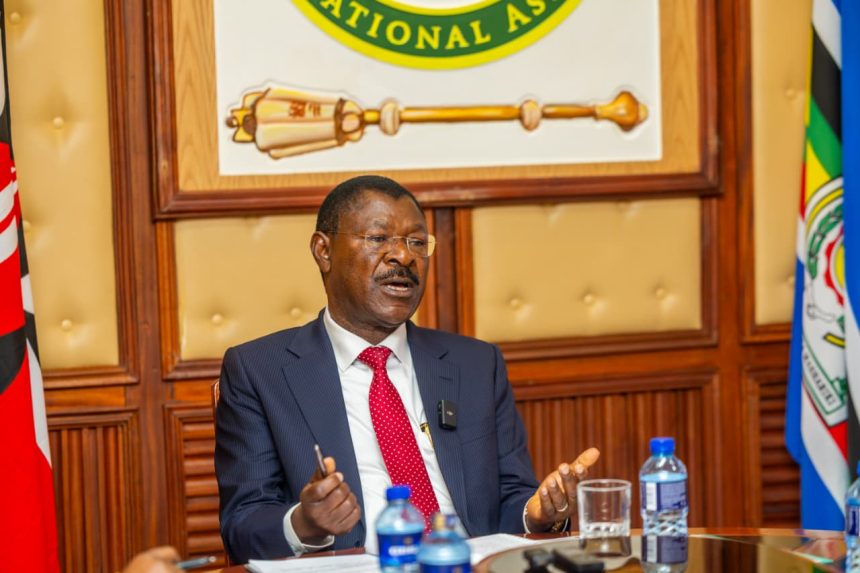
National Assembly Speaker Moses Wetang’ula has challenged the National Cohesion and Integration Commission (NCIC) to regain the trust of Kenyans and play a more active role in promoting national unity throughout the year not just during election periods.
He said the Commission should address the challenges that have affected its work and avoid being seen as an institution that only becomes active during elections.

“NCIC suffers from serious trust issues. The Commission was formed after the 2007 post-election violence to help unite the country and bridge political divisions. It should not only be active during elections,” Wetang’ula said.
The Speaker said continuous civic education is key to changing people’s attitudes and building lasting national unity.
“Changing our mindset through education is far more important,” he said while addressing the Commission led by Chairperson Bishop Kepha Omae at Parliament Buildings on Tuesday.
Wetang’ula said there is nothing wrong with belonging to a particular ethnic community but warned against using ethnicity to divide or discriminate against others.
“There is nothing wrong with belonging to a particular ethnic community. The problem comes when that identity is used to oppress and disadvantage others,” he said.
He urged the Commission to work closely with the Ministry of Education to promote unity among young people.
“Let us help the Ministry of Education build a culture of unity among our children because they are the ones who will shape the future,” he said.
The Speaker also called on NCIC to strengthen its partnership with the Directorate of Criminal Investigations (DCI), the Office of the Director of Public Prosecutions (ODPP), the Judiciary and the Independent Electoral and Boundaries Commission (IEBC) to improve its effectiveness.
“You have the power to investigate, but prosecution is the responsibility of the Director of Public Prosecutions. NCIC must define its role, put its house in order and earn the confidence of Kenyans. Parliament will support the Commission within the law,” he said.
Wetang’ula said elections are a continuous process and not just a one-day event. He urged the Commission to take a leading role in fighting hate speech and leaders who promote division.
“Elections are not just about voting. They are a process, and NCIC has a critical role in protecting communities from hate speech and leaders who spread division,” he said.
NCIC Chairperson Bishop Kepha Omae said the Commission had already started preparing for the 2027 General Election through a roadmap focused on prevention, public engagement and cooperation with other institutions.
“We have a roadmap. We are working with other government agencies and political leaders across the country. Our goal is to reduce political polarisation and ethnic divisions,” Omae said.
He said the Commission would continue engaging political leaders and urging them to conduct themselves responsibly.
“We are asking our leaders to lower the political temperature. We want healthy and peaceful politics,” he said.
Omae added that NCIC would increase its engagement with communities through elders, religious leaders and other opinion leaders while also expanding programmes in schools and other learning institutions.
“We will work with schools and other learning institutions. This roadmap will help us address emerging challenges in our communities,” he said.
NCIC Commissioner Jerusha Mwaathime called for closer cooperation with other government agencies and asked Parliament to strengthen the Commission’s investigative powers.
“We need stronger legal tools to deal with some of the cases we investigate. The Commission’s powers should be expanded to allow more effective investigations,” Mwaathime said.