I came to Beijing expecting to deepen my understanding of governance, leadership, communication and broadcasting through the China International Press Communication Centre (CIPCC) programme. Instead, I have found myself asking a difficult question: What would Kenya, and indeed Africa, look like if public integrity was pursued with the same determination I have witnessed here?
As part of the programme, I have had the opportunity to engage with government officials, academics and media professionals while visiting institutions that shape China’s governance philosophy. Among the many lessons, one has stood out above all others: China’s uncompromising fight against corruption.

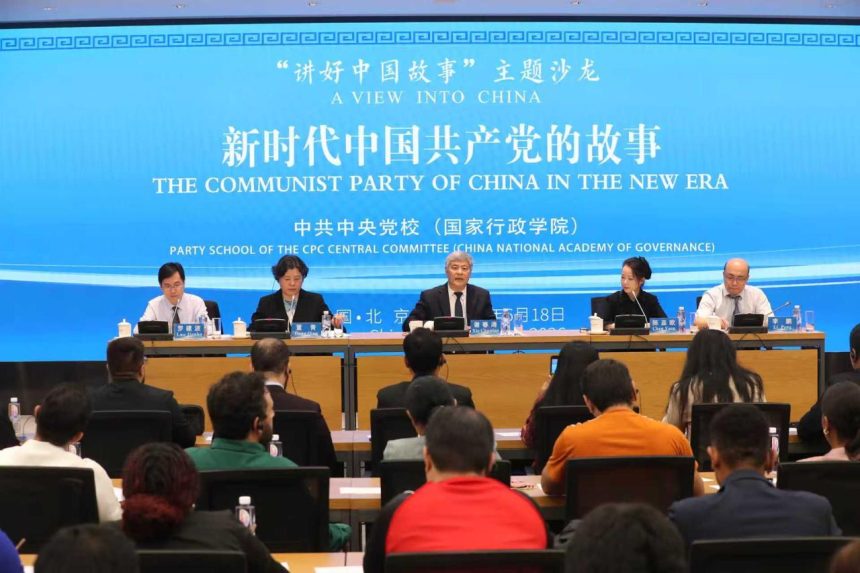
During a recent engagement at the Party School of the Central Committee of the Communist Party of China (CPC), Executive Vice President Professor Xie Chuntao offered a candid account of why President Xi Jinping made the fight against corruption a defining priority after assuming office in 2012.
The Party School is not an ordinary academic institution. It is the highest level training centre for officials and leaders within China’s governance system, where senior cadres are trained in political ideology, discipline, policy implementation and state governance. It plays a central role in shaping how leaders understand responsibility, power and public service.
Professor Xie explained that corruption had reached levels that threatened public confidence in government.
“President Xi believed that if corruption was not addressed in time, the people would eventually abandon the Party,” he told journalists participating in the programme.
That statement has remained with me.
Across Africa, corruption continues to divert resources meant for schools, hospitals, roads and jobs. Kenya has established institutions to fight graft, yet scandals continue to emerge, reminding citizens that the battle is far from over.
China’s experience suggests that defeating corruption requires much more than arrests and public statements.
One of the most striking lessons is that accountability is expected to reach every level of leadership. According to Professor Xie, more than 900 senior officials at provincial level and above have been punished over the past decade, including retired leaders.
“The difference lies in leadership,” Professor Xie said. “If leaders themselves are corrupt, it becomes difficult for them to effectively fight corruption.”
It is a simple observation, yet perhaps one of the most powerful lessons for Africa. Institutions can only be as strong as the integrity of those entrusted to lead them.
Another aspect that surprised me is that China’s understanding of integrity goes beyond financial misconduct.
Officials are expected to maintain high ethical standards in both their professional and private lives. Conduct that could expose an official to blackmail or create conflicts of interest, including undisclosed extramarital relationships, is treated as a disciplinary matter because personal conduct can influence public decision making.
The lesson is that leadership is not judged solely by how public money is managed but also by the character and discipline of those entrusted with public office.
Equally remarkable is the discipline surrounding the use of public resources.
Official delegations are deliberately kept lean. Government funded travel, accommodation and official receptions follow strict regulations designed to eliminate waste and extravagance. Public money is treated as exactly that-money belonging to the people.
Imagine the savings Kenya and many African governments could realise by reducing oversized delegations, unnecessary foreign travel and lavish public expenditure. Those resources could instead finance healthcare, education, infrastructure and employment opportunities for young people.
Professor Xie also emphasised that discipline begins at the top.
“The state is the people, and the people are the state,” he said, echoing President Xi Jinping’s philosophy that leaders exist to serve citizens rather than themselves.
Another lesson Africa cannot ignore is the protection of accountability. Fighting corruption requires citizens, journalists and public officers who can expose wrongdoing without fear. Stronger whistleblower protection laws would encourage transparency and strengthen public confidence in institutions.
China and Kenya operate under different political systems, and no country should simply copy another’s governance model. However, integrity, discipline, prudent use of public resources, protection of whistleblowers and leadership by example are principles that transcend political systems.
As I continue my studies here, at the CPC School of Governance system and beyond,one lesson becomes increasingly clear: governance here is not treated as a technical function alone, but as a structured discipline of leadership formation. Officials are not only trained in policy execution but also in political responsibility, ideological grounding and the ethics of public service. The emphasis is on ensuring that those who govern understand both authority and restraint.
Professor Xie’s words continue to echo in my mind: “If leaders themselves are corrupt, it becomes difficult for them to effectively fight corruption.”
Perhaps that is the lesson Africa, and Kenya in particular, needs most. The fight against corruption will not be won by promises alone. It will be won when integrity becomes the standard, accountability becomes the culture and leadership begins with example.