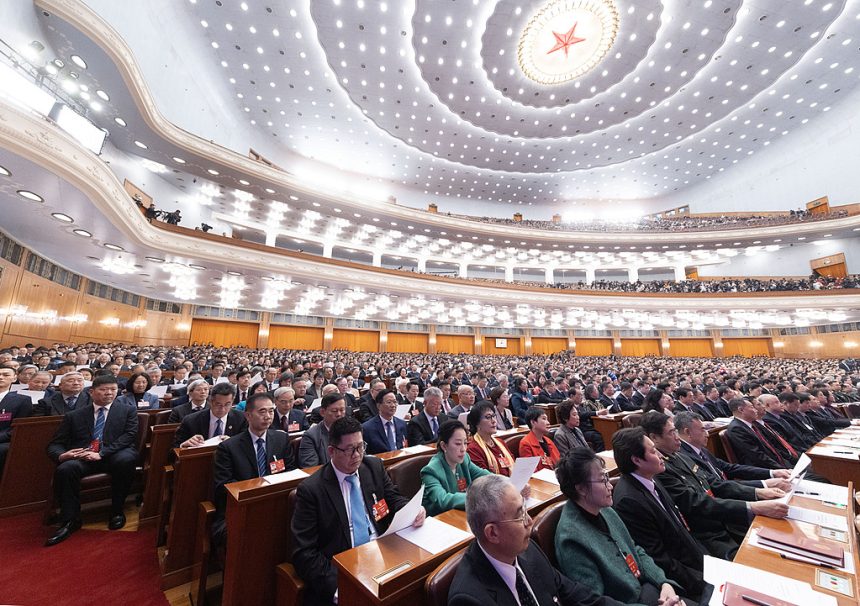
While the world struggles with soaring inflation, waves of unemployment, and broken supply chains, the most valuable message this year’s Two Sessions sent to the world—particularly for developing nations—can be summed up in one word: stability.
China has set a range of economic targets for 2026, the opening year of its next development phase: GDP growth of around 4.5%–5%, the creation of over 12 million new urban jobs, an unemployment rate of around 5.5%, grain output of roughly 700 million tonnes, and inflation kept at approximately 2%. These are not just numbers; they represent China’s commitment to keeping its economic fundamentals steady. This stability benefits not only China but also its trading partners in Africa, Latin America, and South Asia. As long as China’s purchasing power, supply chains, and food prices remain stable, many Global South countries may benefit from reliable export markets, steady domestic prices, and greater investor confidence. In other words, in an era plagued by uncertainty, China’s “predictability” is increasingly seen as a rare public good for the Global South.
A Development Path That is “Replicable and Accessible”
Another major highlight was the release of early policy directions for the 15th Five-Year Plan (2026–2030). This time, China’s development direction is clearly focused on: innovation, digitalization, and green transition. Over the next five years: R&D spending is expected to grow by more than 7% annually; carbon emissions intensity will decline by 17% over the five-year period; and the core digital economy sector will account for 12.5% of GDP. This structural adjustment means that while China upgrades itself, it is also making Chinese technology, equipment, and experience cheaper, more mature, and easier to use. From electric vehicles and solar panels to digital payments and smart logistics, China is seeking to build an “affordable modernization model.” For countries hoping to skip the traditional, high-pollution stages of development, this may offer a far more realistic path.
At the same time, as China’s manufacturing moves up the value chain, some medium-scale industries may begin to relocate abroad. Cooperation between China and Global South nations is upgrading accordingly: it’s no longer just about building roads and bridges, but about co-production, local manufacturing, and green collaboration. South-South cooperation is evolving from simple “project deals” into deep “industrial chain co-construction.” Furthermore, China’s internal focus—”ensuring people live better, prioritizing employment, pursuing green development, and maintaining policy consistency”—is increasingly viewed as a governance model that many nations can study and adapt.
China’s approach, as reflected in this year’s Two Sessions, demonstrates to the world how to chart a clear course amidst global uncertainty. It suggests that even in turbulent times, a nation can sustain growth, upgrade its industries, embrace green transition, and create space for cooperation with the Global South. For developing nations searching for a way forward, this is more than just annual news—it is a real-world case study in progress. While it may not be the only right answer, it serves as a powerful mirror for Global South countries to rethink their own development paths.
Zhao Qian is a journalist for CGTN.