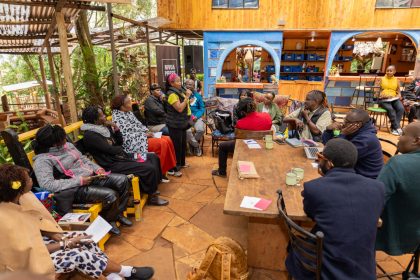
Zippy Kimundu’s sophomore documentary, ‘Widow Champion’, served as the first film screening of the year for the Kamera Kwanza initiative hosted at the Goethe-Institut.
The initiative, Kamera Kwanza, officially formalised in early February by the Goethe-Institut and Docubox, aims to foster and promote a shared love for films and the art of filmmaking, with a particular focus on African documentaries.
Beyond screening important Kenyan films, the initiative also offers an opportunity for the audience to engage with filmmakers, a part of the event that organisers say is “rewarding.”
“What I love most about this film screening series is the intensity of the conversations we have after showing the film. The audience’s questions and remarks strike me as both thoughtful and compassionate,” said Cristina Nord, Director of the Goethe-Institut Kenya. “For the filmmakers, the warm and informed response to their work often triggers a wealth of new ideas and emotions. It is such a rewarding experience!”
Wednesday night’s highlight was the documentary, ‘Widow Champion’ (2025), which highlights the plight and resilience of Kenyan women navigating patriarchal cultural structures.
The film follows Rodah Nafula, a widow and fierce advocate, as she works to empower other women while negotiating the tension between deeply ingrained traditions and a rapidly evolving world.
Speaking about her first encounter with Rodah, the film’s director Zippy Kimudu said her personal experiences drew her to tell this story.
“In Kenya, especially in the rural areas, the issue of land is crucial as people depend on it to earn a living, and to feed and take care of their families,” Zippy said. “Gains have been made to increase legal protections for women to use, own and inherit land, yet entrenched social norms in communities like Rodah’s often trump the law of the land.
“And so, in 2019, when I heard about what was happening with the widows in Kisumu and then met Rodah, we quickly bonded over the work that I was doing around Land Rights – 4 and my personal experience as a teenager, when our family home was burnt down, and we were kicked off our land due to politically-charged unrests.”
The film was selected for the Tribeca Film Festival 2025 in New York, where it had its world premiere and it also premiered in Nairobi on October 23, 2025, in partnership with the Kenya Legal and Ethical Issues Network on HIV (KELIN) and Afro Films International.
Despite its screenings globally, Ms Kimudu believes it is important to tell our own stories.
“As a Kenyan filmmaker whose stories have often been told from the outside, I believe in telling stories from under-represented communities who are doing extraordinary things for themselves,” Zippy says. “ I follow these trend-setters, so that their stories become a catalyst for change and give agency to fellow women.”
She further adds that while it was told from a local perspective, the story is “universal.”
“‘Widow Champion’ has been described as an experimental court drama that is dramatic, human, loving and stirring enough to open hearts in Kenya and around the globe,” Zippy added. “For me, ‘Widow Champion’ is as personal as it is universal, a story and a film that are intricately linked to wherever women’s land rights have been and continue to be denied in many forms.”