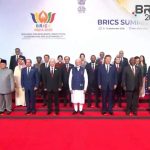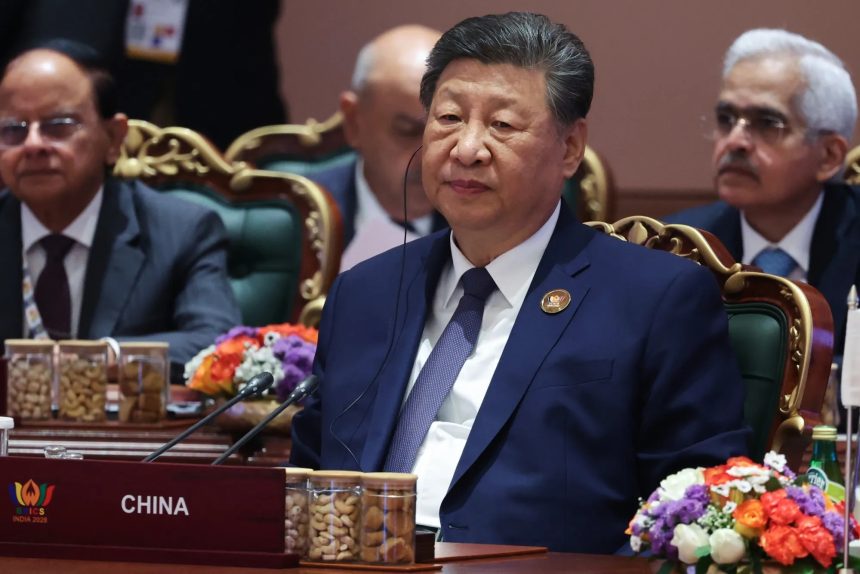
Chinese President Xi Jinping presented five bold proposals at the BRICS Summit in New Delhi on Sunday, aimed at supercharging cooperation among emerging economies and strengthening the economic and technological influence of the Global South.
Speaking at the second session of the 18th BRICS Summit, Xi unequivocally stated that it is time for emerging markets and developing nations to collaborate, stating that BRICS ought to proactively shape a more stable and balanced world order, rather than merely reacting to global issues.

He argued that the rise of the Global South is now the single biggest force driving the world towards multipolarity, a development that is increasingly crucial as geopolitical and economic turbulence escalates.
“To bring stability to the world and make it a better place, BRICS countries must seize the historical initiative, rally the Global South, and be an active, stabilising and positive force in international affairs,” he asserted.
Central to his proposals was a call for greater cooperation in emerging technologies, trade, digital transformation, and skills development.
The first initiative is an open-source and inclusive artificial intelligence (AI) programme, under which China proposes the establishment of a BRICS AI open-source community.
Xi indicated that China would support collaboration in developing and applying large language models, organise specialised AI seminars and training courses, and work towards building an open AI ecosystem.
The second initiative focuses on trade and investment facilitation, including a proposal for a BRICS special economic zone partnership.
Under this proposal, BRICS countries would establish an intelligent portal, coordinate policies, and create what Xi described as a new frontier for open development.
China will also host the BRICS Forum on Trade in Services next year and has extended an invitation to other members to participate.
Xi’s third proposal addresses digital industry cooperation. China plans to advocate for the establishment of a BRICS digital ecosystem cloud platform, while simultaneously expanding digital skills training, technological exchanges, and industrial alignment.
He stated that the initiative would help countries jointly develop their digital economies.
The fourth initiative targets intelligent manufacturing. China is offering to assist fellow BRICS countries in developing smart factories and establishing standards and norms to support the transformation and upgrading of manufacturing processes.
The fifth proposal centres on science and technology talent development. Xi proposed establishing a BRICS engineer cultivation alliance to jointly develop engineers and promote mutual recognition of competency standards. China will also launch a BRICS youth exchange programme specifically focused on scientific and technological innovation.
Collectively, these initiatives, according to Xi, aim to expand BRICS cooperation beyond traditional economic and trade ties to encompass technology, industrial development, innovation, and human capital.
Xi also used the summit to advocate for a stronger collective voice for developing countries within global institutions.
He urged Global South countries to uphold sovereign equality, non-interference in internal affairs, and the peaceful settlement of disputes, while insisting that international law should be applied without double standards.
“A world without rules is like a crossroads without traffic lights, where chaos and disorder are all but guaranteed,” Xi remarked.
He called for greater authority for the United Nations and reforms to multilateral institutions to ensure developing countries have increased participation in international decision-making.
Xi also called for reforms to the World Trade Organization and the international financial architecture, arguing that developing countries should have greater representation and a stronger voice.
Xi stated that BRICS countries should maintain a people-centred approach and work towards the UN 2030 Agenda for Sustainable Development. He highlighted China’s Global Development Initiative, noting that it has resulted in over 2,000 projects implemented in partnership with other countries over the past five years, alongside training for more than 200,000 professionals in over 120 countries.
Xi also drew attention to China’s expanding trade access for developing countries, stating that Beijing has granted zero-tariff treatment to all 53 African countries with which it has diplomatic relations.
On global challenges, he called for closer cooperation on traditional and non-traditional security threats, climate change, and artificial intelligence.
He urged countries to fully implement the Paris Agreement and called for a consensus-based framework for global AI governance, arguing that AI should be developed and used “for the positive and for good.”
Xi concluded by stating that China’s own development plans would remain closely linked to international cooperation.
He said that China’s 15th Five-Year Plan, launched this year, should be viewed not only as a blueprint for the country’s economic and social development but also as a “cooperation list” for the rest of the world.
He pledged that China would continue to expand high-standard opening up, implement the Global Development Initiative, and advance high-quality Belt and Road cooperation. Xi said BRICS countries should work collectively to deepen cooperation and strengthen the Global South.