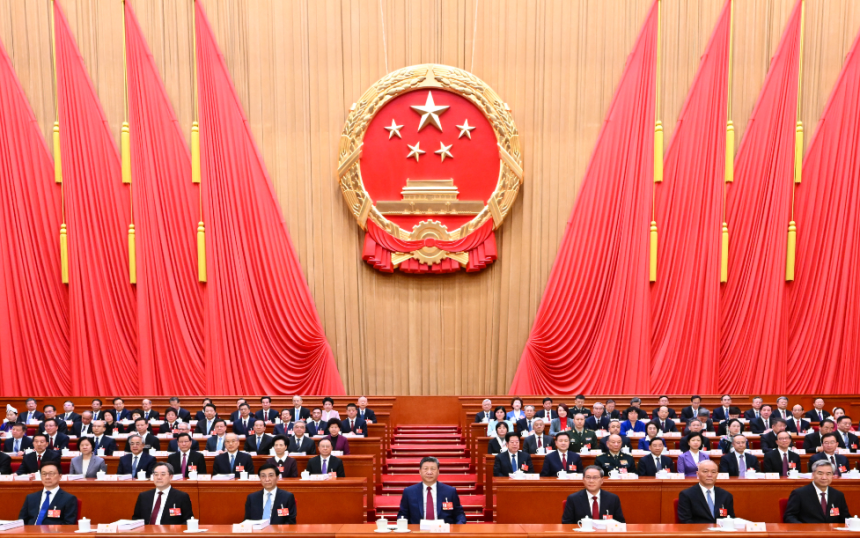
China’s annual “Two Sessions” officially commenced in Beijing on Thursday, marking the beginning of the fourth session of the 14th National People’s Congress. The session gathers national leaders and lawmakers to review the government work report, deliberate legislation, and set the development agenda for the coming years.
The opening meeting took place at the Great Hall of the People, attended by key figures including President Xi Jinping and senior officials from the Communist Party of China and the state.

In keeping with tradition, Premier Li Qiang presented the government work report, detailing economic priorities and laying out key development targets for the 2026–2030 period. According to a statement released after the session, lawmakers reviewed a draft outline of China’s 15th Five-Year Plan for national economic and social development, which will guide the country’s economic transformation and social policy direction over the next five years.
The report states that China aims to maintain GDP growth within an appropriate range during the 2026–2030 period, with annual targets adjusted according to prevailing economic conditions. The growth trajectory is designed to support the long-term goal of doubling per capita GDP from 2020 levels by 2035, allowing China to achieve the status of a moderately developed economy.
The development framework emphasizes innovation-driven growth and green transformation. The government plans to increase nationwide research and development spending by at least seven percent annually over the next five years. At the same time, policymakers aim to reduce carbon dioxide emissions per unit of GDP by approximately 17 percent during this period, reflecting China’s commitment to enhancing energy efficiency and advancing low-carbon development.
The report anticipates that core digital economy industries will represent about 12.5 percent of national GDP by the end of the five-year period. In addition to economic modernization, the government outlined social development goals, including raising the national average life expectancy to 80 years.
To facilitate these priorities, the report proposes 109 major national projects across six strategic areas. These initiatives will focus on strengthening advanced manufacturing and innovation capabilities, promoting what policymakers term “new quality productive forces,” enhancing infrastructure and digital transformation, and improving public services and social welfare systems.
During the legislative session, lawmakers also reviewed reports on the implementation of the current national economic and social development plan and discussed draft targets for the upcoming fiscal cycle, including proposals related to central and local government budgets. Additionally, legislative proposals were introduced for an environmental code, a law to promote ethnic unity and progress, and a law governing national development planning.
The annual Two Sessions, which combine the meetings of the national legislature and the country’s top political advisory body, serve as a crucial platform for evaluating economic performance, approving major policy initiatives, and shaping China’s governance and development agenda for the year ahead.