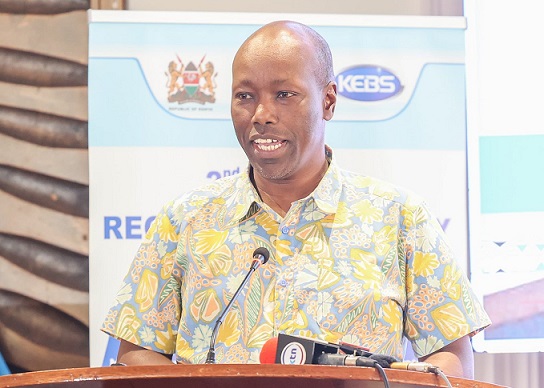
Trade Cabinet Secretary Lee Kinyanjui has called for the mainstreaming of metrology, the science of accurate and reliable measurement, across health, manufacturing and trade sectors to strengthen consumer protection and drive regional economic growth.
Speaking during the official opening of the East African Metrology (EAMET) Regional Conference in Mombasa, Kinyanjui underscored the importance of harmonised measurement systems as the backbone of fair trade, reliable healthcare and competitive industries.

The conference, held under the theme “Mainstreaming Metrology in Health, Manufacturing, and Trade to Enhance Consumer Protection,” has brought together experts, policymakers and stakeholders from East African Community (EAC) partner states and international organisations.
Kinyanjui highlighted the critical role of metrology in advancing the EAC Vision 2050, which seeks to transform the region into an upper-middle-income bloc within a secure and politically united East Africa.
He noted that Article 81 of the EAC Treaty and the EAC Standardisation, Quality Assurance, Metrology and Testing (SQMT) Act, 2006, recognise harmonised measurement systems as essential for a functional single market. Ongoing reforms to split the SQMT Act into separate laws covering standardisation, accreditation, conformity assessment and metrology are expected to further strengthen the legal framework.
The Cabinet Secretary also pointed to the African Continental Free Trade Area (AfCFTA), which creates a market of more than 1.4 billion people with a combined GDP exceeding $3.4 trillion. He noted that Annex 6 on Technical Barriers to Trade emphasises cooperation in metrology to facilitate intra-African trade through mutual recognition of calibration certificates and alignment with international standards.
“Accurate measurement systems are prerequisites for effective regulation, seamless trade and the protection of citizens. For EAC products to competitively access the AfCFTA market, our metrology infrastructure must meet global standards,” said Kinyanjui.
He further linked metrology to Africa’s development blueprint, Agenda 2063, noting that aspirations for inclusive growth, sustainable development and world-class infrastructure depend on strong quality systems.
National Standards Council Chairman Chris Wamalwa reaffirmed the government’s commitment to advancing measurement science as a pillar of consumer protection and national development.
He emphasised the need to strengthen laboratory capacity, accreditation systems and technical expertise to support healthcare through reliable measurements.
“Metrology ensures safe medicine, compliant products and fair transactions. Investing in it is investing in human life,” said Wamalwa.
Kenya Bureau of Standards Managing Director Esther Ngari illustrated the practical impact of metrology on everyday life.
She cited examples such as calibrated fuel pumps for boda boda operators, accurate medical devices for maternal and child healthcare, and precise tools that enable farmers and exporters to secure fair prices and access markets.
“Metrology must move beyond laboratories into the marketplace. It determines correct medicine dosages, fair produce pricing and confidence in exports across the region,” said Ngari.
She highlighted KEBS’ role as the custodian of national measurement standards, offering accredited calibration services recognised internationally through published Calibration Measurement Capabilities on the BIPM Key Comparison Database.
Ngari called for sustained collaboration among national metrology institutes, regulators, industry players and development partners to strengthen regional capacity through EAMET, AFRIMETS and partners such as Germany’s PTB.
The four-day conference, running from March 16 to 19, has brought together delegates from EAC partner states including Kenya, Tanzania, Uganda, Rwanda, Burundi, South Sudan and Somalia, alongside international partners.