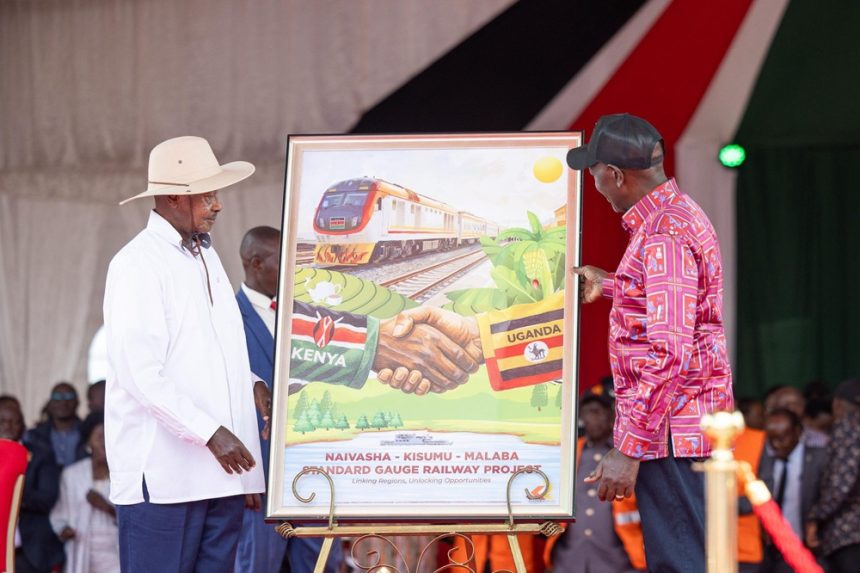
Presidents William Ruto and Yoweri Museveni of Uganda launched the construction of the 107km Kisumu-Malaba section of Standard Gauge Railway (SGR) on Saturday.
President Ruto described the infrastructure project as key to strengthening regional connectivity and trade within East Africa.

He pointed out that the region faces an urgent transportation challenge that needs to be urgently addressed.
“Our economies are not generating sufficient opportunities to match the pace of our rapidly growing populations. At the same time, our businesses continue to grapple with high logistics costs that undermine competitiveness,” he said.
The President announced that to make the railway an economic asset in the region, two special economic zones would be in Kisumu and Busia.
Additionally, an 8.7km railway line would be extended to Kisumu Port.
Explaining the role the new railway will play in reducing the costbof doing business, President Ruto said transport and related costs account for between 30 and 40 per cent of the final value of goods. On its part, cargo takes 80 hours to move from Mombasa to Malaba, and more than 100 hours to reach Kampala.
“We cannot build prosperity on inefficiency. That is why we must invest in modern, efficient transport and connectivity systems not only as transport corridors, but also as economic corridors,” President Ruto said.
The President said the planned extension of the SGR from Uganda to the Democratic Republic of Congo, South Sudan, Rwanda, Burundi and Central Africa Republic will further unlock regional opportunities, stimulating fresh waves of economic activity and deepening integration in our region.
Recalling the role the old Kenya-Uganda Railway, traversing the country from Mombasa to the Western part of the country and into Uganda, played in the economy and growth of thriving urban centres and cities, he pointed out that the new infrastructure would surpass the colonial railway.
“As we launch the Kisumu-Malaba section of the SGR, we are confident that this modern infrastructure will replicate and surpass that legacy by igniting new growth corridors,” he added.
He said the project, which will run from Kisumu to Malaba, marks a significant milestone in Kenya’s plan to extend the railway to the border and eventually link it with Uganda’s rail network.
On his part, President Museveni described the extension of the SGR as an important step in operationalising regional cargo transport.
He said continued reliance on road freight for heavy goods and petroleum would not be ideal and was a burden to the economy, manufacturing and other businesses.
He rooted for affordable transport, electricity, and access to credit, saying they are the cornerstone of any economy.
“High costs in transport, electricity, and finance have kept Africa import-oriented,” President Museveni explained.
The construction of SGR began in 2014 when Kenya built the sections from Mombasa to Nairobi and Nairobi to Narok.
Last Thursday, President Ruto launched the extension of the 264km railway from Narok to Kisumu at a colourful ceremony.
Other leaders who spoke at the function were Prime Cabinet Secretary Musalia Mudavadi, Roads and Transport Cabinet Secretary Davis Chirchir, Orange Democratic Movement (ODM) Party Leader Oburu Oginga, and Kisumu Governor Peter Anyang’ Nyong’o.
At the same time, President Ruto said Kenya is undertaking many mega infrastructure projects, citing the state-of-art Talanta Sports City Complex that is near complete and will be one of the veneus of AFCON 2027.
Other mega projects include the 175km Rironi-Nakuru-Mau Summit dual carriageway, the dualling of the 58km Rironi-Maaì Mahiù-Naivasha road, and the Bomas International Convention Complex in Nairobi.
He said these were a demonstration of the government’s commitment to transforming Kenya and delivering on its development agenda.
“The government’s track record in infrastructure development speaks for itself and even those opposed to this administration now acknowledge the progress we have made,” President Ruto said.
Later, President Ruto visited various projects in Siaya and Kisumu counties. In Gem Constituency, he laid the foundation stone for the Yala Affordable Housing Project.
In Kisumu County, he broke ground for the construction of Asat Fish Landing Site in Seme Constituency. He explained that the government was investing KSh9.5 billion in various blue economy projects along the shores of Lake Victoria to boost fisheries and livelihoods.
The President also commissioned Seme Teachers Training College to strengthen education and support skills development in the region.
He also announced that the government was spending KSh45 billion in affordable housing, 25 modern markets and hostels for college and university students in Kisumu County.
In Siaya, President Ruto launched construction of the Yala Affordable Housing Project.
Dr Oginga urged Presidents Ruto and Museveni to consider the joint management of security in the Lake Victoria region.
National Assembly Minority Leader Junet Mohammed said President Ruto has ensured equal development across the country.
Homa Bay Governor Gladys Wanga said Nyanza residents are in the “broad-based government to stay”, and will support the re-election of President Ruto in 2027.
National Assembly Majority Leader Kimani Ichung’wa told church leaders to condemn leaders who preach division and hatred.
“Church leaders should stop selective judgement of leaders. They should also condemn leaders who preach division and hatred while speaking in churches,” Mr Ichung’wa said.