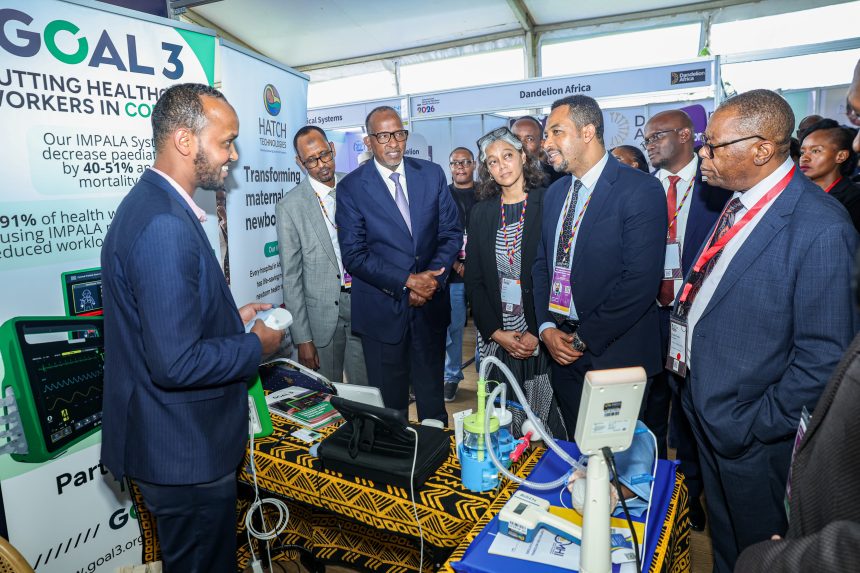
Kenya has official opened the 2026 International Maternal and Newborn Health Conference (IMNHC) in Nairobi.
Speaking during the opening ceremony, Health Cabinet Secretary Aden Duale who was representing President Ruto called for accelerated global efforts to reduce maternal and newborn deaths.

Themed “Moving Forward. Together,” the CS described the conference as more than a routine gathering, but rather “a shared declaration that no woman should die while giving life, and that every newborn must have the chance not only to survive, but to thrive.” This, he emphasized, was both “a call to our conscience, and a call to decisive action.”
CS Duale acknowledged strong frameworks such as the Maputo Plan of Action, the International Conference on Population and Development, and the Every Newborn Action Plan have already defined the path forward.
Referencing renewed commitments at the United Nations General Assembly and the World Health Assembly, Duale stressed that maternal and newborn health is inseparable from broader goals of equity, gender equality, and sustainable development. “We must therefore move decisively from commitment to implementation,” he affirmed.
Kenya’s national journey
The CS noted government’s commitment to building “a health system that leaves no one behind.” A vision being realized through reforms under Universal Health Coverage(UHC) anchored on the belief that “a mother in the most rural part of Kenya has the same chance of surviving childbirth as one here in Nairobi.”
He highlighted measurable progress: expanded access to maternal and child health services, improved antenatal care uptake, increased skilled birth attendance, and wider immunisation coverage.
A key pillar of Kenya’s transformation is the Social Health Authority(SHA), which has already registered over 30 million Kenyans. This expansion of health coverage is not just administrative success it is changing lives. “This is not just insurance it is equity in action,” he stated, noting increased uptake of maternal services and reduced financial barriers, particularly among vulnerable populations.
He further linked health outcomes to broader development investments, observing that infrastructure, digital systems, and education are reinforcing healthcare delivery. “These achievements are the interconnected pillars of a healthier nation,’ he said.
Despite progress, the CS did not shy away from the harsh realities. “Maternal mortality remains unacceptably high. Newborn deaths and stillbirths have persisted,” he said, reminding the delegates that behind every statistic is “a name, a face, a family, and a future lost.” With this, he issued a clear warning: “We cannot allow complacency to masquerade as progress. The time for incremental steps has passed.”
He underscored the centrality of reproductive and adolescent health, stressing that “these are not secondary concerns; they are central to reducing maternal and newborn mortality.”
Kenya’s commitment to accelerated action is evident through the adoption of the Every Woman Every Newborn Everywhere Acceleration Plan 2026–2028 and the rollout of the Rapid Results Initiative (RRI), both aimed at translating commitments into measurable outcomes. “Together, EWENE and the RRI signal a shift from commitment to execution, from intention to results.”
He outlined six strategic priorities guiding this effort, including sustainable financing, partnerships, high-impact interventions, workforce strengthening, commodity security, and digital transformation. Emphasizing accountability, he reminded delegates: “What gets measured gets done, and what gets done saves lives.”
Looking ahead, he painted a hopeful vision: “A Kenya, and a world, where no mother dies from preventable causes, and no newborn is lost to conditions we already know how to prevent and treat.” He emphasized that this future is within reach but only through urgency, purposeful investment, and accountability.
The conference brought together distinguished leaders, including Ministers of Health such as Douglas Tendai Mombeshora of Zimbabwe and Dr. Dereje Duguma of Ethiopia, alongside Kenya’s Principal Secretary for Public Health and Professional Standards Mary Muthoni, Director-General for Health Dr Patrick Amoth, Director-General of the Africa Centres for Disease Control and Prevention Dr Jean Kaseya, and Ministry’s Family Health Director Dr. Bashir Isaak, among other dignitaries.