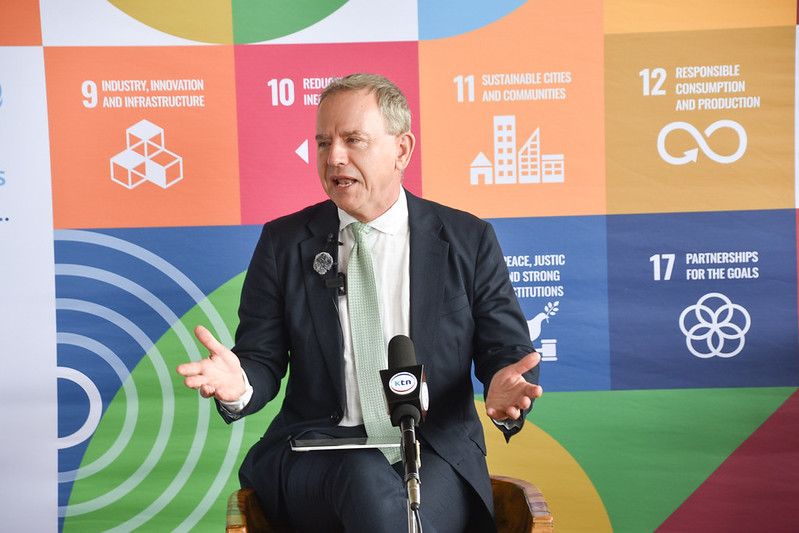
Outgoing United Nations Resident Coordinator in Kenya, Stephen Jackson, has praised the country’s development progress, rating Kenya 6 to 7 out of 10 for its performance in achieving the Sustainable Development Goals (SDGs).
Speaking to journalists on Wednesday at the UN Complex, Dr. Jackson said Kenya is performing strongly in sectors like the renewable energy with over 90pc clean electricity being generated from renewable sources.

SDGs on health and education sectors have made great strides as well while poverty eradication, hunger and industrialisation lag behind.
He noted that the country, just like many others worldwide is off track in fully achieving the 17 global goals by 203o attributing this to both local and international challenges including climate change, COVID-19 pandemic, rising conflicts.
“On one hand Kenya is making steady progress towards quite a number of the goals, but the bad news is yes, we’re off track on others but Kenya is not alone in that in fact, the SDGs are off track around the world,” said Dr. Jackson.
Adding that: “We’ve have faced successive global challenges including the return of global conflict. We have a conflict right now in the Middle East that is putting the prices of food fuel and fertiliser in Kenya at risk of increasing because of a conflict that has nothing to do with Kenya.”
Financing gap threatens SDGs
When asked about the impact of funding cuts, Dr. Jackson acknowledged the that they have significant affected UN operations leading to job losses. “I’m the first thing to say is I deeply regret, those funding cuts because they have a material impact on people’s lives. But they also symbolically represent the failure of solidarity.”
However he stressed that achieving the SDGs requires trillions of dollars which is far beyond traditional aid calling on involvement of private sector.
To achieve the goals he remarked that Kenya must mobilise larger development financing from the private sector, government through responsible taxation and spending as well as from multilateral institutions like World Bank.
“Aid alone will never be enough. We must mobilise private sector investment and domestic resources,” he said.
He described the UN’s evolving role as ‘catalytic,’ using limited funds to unlock larger investments.
Additionally, he cited high borrowing costs for developing countries as a limitation to achieving the goals noting that “If Kenya could access finance at the same rates as developed countries, it would transform its development trajectory,” he said.
Climate change
Dr. Jackson also raised concerns over the growing impact of climate change, warning that the crisis continues to outpace response efforts pointing out increasing cases of urban flooding in cities such as Nairobi, linking the problem to inadequate drainage systems and rapid, unplanned urban development.
He highlighted a major initiative that has secured $20 million (approximately Ksh2.5 billion) to expand climate-resilient water access for over one million Kenyans, particularly in vulnerable regions.
“Climate change is not going away. We must do more to help communities adapt, especially through water solutions and climate-smart agriculture,” he said.
Key achievements despite challenges
Further, Dr. Jackson highlighted the work of the UN agencies operating in Kenya, noting that a key focus has been on populations at risk of being left behind, in line with the global SDGs.
“Our job has been to ensure that even as Kenya develops rapidly, those most at risk are not left behind,” he said.
Under his tenure, UN Kenya has continued to deliver results at scale despite global funding cuts, mobilising approximately Ksh. 59.7 B USD 460M in 2025 expenditures.
The results reflect the collective work of 28 UN agencies operating under the UN Sustainable Development Cooperation Framework (2022–2027), aligned with Kenya’s Vision 2030 and the Bottom-Up Economic Transformation Agenda.
Key achievements include; vaccination of 17 million children against typhoid, 5 million against measles and rubella, reaching over 500,000 adolescent girls with sexual and reproductive health services.
Additionally close to 9 million received food and nutrition support especially in Arid and Semi-Arid Lands (ASALs).
In social protection, 2.4 million people benefited from the Inua Jamii cash transfer programme, receiving consistent monthly support to ease extreme poverty, while close to 1.9 million people were reached through education, skills and wellbeing programmes.
955,811 accessed safe water while in agriculture and climate resilience, 197,780 farmers were supported with climate-smart technologies, while 7 million farmers were registered under the KIAMIS system to streamline fertilizer distribution covering 50 million bags.
Further, 90,133 entrepreneurs increased their technical skills in low-carbon, circular & climate-resilient sectors to generate sustainable income.
A global hub for the United Nations
Jackson underscored Kenya’s importance as a global UN hub, noting that Nairobi hosts one of the UN’s four headquarters globally.
“The global South is becoming more influential, and Kenya is at the centre of that shift,” he said.
Dr. Jackson narrated how he first came to Kenya in the 80s as a student as he reflected on the country’s growth noting that there has been significant progress in economic development, urban expansion, and political freedoms compared to the 1990s.
However, he emphasized that what has remained constant is the resilience and optimism of Kenyans describing his time in Kenya as ‘an immense privilege’.
“This is a society that has gone from strength to strength. Kenyans are resilient, hardworking, creative, and optimistic,” he said.
As he prepares to leave, Dr. Jackson expressed deep appreciation for Kenya and its people.
“I hope I’ve contributed in some small way, but honestly, the debt is the other way. I thank Kenya for the opportunity,” he said.
He added that despite current challenges, he remains confident in Kenya’s future: “This is a country whose best years are still ahead.”