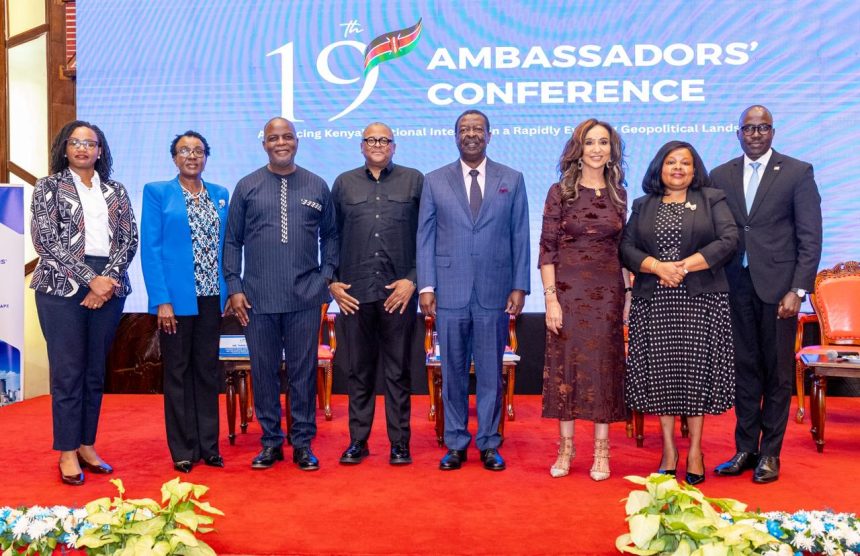
Kenya must urgently take control of its global narrative or risk losing ground in an increasingly competitive and perception-driven world, leading communications experts have warned at the 2026 Ambassadors’ Conference in Nairobi.
Across a series of high-level sessions on strategic communication, crisis leadership and digital diplomacy, a consistent message emerged: in today’s geopolitical landscape, narrative is not secondary to policy, it is a core instrument of statecraft.

Moderated by Kenya’s Ambassador to Thailand, Ambassador Lucy Kiruthu, the final session challenged traditional notions of diplomacy, emphasizing that shaping perception is now central to foreign policy effectiveness. She noted that Africa’s story has historically been told through external lenses, often producing distorted or incomplete portrayals. The task ahead, she argued, is for African countries to shift from passive narrators to active architects of their global image.
Highlighting the continent’s youthful population and growing innovation ecosystem, she called for authentic storytelling that reflects Africa’s evolving realities. Reclaiming the narrative, she stressed, is essential to building trust, attracting investment and strengthening global influence.
This theme was reinforced throughout a Master Class on Strategic Communications, Crisis Leadership and the National Story, where Thebe Ikalafeng delivered a stark warning: “Kenya’s story is still being told about Kenya, not by Kenya.”
According to Ikalafeng, perception has tangible consequences. It shapes investor confidence, borrowing costs and diplomatic partnerships. Across Africa, externally driven narratives often reinforce risk profiles that translate into real economic penalties. For Kenya, he argued, reputation management is therefore not cosmetic, it is strategic.
Despite its considerable strengths, Kenya’s global image remains uneven. The country is widely associated with cultural heritage, tourism and sporting excellence, yet these are often overshadowed by episodic crises that dominate international coverage. This imbalance, he noted, obscures Kenya’s growing role as a regional hub for trade, innovation and diplomacy.
Innovations such as M-Pesa have continued to position Kenya as a global leader in mobile finance, while its creative industries and entrepreneurial ecosystem continue to expand. However, these assets are not being consistently projected through a coherent national narrative.
Gina Din Kariuki advanced this argument by calling for what she termed “geo-narrative mastery”, the deliberate shaping of global perceptions. In a digital-first world, she warned, silence amounts to a surrender of influence, as opinions are often formed long before direct engagement occurs.
Drawing lessons from countries such as Singapore and South Africa, she emphasized that reputations are increasingly built online rather than through physical diplomatic presence alone. Embassies may symbolize national presence, she noted, but digital platforms define how countries are perceived in real time.
Her message centered on trust. Every action, she explained, contributes to what she described as a “trust scoreboard.” Inconsistency, inaction or silence can quickly erode credibility, while rebuilding trust is often slow and difficult. For diplomats, this means communication must be proactive, consistent and aligned with reality.
The importance of trust was echoed by Ikalafeng, who stressed that credibility depends on accountability, transparency and delivery. Leaders must be visible, data-driven and reliable, ensuring that communication reflects actual performance.
A data-driven audit of Kenya’s digital diplomacy revealed significant structural gaps. Of 44 diplomatic missions assessed, only 36 percent maintain active social media engagement, while 14 percent have no digital presence at all. In key regions, this has created information vacuums that weaken Kenya’s ability to influence perception.
“Silence is not neutral; it is interpreted,” Ikalafeng cautioned, noting that in a fast-moving information environment, inactivity can be perceived as indifference or weakness.
Performance across KENHA Missions abroad was uneven. While embassies in Seoul, Stockholm, London and Abuja demonstrated effective multi-platform engagement, others were found to be misaligned with local communication ecosystems or inactive for extended periods. In some cases, missions were communicating on platforms that their target audiences do not use, limiting both reach and impact.
A key takeaway was the need for audience-centered communication. Diplomatic messaging must be tailored to host country audiences, using relevant platforms and local languages. The lack of multilingual engagement, particularly in French, Arabic and Asian languages, was identified as a major constraint on Kenya’s global reach.
Participants also pointed to emerging opportunities, including the potential expansion of United Nations functions in Nairobi, which could further position Kenya as a global diplomatic hub. However, they cautioned that increased visibility must be matched by a clear and compelling narrative to translate into lasting influence.
In closing, the sessions returned to a common theme: authenticity. Kenya’s global story must be rooted in its own identity, culture and values, rather than shaped by external expectations.
The message from Nairobi was clear. In a world where perception shapes power, the ability to define and project a coherent, credible and confident narrative is no longer optional, it is essential.
For Kenya, the choice is stark: tell its own story, or be defined by others.