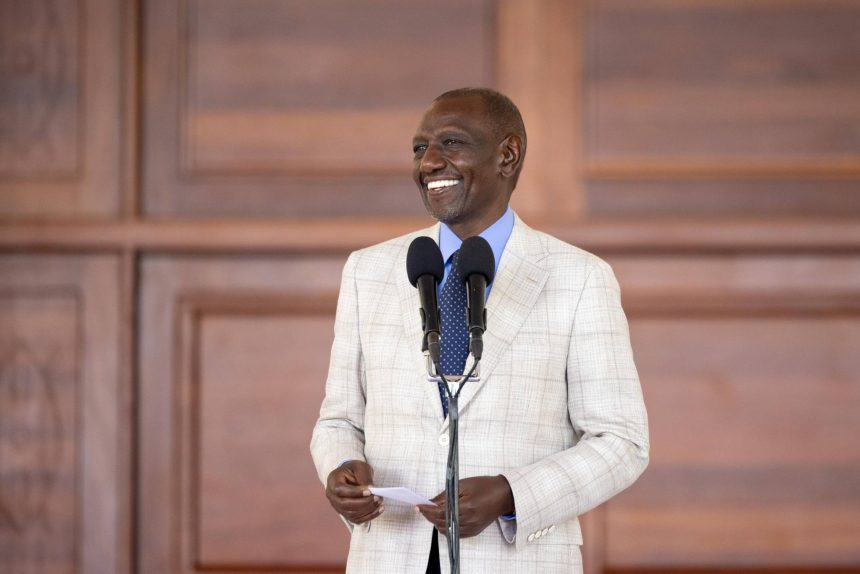
President William Ruto has announced that the government will subsidise seeds beginning the next financial year to boost production and productivity and also ease farming costs.
The President pointed out that the government is committed to lowering the cost of production and increasing yields to make Kenya food secure.

“We are planning to subsidise seeds, just like we have been doing with fertilisers, to reduce the cost of production for farmers,” he said.
At the same time, the President said the government will establish a Level Six hospital in Bungoma County to take highly skilled services nearer to the people and ease congestion at the Moi Teaching and Referral Hospital in Eldoret.
Addressing church leaders from Bungoma County at State House Nairobi on Saturday, President Ruto said the ongoing rehabilitation of the Kakamega Level Six hospital will also revitalise the health sector in the region.
On infrastructure development, he also announced the construction of an airport at Matulo, complete with a terminal building and an expanded runway.
“We will also be extending the runway terminal for Matulo Airport in Bungoma if we get additional land. Already, the ongoing expansion of the Kakamega Airport runway is 70pc done,” the President explained.
At the same time, he urged the Church leaders to support the government’s transformation agenda, saying they should be at the forefront of making Kenyans understand that national transformation is possible if the right policies are implemented.
Enumerating the achievements of the government in the past three years, President Ruto said the government has stabilised the economy, rescuing the country from the brink of debt default and propelling it from the eighth to the sixth largest economy in Africa.
In 2022, the President told the bishops that Kenya was listed among six African countries that were headed for debt default.
“When I took over the leadership of this country in 2022, the state of the economy was strained because of huge debts. But we managed to meet our debt obligations because of discipline and strategic planning,” President Ruto explained.
He said transformation of the country depends on the implementation of productive programmes and projects such as the affordable housing, food security and provision of healthcare to everyone.
On universal healthcare, the President said reforms have led to registration of 31 million Kenyans under the Social Health Authority (SHA) up from 7 million under the defunct National Health Insurance Fund.
In agriculture, he pointed out that the country has received consistent rainfall for the past three years and, coupled with the provision of subsidised inputs and clean up of the sector, has increased production and productivity.
Additionally, the President commended growing national savings, saying the change of government policy from saving Ksh 200 a month to saving 6pc of each employee’s income and a similar amount from the employer, has dramatically increased savings at the National Social Security Fund (NSSF).
“For nearly 60 years, employees and employers saved Ksh 312 billion. But from 2023 when we changed the saving structure, we have more than doubled what we had saved in 60 years. In February 2026, savings at NSSF stood Ksh700 billion,” President Ruto disclosed.
In a few years, he noted, Kenya won’t be borrowing development funds from elsewhere. Instead, the country will be borrowing from the national savings and paying interest to Kenyan workers.
The meeting, which brought together bishops and other religious leaders from various denominations, underscored the government’s continued engagement with religious institutions as key partners in governance and community development.
Other than the religious leaders, the meeting was also attended by National Assembly Speaker Moses Wetang’ula, Bungoma Governor Ken Lusaka, and several MPs.
The President expressed appreciation for the longstanding relationship between his administration and religious leaders across the country.
He noted that the clergy remains a critical pillar in promoting unity, moral guidance, and national cohesion.
“We are very proud of the relationship we have built with the clergy not only in Bungoma, but also in the country,” he said.
President Ruto also acknowledged the role of faith leaders in complementing government efforts, noting that collaboration with religious institutions has been central to his administration’s approach.
The President reiterated his commitment to working closely with the clergy, emphasising that inclusive dialogue remains central.
Mr Wetang’ula commended the transformation agenda across the country, saying the President was the right leader to take Kenya to a first world economy.
“We appreciate the development taking place in Kenya, including the revival of Mumias and Nzoia Sugar factories in Western Kenya,” Mr Wetang’ula said.
He said the proposed hydro-electric power station in Bungoma is expected to produce over 45 megawatts of electricity.
The Speaker explained that the project is aimed at boosting the national grid and enhance sustainable power in the region.
He also thanked President Ruto for directing that the Kisumu-Malaba section of the Standard Gauge Railway passes through Mianga in Bungoma.
Mr Wetang’ula told the clergy to rally residents of Bungoma and Western Kenya to register as voters in large numbers to boost the re-election of President Ruto in 2027.
Governor Lusaka used the occasion to highlight ongoing development projects in Bungoma County, defending the government’s record in infrastructure development, health, and economic empowerment.
He also pointed to continued investments in key sectors as evidence of progress in the region.