It was a pointed headline that forced a presidential rebuttal. “William Ruto is travelling again,” the Kenyan media declared and this time, the President of Kenya chose not to let it pass unanswered.
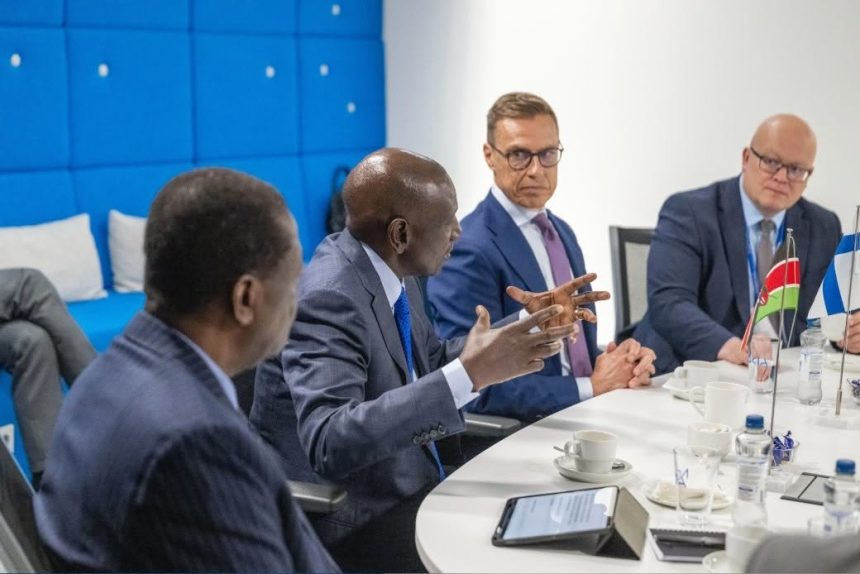
Standing before a gathering of Kenyans living in Helsinki, Finland, on the evening of June 11, 2026, President William Ruto delivered what may be the most candid and consequential defence of executive diplomacy heard from a Kenyan leader in a generation. “I have not come here as a tourist,” he said, his voice carrying the unmistakable weight of a man who had spent five days in Brussels, Oslo, and Helsinki closing deals that most critics had not bothered to look up.

The speech was short. It was direct. And buried in its matter-of-fact delivery was a vision of Kenya that is rarely articulated with such specificity from the highest office: a nation actively repositioning itself not as a recipient of global goodwill, but as a deliberate, strategic actor on the world stage. “I am the chief diplomat of our country,” Ruto told the diaspora audience. “People want to know what Kenya stands for.”
The Deals Behind the Departure
Critics of presidential travel often focus on cost and optics. What they miss is the opportunity cost of absence. In Brussels, Ruto negotiated the stability of Kenya’s Economic Partnership Agreement with the European Union a framework that governs billions of shillings in trade while simultaneously laying groundwork to onboard East African Community partners ahead of the critical 2031 scaling deadline. A missed conversation at that level is not a saved flight allowance; it is a potentially disrupted trade architecture that takes years to repair.
But it was the EU data adequacy agreement secured in Brussels and set for formal framework adoption by August or September 2026 that deserves particular attention. In a world where data flows are the new oil pipelines, Kenya gaining EU data adequacy status means Kenyan businesses and tech firms can exchange data with European partners under the same legal protections as EU member states. For a country positioning itself as Africa’s premier technology and business process hub, this is not a bureaucratic footnote it is a competitive advantage of historic proportions.
“I have not come here as a tourist. I have come here pointedly to make sure that we achieve certain things. Just for the record, I am the chief diplomat of our country.” — President William Ruto, Helsinki, 11th June, 2026
Nokia, Data Centres, and the Digital Frontier
In Finland, Ruto held what he described as a “most consequential meeting” with Nokia the global telecommunications and network infrastructure giant on deploying data centres in Kenya. This is not a marginal technology announcement. Data centres are the foundational infrastructure of the digital economy: they host cloud services, enable AI workloads, attract multinational technology investment, and create high-skill employment. Nokia’s commitment signals that Kenya is being considered not merely as a market, but as a regional digital infrastructure hub for Sub-Saharan Africa.
Key Deliverables from the Nordic & Brussels Mission:
Brussels, Belgium — EU–Kenya Economic Partnership Agreement stability secured; EAC partners recruitment for 2031 scale-up initiated
Brussels, Belgium — EU data adequacy agreement framework agreed; formal adoption expected by August–September 2026
Oslo, Norway — Bilateral agreements on key sectors advanced with Norway; specific instruments to be formalised
Helsinki, Finland — Nokia data centre deployment in Kenya agreed; Kultaranta Talks foreign policy forum — first African head of state to participate
Diplomacy Is Not a Departure — It Is a Delivery
The deeper argument Ruto was making in Helsinki was not a personal defense. It was a structural one. In the 21st century, no economy however well-governed domestically — can afford to operate in diplomatic isolation. Trade agreements, technology partnerships, investment frameworks, and global governance influence are all negotiated face to face, at bilateral meetings, multilateral forums, and yes at town halls with diaspora communities who carry Kenya’s name and reputation with them every day.
Kenya’s diaspora remittances exceeded Kshs. 700 billion in 2025, making them one of the country’s largest inflows of foreign exchange. The Kenyans sitting in that Helsinki hall were not bystanders to their country’s economic story they were, in many cases, funding it. A president who travels to meet them, brief them, and hear their concerns is not wasting time. He is doing exactly what a chief diplomat should do.
Dr. Yusuf Muchelule is a Senior Lecturer & a Consultant.