When the World Health Organisation declared the DRC’s Bundibugyo Ebola outbreak a Public Health Emergency of International Concern on May 17, 2026, it issued an unscripted test of international solidarity. The responses from Washington and Beijing in the weeks that followed produced a revealing case study in how great powers translate stated commitments into concrete action, and what those choices signal to the countries most affected by the disease.
On May 18, the CDC, the Department of Homeland Security, and other federal agencies announced enhanced travel screening, entry restrictions, and public health measures framed around protecting the United States from the ongoing outbreaks in East and Central Africa. The resulting ban restricted entry for nationals of the DRC, Uganda, and South Sudan for 30 days, with exemptions for US citizens and permanent residents.

It was the first time the US had imposed a travel ban in response to an Ebola outbreak. In prior episodes, US policy had rested on enhanced airport screening rather than categorical entry prohibitions, a posture grounded in the established epidemiological position that travel bans can disrupt outbreak monitoring without meaningfully reducing cross-border transmission. The May 2026 measures marked a departure from that approach.
Days later, a second and more consequential decision emerged. The Trump administration announced that Americans exposed to Ebola abroad would not be repatriated to the US, but directed instead to a quarantine facility at Kenya’s Laikipia Air Base, a country with no known Ebola cases at the time, situated over 1,500 miles from the outbreak zone. Secretary of State Marco Rubio framed the policy plainly, “We cannot and will not allow any cases of Ebola to enter the United States.”
The announcement raised immediate practical questions that would take on greater significance in the days that followed. What biocontainment arrangements existed at Laikipia, what role Kenya had played in the decision, and how the proposal would interact with Kenya’s own public health institutions and legal framework.
Kenya’s institutions did not accept the arrangement quietly. The Kenya Medical Practitioners, Pharmacists and Dentists Union warned that Kenya should not become a “dumping ground,” while the Law Society raised concerns about the absence of high-containment infrastructure required to safely manage such a facility. The High Court suspended the establishment of the facility pending a legal challenge, citing the country’s existing health system pressures.
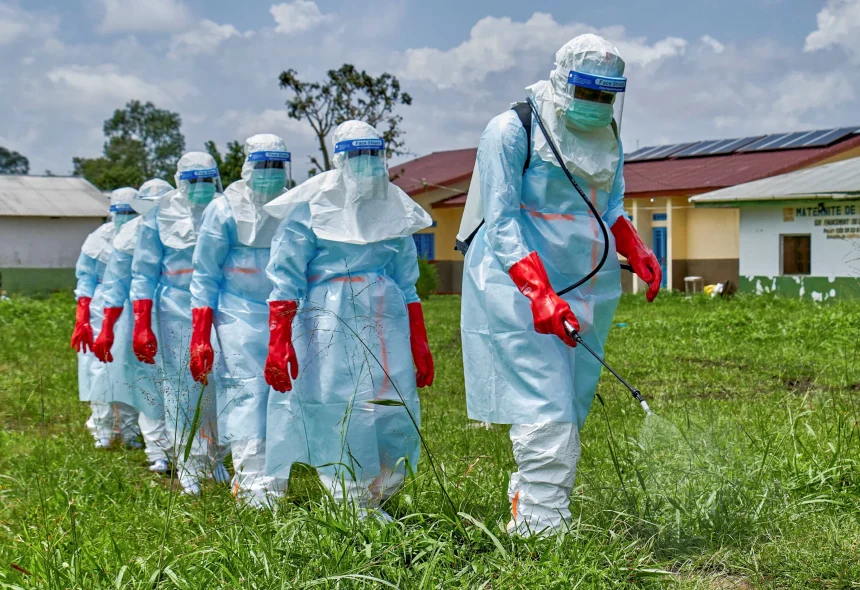
Against this backdrop, the Chinese government’s response followed a structurally different logic. On June 2, a Chinese anti-epidemic medical expert team arrived in Kinshasa for a three-month mission, with expertise spanning public health, laboratory diagnostics, and both traditional Chinese and Western clinical medicine. The team augmented Chinese Medical Teams already stationed in the DRC, personnel who, since the outbreak began, had activated emergency response protocols, conducted training drills, and coordinated epidemic prevention supplies.
The June deployment was a reinforcement of an existing operational presence, not a reactive measure. In 2014, when many international actors withdrew medical personnel from Ebola-affected West Africa, China’s teams moved in the opposite direction, entering epidemic zones and addressing critical gaps in local clinical services. The 2026 deployment continues a pattern of sustained forward engagement, grounded in long-term relationships with African health institutions rather than crisis-driven calculation.
The contrast between these approaches is not simply a matter of style or diplomatic tradition. It reflects different assumptions about what engagement with Africa means in practice. Sovereign governments make choices about how to manage public health risks, and those choices are constrained by domestic political pressures, institutional capacity, and legal frameworks. What matters for African countries is not the reasoning behind those choices, but their practical consequences on the ground.
What the Kenya episode illustrates is that when the international architecture of outbreak response is stress-tested, the gaps between stated partnership and operational reality become visible. Countries with advanced biocontainment infrastructure, airlift capacity, and long-established public health institutions have choices that others do not. How those choices are exercised, and at whose expense, is a question that African governments and publics are watching with increasing attentiveness.
Africa CDC has observed that the international community’s response to previous Ebola outbreaks often accelerated only when cases reached or threatened high-income countries, while the burden of the disease fell overwhelmingly on African communities. The concern raised by the 2026 response is that the structural features of that pattern — selective urgency, risk exported rather than shared — have not been comprehensively addressed.
Great power engagement with Africa will ultimately be judged not by stated intentions or diplomatic communiqués, but by conduct in the specific moments when events force a choice. On the evidence of May and June 2026, China dispatched medical teams to the country where the disease is, reinforcing personnel who were already there. The record of who moved toward the outbreak, and who moved to insulate themselves from it, is not lost on African policymakers.
The writer is an expert in China-Africa relations