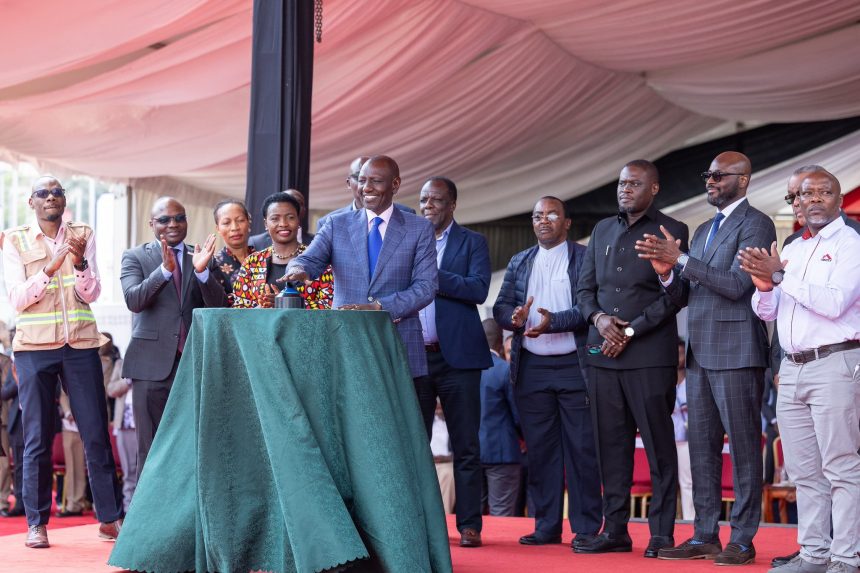
President William Ruto has called on the banking sector to lend more to the medium, small, and micro enterprises to enable them play a bigger role in national development.
The President said despite contributing to 40 per cent of the country’s economy, majority of small businesses are locked out of crucial financial services to expand and grow.

Although commercial banks have lent about KSh1 trillion to the sector in the past three years, he pointed out, this is still “woefully low” compared to what is needed for small businesses to flourish.
“The uncomfortable truth remains: The vast majority of micro and small enterprises, the very backbone of our economy, have remained outside that flow of capital,” he said.
He made the remarks on Saturday during celebrations to mark this year’s World MSME Day at the Kenyatta International Convention Centre, Nairobi.
President Ruto noted that there is a financing gap of KSh3 trillion for the sector to fully flourish, and invited the private sector to tailor mutually beneficial financial solutions.
“I put it to my friends in finance plainly – how can we possibly grow our economy while locking most of our people off the balance sheet? How do we create jobs for our youth while refusing to bank them?” he asked.
Present were Co-operatives and MSMEs Development Cabinet Secretary Wycliffe Oparanya, United Nations Resident Coordinator Garry Conille, Nairobi Governor Johnson Sakaja, Principal Secretaries and MPs, among other leaders.
Also at the function were owners of medium and small businesses from across the country, who have benefited from Government financial initiatives such as the National Youth Opportunities Towards Advancement (NYOTA), Youth Enterprise Fund and Women Enterprise Fund, among others.
The President explained that the Government has undertaken various steps to strengthen MSMEs, beginning with the creation of a State department to give the sector a permanent home.
To address the financial question, he said the Government has so far disbursed KSh90 billion through the Hustler Fund to more than 27 million Kenyans over the past three years.
Additionally, the Government has delisted more than eight million Kenyans who had been blacklisted by the Credit Reference Bureau (CRB).
Two million of the eight million have since rebuilt their credit standing and rejoined the formal economy.
“We are now turning that credit history into a National Credit Score so that character and behaviour, not just a title deed or a logbook, can unlock financing,” he said.
President Ruto called on local banks to borrow a leaf from Bangladesh’s Grameen Bank founded by economist and Nobel Prize winner Muhammad Yunus, which has extended more than $37 billion in interest-free loans since its founding 50 years ago.
“The unbanked are not a risk to be kept at arm’s length. They are a market waiting to be served,” he said.
The UN Resident Coordinator in Nairobi commended Kenya for its commitment to empowering small businesses to play a meaningful role in the country’s economy.
“This is not charity. This is a nation deciding that no Kenyan with ambition should be invisible to the economy,” he said.
Mr Oparanya said the Revised MSMEs Policy 2026 launched by the President would empower entrepreneurs by removing hurdles to the expansion of their businesses.
Governor Sakaja said through the Unified Business Permit, Nairobi County has cut red tape in the issuance of permits, thus improving the ease of doing business within the capital city.