Trust is the foundation upon which strong institutions, stable democracies and prosperous economies are built, Prime Cabinet Secretary Musalia Mudavadi has said.
Mudavadi said in today’s digital era, where misinformation and declining public confidence present growing challenges, strengthening trust between citizens, institutions and governments has become more important than ever.

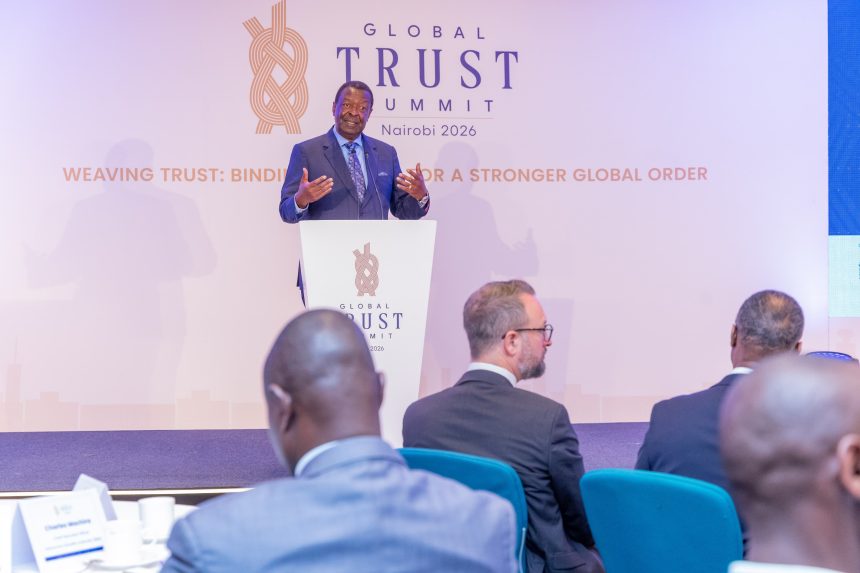
Addressing the Kenya Regulatory Institutions Consultative Meeting on the upcoming Global Trust Summit 2026, which Kenya will host from 22nd to 23rd October 2026, Mudavadi said Kenya is among democracies that are putting effort to re-build trust aimed at realizing shared strength, advance sustainable peace and economic growth.
“We should believe in our institutions. As government we are working tirelessly to ensure sharing of information is open and transparent. We are also upholding the principle of doing what is right for citizens to build confidence in what we tell them.” said the Prime CS.
Mudavadi said the government is also working on key sector reforms within various institutions to help reform what has been previously perceived as the norm within the public eye.
He said the government acknowledges the inadequacy in budgetary allocations for critical regulators, but spanners are in the works to ensure adequate funds are channelled to help institutions strengthen their capacity.
“To build capacity in institutions that are regulators, the government must resource them appropriately. On the other hand, the institutions must have integrity which is solid and as good as Ceasar’s wife.” Mudavadi noted.
“I challenge the institutions to also appreciate that a good regulatory body is as good as the people in it. Integrity, dedication and hard work should replicate from top, middle and at the base.” he added.
Mudavadi said as Kenya plans to host the Global Peace Summit in October, efforts are ongoing to continue championing the development of a framework that will strengthen the capacity of key institutions to promote transparency, accountability and public confidence while safeguarding democratic values in the digital age.
“I want to give an example of when I was the finance minister in the 1990s. At that time Kenya’s financial systems had completely lost the trust of the public. Banks were collapsing, the shilling was propping, depositors’ savings had become insecure and Kenyans had resulted in shifting from banks to hiding their savings under mattresses.” Mudavadi regretted.
“At that time, we had to make some drastic and tough interventions like cutting down the limitless term of Central Bank Governors to a maximum of two terms. This helped us restore the valuable commodity called trust amongst Kenyans. Unfortunately, at that time some decisions were being made outside Central Bank since the regulatory system had collapsed.” Mudavadi explained.
The Prime CS said Kenyans should begin to appreciate the gains being made under the current administration in various sectors of the economy including health, education, infrastructure, and agriculture among others.
He said for instance the government has remained forthright in sharing information regarding the quarantine facility for Ebola saying to date at least 162,000 individuals have been tested at the facility and none has presented any ebola symptoms, calling on Kenyans to compare the same with how neighbouring countries are handling the data and information on the ebola outbreak.
“The discourse we see in various sectors narrows down to the underlying issue of trust amongst the public. Making information public boosts both credibility and believability and that is what this administration is working towards.” noted the Prime CS.
“If you were to look at Africa, how many countries can have their currencies pass the test of being convertible? Because this comes with building trust systematically. For Kenya currently if you go in some of the countries you will find that the Kenya shilling can be accepted like the dollar since we are progressively building solid regulatory frameworks within our institutions.” Mudavadi said.
He urged Kenyans to also build trust in institutions that anchor democracy like the Independent Electoral and Boundaries Commission, IEBC noting that their mandate determines how free, fair, transparent and credible the electoral process will be.
He said the outcome of such processes defines the threshold of trust in relation to the what systematically boosts economic growth.
The Global Trust Summit-2026 will focus on strengthening information integrity, democratic institutions, intergenerational governance, trust as an economic asset, and the future of multilateralism and international cooperation.
By convening the Global Trust Summit, Kenya is positioning itself as a global thought leader on one of the defining issues of our time.
The Summit will bring together governments, regulators, academia, the private sector and international partners to shape practical solutions that foster sustainable peace, inclusive growth and stronger institutions.