The United States has announced an additional $242 million (about KSh31.3 billion) to strengthen Ebola response and preparedness efforts in the Democratic Republic of the Congo (DRC) and Uganda, significantly increasing support for one of Africa’s fastest-growing Ebola outbreaks.
The funding, announced by the U.S. Department of State on Wednesday, will support emergency response operations, disease surveillance, treatment, border screening and humanitarian assistance in affected communities. The latest commitment raises total direct U.S. State Department assistance for the outbreak to more than $512 million, making Washington the largest single financial contributor to the response.

According to the State Department, the new funding is part of a broader commitment made during the G7 Leaders’ Summit in June, where the United States pledged up to $500 million in additional support for Ebola response efforts. The package comes alongside wider humanitarian assistance already allocated to countries affected by the crisis.
The U.S. said the additional resources will enable governments, humanitarian agencies and implementing partners to expand critical interventions aimed at slowing transmission and saving lives.
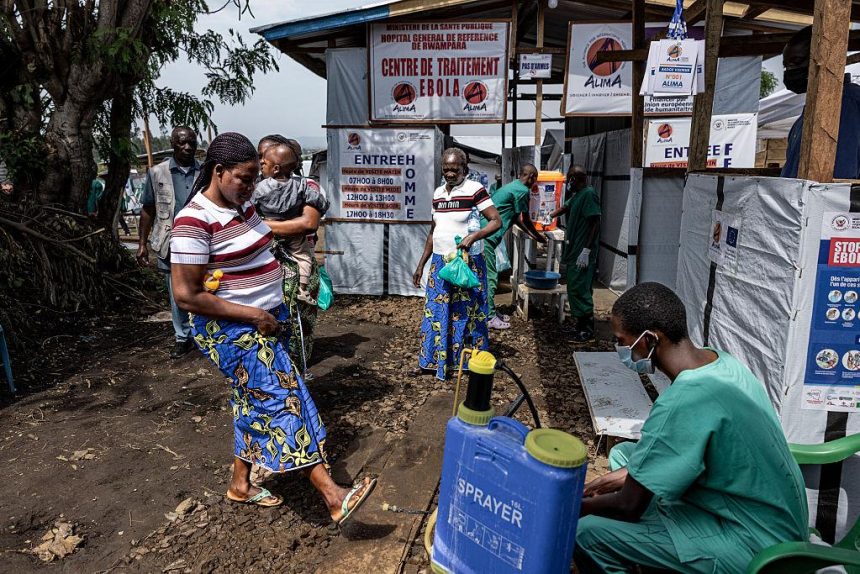
Among the activities supported through previous U.S. funding are surveillance and early detection, isolation and treatment of patients, strengthening laboratories, community engagement campaigns, and screening at border crossings and other points of entry. The assistance has also helped procure and distribute nearly 300 metric tonnes of essential medical and infection-prevention supplies while supporting more than 180 health facilities across affected areas. Over 8.6 million health screenings have also been conducted through the response.
The State Department commended Uganda for acting swiftly to contain imported cases and prevent wider transmission, noting that close cooperation between neighbouring countries remains essential in limiting the spread of the virus across East and Central Africa.
Outbreak continues to accelerate
The funding announcement comes as international health agencies warn that the Ebola outbreak is spreading faster than response efforts.
The World Health Organization (WHO) says the outbreak, confirmed in May 2026, is caused by the Bundibugyo strain of the Ebola virus—a strain for which there is currently no approved vaccine or specific treatment, although several experimental vaccines and therapies are under development.
As of early August, the outbreak had recorded about 3,900 confirmed cases and more than 1,750 deaths, making it the second-largest Ebola outbreak in history after the 2014-2016 West African epidemic. Health officials warn the true number of infections could be significantly higher because many cases remain undetected in remote and conflict-affected communities.
WHO Director-General Tedros Adhanom Ghebreyesus has warned that the epidemic is outpacing the current response, citing delayed case detection, insecurity, limited healthcare access and growing community transmission as major challenges. Health experts estimate that between 60 and 70 per cent of new infections are no longer linked to known contacts, making the outbreak increasingly difficult to contain.
Regional implications
Although Kenya has not reported Ebola cases linked to the current outbreak, the country’s health authorities continue to monitor developments because of frequent travel and trade links with Uganda and the wider East African region.
Kenya has previously strengthened surveillance at airports and land border points during regional Ebola outbreaks and has repeatedly urged travellers to observe public health advisories. Cross-border collaboration remains a key pillar of East Africa’s disease preparedness strategy, particularly given the movement of people and goods within the region.
The WHO has emphasized that coordinated regional surveillance, rapid testing, contact tracing and community engagement are essential to preventing further international spread.
US calls for greater international support
The United States has also urged other international donors to increase funding for the response, arguing that containing the outbreak at its source remains the most effective way of preventing wider regional and global spread.
In addition to supporting frontline health workers, laboratories and treatment centres, U.S. assistance includes humanitarian aid for communities affected by the outbreak as well as support for public awareness campaigns aimed at countering misinformation and encouraging early reporting of suspected infections.
The State Department said it remains in close coordination with the U.S. Centers for Disease Control and Prevention (CDC), African governments and international partners as efforts intensify to contain the outbreak before it spreads further across the region.