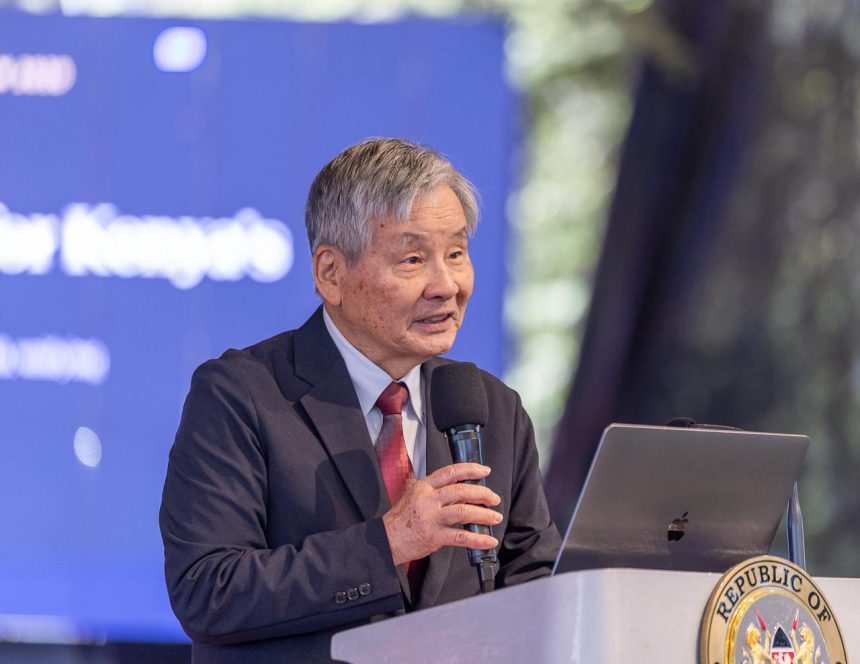
Prof Hiroyuki Hino, an international economic consultant, has expressed confidence that Kenya can achieve significant economic and social transformation within a generation. He urged the country to pursue bold reforms, strengthen human capital, and accelerate economic growth.
Speaking during the launch of the National Conversation, Beyond Vision 2030, Prof Hino challenged Kenyans who view Singapore as an unrealistic benchmark. He argued that Kenya possesses the human attributes necessary to drive extraordinary growth.

“To sceptics, I would say Kenyans possess personal attributes that can power extraordinary growth. The Asian miracle was driven, in an important part, by the strength of its people: hard work, motivation, discipline, and cooperation,” he stated.
Prof Hino acknowledged the wide gap between the two countries. Singapore’s income per person exceeded $80,000 last year, compared with slightly more than $2,000 in Kenya. However, he maintained that this difference should not deter Kenya from setting ambitious development targets.
He proposed that Kenya could reach or surpass Singapore’s current performance in three out of four key measures of economic well-being by 2063, when the country marks its centenary. These measures include childhood nutrition, learning outcomes, and access to basic services.
He suggested that eliminating stunting could be achieved within 10 years through concerted action, while closing Kenya’s learning gap with Singapore would require an annual improvement of only 0.63 per cent.
On access to basic services, Prof Hino believed Kenya could achieve universal access by 2063, noting that the weakest area, access to clean cooking fuel, could benefit rapidly from new technologies.
The most challenging target, he said, would be matching Singapore’s current income levels. Achieving this would necessitate Kenya’s income per person growing by more than 10 per cent annually for 35 years.
Prof Hino said Kenya should therefore focus on creating a substantially higher growth trajectory rather than relying on incremental economic improvements.
“In other words, Kenya needs a quantum jump, a quantum leap to a substantially higher growth trajectory. This requires bold and transformative change,” he explained.
He cited Kenya’s flower industry as an example of the type of transformation needed across the economy. The sector, he noted, became globally competitive by adopting new floriculture technologies and leveraging faster global transport networks.
“Kenya needs similar transformative changes throughout its economy and society,” he asserted.
Prof Hino identified stronger fiscal management, infrastructure investment, essential services, and private enterprise as key foundations for sustained growth. He emphasised that Kenya must bring public debt under control while maintaining support for private businesses.
He cautioned, however, that these measures alone might not be sufficient to move Kenya beyond the middle-income trap, which has prevented many developing economies from reaching high-income status.
Against an increasingly uncertain global economic environment, he advised Kenya to aim to sustain annual per-person income growth of 5 per cent. With population growth estimated at 1.5 per cent annually, this would translate into GDP growth of approximately 6.5 per cent a year.
Prof Hino also placed education and human capital at the centre of Kenya’s development strategy. He observed that Kenyan children demonstrate strong optimism, perseverance, connectedness, and happiness, but require greater support to develop self-management skills.
He called for a review of the formal education system to expand learning beyond cognitive abilities and incorporate self-management and other capabilities that can strengthen productivity, entrepreneurship, and employment prospects.
Artificial intelligence, he added, would also reshape economies and societies, although its full impact remains uncertain. He urged Kenya to draw on leading global experts as it develops a new long-term national vision.
Prof Hino further identified inequality as a major obstacle to inclusive growth. He noted that the poorest 20 per cent of Kenyans receive only 5 per cent of national income, while the richest 20 per cent receive about half.
“Narrowing this imbalance would raise the income of ordinary households and bring Kenya closer to the income growth trajectory to Singapore we are looking for,” he said.
He proposed stronger government support for vulnerable citizens and greater recognition of small informal enterprises. He stated that informal businesses can grow rapidly and do not necessarily require subsidised government loans, with privately financed microfinance capable of supporting their expansion.
Corruption, he said, must also be treated as a central development challenge.
“Corruption damages the economy and weakens the social fabric. Curbing corruption would be truly transformative for Kenya,” Prof Hino affirmed.
He called for full and consistent enforcement of conflict-of-interest laws and electronic procurement systems, while urging citizens to remain vigilant and use social media to expose corruption and demand accountability.
Prof Hino said the National Conversation should focus on childhood learning, support for the poor, micro-business development, and the fight against corruption, while allowing other ideas to emerge through public participation.
He also linked the initiative to the late former Prime Minister Raila Odinga’s vision of a Kenya where ordinary citizens can enjoy decent lives and young people are empowered to pursue their aspirations.
“Raila dreamed of a new Kenya where ordinary citizens enjoy a decent life and look to the future with full hope. His dream, Raila’s dream, was to empower young Kenyans to live their dreams,” he stated.
Prof Hino urged President William Ruto to sustain the national process to its conclusion and challenged Kenyans to embrace the ambition of transforming the country.
“Singapore is reachable,” he told Kenyans.