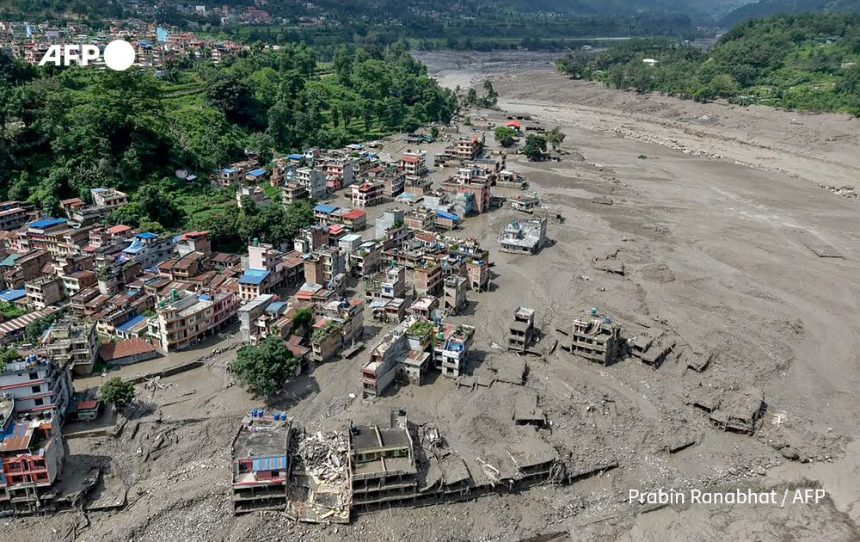
At least 273 people have died and about 1,400 remain missing after a glacial collapse triggered devastating flash floods along the Nepal-China border.
The disaster struck on Wednesday after an ice-and-rock avalanche in the Himalayas sent a massive surge of water, mud and debris into the Lhende Khola river system, which feeds into the Bhote Koshi and Trishuli rivers.

The flood swept through communities in Nepal’s Rasuwa district before surging downstream into Nuwakot, Dhading and other areas. Across the border, debris also hit Gyirong Port in Tibet.
Nepalese authorities said 270 people had been confirmed dead and 826 remained missing as of Thursday afternoon. In Tibet, Chinese authorities reported three deaths and 558 people missing, bringing the combined number of people unaccounted for to about 1,400. Hundreds of foreigners, including pilgrims travelling towards Mount Kailash, are among those missing.
The United States Geological Survey (USGS) ruled out an earlier theory that an earthquake triggered the disaster. It determined that the seismic signal initially interpreted as an earthquake was generated by the massive landslide itself, which registered as a magnitude 5.2 seismic event.
Satellite analysis showed that a large section of glacier collapsed at an elevation of about 5,200 metres, plunging into the valley and triggering the destructive chain of events.
The floods caused extensive damage to infrastructure, with at least 19 bridges destroyed and about 40 kilometres of roads damaged. Several hydropower projects were also affected, while communications and transport links in the region were disrupted.
Nepal has deployed thousands of security personnel, helicopters, drones and search teams to the worst-affected areas as rescue operations continue. The difficult terrain, damaged roads, high river levels and disrupted communications are hampering efforts to reach some of the hardest-hit communities.
Authorities are also monitoring the risk of further flooding, with a barrier lake upstream in Tibet posing an additional threat if it bursts, while continued rainfall could trigger more landslides and flooding.