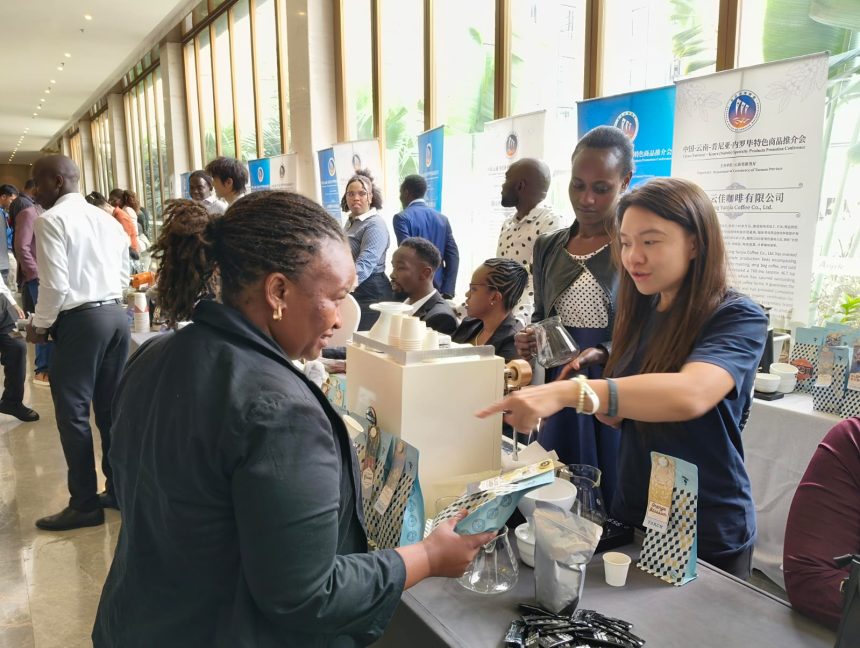
Kenya and China are working to transform Beijing’s recently introduced zero-tariff access for African goods into expanded trade, investment and value addition, with coffee emerging as a key sector for deeper commercial cooperation.
The commitment was made during the China Yunnan-Nairobi-Kenya Speciality Products Promotion Fair in Nairobi, where officials and business leaders advocated for stronger connections between Kenyan producers and Chinese buyers, processors, investors and technology companies.

The discussions follow China’s decision to grant zero-tariff treatment to goods from African countries with which it maintains diplomatic relations, including Kenya. Chinese Embassy officials at the event highlighted that this policy, effective from May this year, aims to create new opportunities for African exports and deepen economic and trade cooperation.
The opportunity is particularly significant to Kenya in agriculture. Coffee, tea, nuts, fruits, flowers and leather were identified as products with strong potential for increased access to the Chinese market.
Zhou Zhengcheng, Minister Counsellor and Head of the Economic and Commercial Office at the Chinese Embassy noted that the two countries have already established a robust economic relationship, with bilateral goods trade exceeding US$10 billion in 2025.
“China-Kenya economic and trade cooperation has a strong foundation and significant complementarity,” stated Zhou adding that there remains considerable scope to expand Kenya’s exports to China.
Zhou urged businesses from both nations to utilise the new policy environment to forge stable supply and demand relationships, converting preferential market access into “actual orders, concrete projects and long-term, stable and mutually beneficial cooperation.”
Yunnan, a major coffee-producing region in China, is keen to source high-quality Kenyan green coffee beans while contributing its processing, roasting and marketing expertise to the partnership.
Li Yi, Deputy Director-General of the Yunnan Provincial Department of Commerce, stated that the objective is to create a model that links Kenyan raw materials with Yunnan’s processing capabilities and the Chinese and global markets.
“We aim to build a closed-loop cooperation model based on ‘high-quality Kenyan raw materials + Yunnan deep processing + Chinese and global markets’,” Ms Li explained.
The proposed model, according to Li, would elevate the relationship beyond the export of unprocessed coffee to include processing, branding, technology and market development.
Li noted that Yunnan has developed a comprehensive coffee industry spanning cultivation, processing, roasting and sales, with over 80 per cent of its coffee reportedly undergoing deep processing. A delegation from the province brought 22 coffee and motorcycle companies to Kenya to explore procurement, investment and distribution opportunities.
Kenya, meanwhile, wants Chinese companies to invest directly in its local processing and value-addition industries. Dr Erick Rutto, President of the Kenya National Chamber of Commerce and Industry, encouraged Yunnan companies to establish processing and value-addition facilities in Kenya, highlighting that such investment would grant Chinese firms access to the broader East African market.
He also called upon Kenyan coffee exporters and businesses to strengthen their presence in China.
“We want to have Chinese brands, Kenyan brands in China,” Rutto stated, emphasising the necessity for a reciprocal commercial relationship rather than one solely focused on Kenyan commodity exports.
The Chamber identified several areas for cooperation, including coffee-processing machinery, research, technology and knowledge transfer, coffee tourism, e-commerce, and digital marketing.
Chinese companies were invited to explore opportunities in agricultural machinery and technology, tea and agricultural processing equipment, macadamia and avocado value addition, logistics and cold-chain infrastructure, as well as technical and vocational training.
The overarching aim is to ensure that increased market access translates into investment and enhanced productive capacity within Kenya, rather than merely boosting the volume of raw commodity exports.
Erastus Mwencha, former African Union Commission Deputy Chairperson, asserted that the new trade environment should be assessed by the economic activity it generates.
“The real value of this arrangement, however, will be measured not by tariff preferences alone, but by the economic activity they generate — more Kenyan products reaching the Chinese market, greater investment, stronger supply chains, increased value addition and more opportunities for our people,” Mwencha commented.
Mwencha further urged Chinese companies to perceive Kenya not just as a consumer market, but as a gateway to East Africa and the wider African market, citing Kenya’s regional economic ties and the opportunities presented by the African Continental Free Trade Area.
The motorcycle sector represents another area where both sides see potential for deeper industrial cooperation. Chinese manufacturers are seeking local distributors, agents, and spare-parts suppliers, while Kenyan businesses are looking for opportunities beyond the importation of finished motorcycles.
It is expected that cooperation could extend to local assembly, components, technical training, after-sales services, and broader supply chains.
The promotion fair convened nearly 20 Chinese enterprises from the coffee and motorcycle sectors with Kenyan importers, exporters, and industry institutions.
The Nairobi meeting positioned zero-tariff access as a platform for deeper China-Africa economic integration, with Kenya aiming to derive greater value from its agricultural production while establishing itself as a regional hub for trade, manufacturing, and investment.