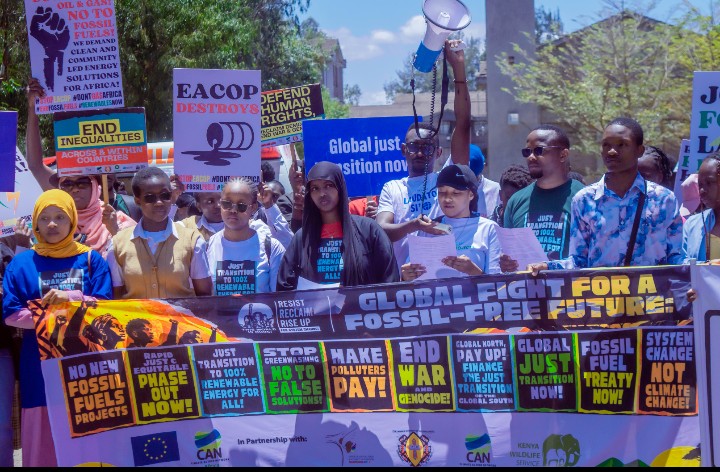
Climate advocates in Nairobi are calling for African governments to accelerate investment in renewable energy and avoid locking their economies into decades of new fossil-fuel infrastructure.
This comes as amid growing investment in fossil fuel projects in the region.

Climate Action Network Africa (CAN Africa) the developments raise a fundamental question for the region.
“We recognise that African countries are starting from very different energy realities, and some remain far more dependent on fossil fuels than others. But Kenya already receives nearly four-fifths of the electricity supplied to its grid from renewable sources, giving it a strong foundation from which to move faster towards 100% clean renewable electricity,” said Ajra Mohamed, the Campaign Lead at CAN Africa.
Currently, the 1,443-kilometre East African Crude Oil Pipeline (EACOP), designed to transport Uganda’s crude oil to Tanzania’s coast, has reached 92.7% overall completion by the beginning of September 2026, according to the project company.
Uganda expects its oil developments to reach peak production of about 230,000 barrels per day.
In Kenya, Nigerian industrialist Aliko Dangote is proposing a $15–16 billion, 700,000-barrel-per-day oil refinery in Lamu, with construction targeted to begin in 2026 and completion envisaged around 2030.
The government has backed the proposal, citing potential benefits including reducing Kenya’s reliance on imported refined petroleum products, while reporting by Reuters has also highlighted financing, crude-supply, infrastructure and environmental challenges facing the project.
CAN Africa says the debate is particularly significant for Kenya because the country already has a strong renewable-electricity foundation.
According to the Energy and Petroleum Regulatory Authority (EPRA), renewable sources accounted for 78.79% of electricity supplied to Kenya’s national grid between July and December 2025, while renewables represented 80.60% of the country’s installed generation capacity.
“New long-term fossil-fuel investments risk pulling in the opposite direction. We want African governments to build on the continent’s renewable-energy potential rather than lock future generations into another cycle of dirty energy dependence,” she added.
Geothermal alone supplied just over 40% of electricity generation during the period.
The action co-funded by the European Union as part of the Funding Fairer Futures initiative held a Climate Walk through Nairobi and was joined by the Office for Justice, Peace and Integrity of Creation (JPIC) – Franciscans Africa, Kenya Wildlife Service (KWS), the Catholic University of Eastern Africa (CUEA), CAN Eastern Africa and 13 other partners from the interfaith and climate justice community.
Participants collectively painted a large canvas contrasting two possible energy futures: continued fossil-fuel dependence on one side, and a clean, renewable-energy future on the other.
The central messages were, “No New Fossil Fuels” and “Yes to a Fair, Fast, Equitable and Just Transition to 100% Clean Renewable Energy.”
Participants also added their own demands describing the kind of energy future they want and the message they would like leaders to hear.