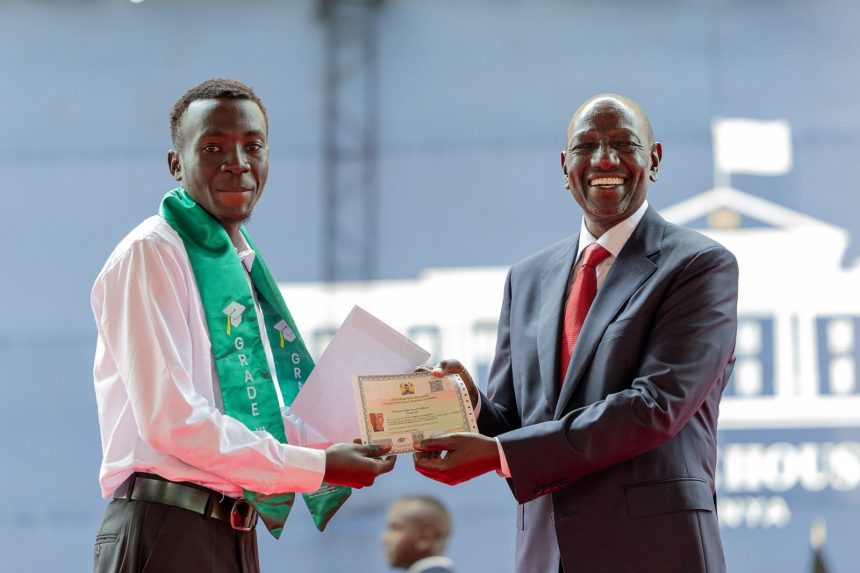
President William Ruto on Thursday presided over a graduation ceremony at State House, Nairobi, where 3,750 beneficiaries were awarded certificates under the Recognition of Prior Learning (RPL) program through the National Industrial Training Authority (NITA).
The historic event marked a major government initiative aimed at formally certifying informal sector workers and skilled artisans across the country.

Addressing the graduates, President Ruto emphasised the value of practical expertise, arguing that an individual’s technical capability should matter far more than academic paper credentials or English language fluency.
The Head of State linked the certification drive to broader national reforms under the Competency-Based Curriculum (CBC) framework, which aims to nurture diverse talents in sciences, engineering, sports, and the arts. He noted that every skill must be recognized to ensure that no hardworking citizen is sidelined, declaring that “every hustle matters.”
“I am talking to you like this so that you know that you are as important as the president, you are as important as the professor in the university, and you are as important as the engineer anywhere else,” the President added.
To scale up the program, President Ruto announced that the government is partnering with the World Bank to certify an initial cohort of 20,000 young artisans in specialized trades such as plumbing and electrical works. Furthermore, the government will independently fund and facilitate the certification of an additional 40,000 skilled workers, ensuring that hard-working youth gain official recognition for their craft.
These certified skills will be directly integrated into national priority economic activities, particularly the flagship Affordable Housing Program, creating immediate job opportunities for skilled youth across the country.
Reflecting on the nation’s economic history, President Ruto noted that Kenya has long relied on uncertified mechanics, builders, plumbers, tailors, and carpenters who perfected their trades in garages, workshops, and construction sites through years of hands-on experience and apprenticeship.
The RPL framework, anchored under the Bottom-Up Economic Transformation Agenda (BETA), formally incorporates those informal skills into the national certification system.
Highlighting a wider cultural shift toward technical careers, the President revealed that enrollment in Technical and Vocational Education and Training (TVET) colleges has grown 780,000 in 2022, with projections expected to hit 1.3 million. He emphasised that even university-admitted students are now actively choosing technical institutions due to the rising demand and value of practical expertise.
By personally hosting the ceremony at State House for the 3,750 graduates, President Ruto reiterated that his presence sent a strong signal across the nation that every practical skill counts toward building a self-supporting workforce and a prosperous Kenya.