Egypt has become the first country globally to sustain the World Health Organization (WHO) Gold Tier Status on the path to hepatitis C elimination, following a validation of its progress between 2023 and 2025.
The validation was endorsed by the WHO Regional Validation Committee on HIV, Hepatitis and Sexually Transmitted Infections in July 2026.

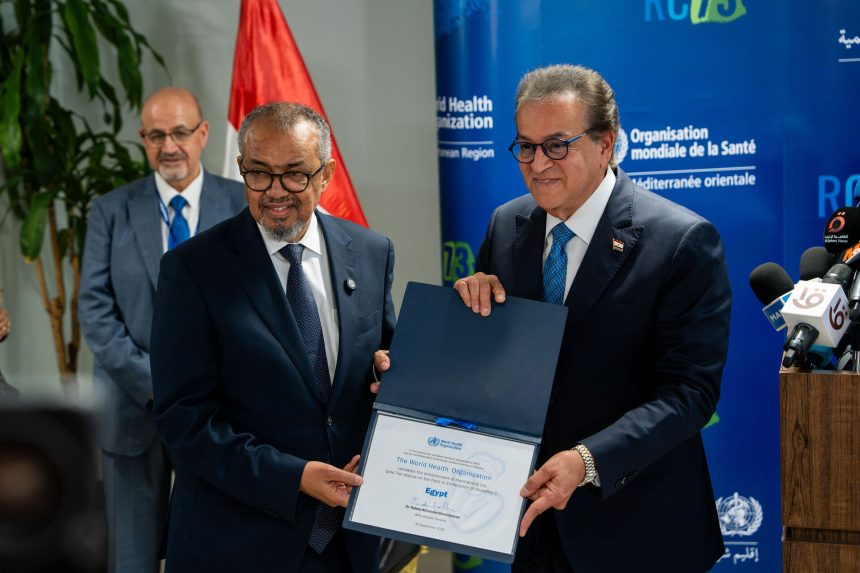
Speaking during the handover of the renewed Gold Tier accreditation certificate to Egypt’s Minister of Health and Population, Dr. Khaled Abdel Ghaffar, WHO Director-General, Dr. Tedros Adhanom Ghebreyesus, said the achievement demonstrated Egypt’s sustained commitment to combating the disease.
In 2023, Egypt became the first country in the world to achieve WHO Gold Tier status on the path to elimination as per the validation criteria set by WHO following a remarkable decline in hepatitis C prevalence from around 10% to less than 0.38% in just over a decade.
Dr. Tedros said maintaining the status demonstrated the importance of sustained investment in disease prevention and control.
“The most important lesson learned from Egypt’s experience is that investments dedicated to combating a single disease are capable of strengthening the entire health system and delivering benefits for future generations,” said Dr. Tedros.
The handing over ceremony took place on the sidelines of the 73rd session of the WHO Regional Committee for the Eastern Mediterranean, hosted by Egypt at the Regional Office headquarters in Cairo.
He noted that sustaining the Gold Tier status reflected the commitment of the Ministry of Health and Population to sustaining high impact prevention, testing, treatment and follow-up services and to strengthening the surveillance and systems needed to prevent a resurgence of hepatitis C.
On his part, Dr. Khaled affirmed that the renewal comes as an extension of the historic moment when the certificate was first presented in October 2023 to President Abdel Fattah El-Sisi, pointing out that Egypt has continued with the same ambition to implement a comprehensive sustainability plan, making it the first country in the world to develop and apply a sustainable plan to ensure the continued reduction of infection and mortality rates.
He explained that the Regional Verification Commission conducted meticulous reviews of Egyptian indicators and confirmed Egypt’s 100% commitment to blood safety measures by screening more than 5.5 million blood units during the years 2023, 2024, and 2025, along with practicing 100% injection safety through the provision of 536 million auto-disable and safe syringes, in addition to maintaining the highest levels of early diagnosis and linking detected cases to free healthcare.
The Health Minister noted that these efforts have resulted in a continuous decline in the virus prevalence rate among the age group (15-59 years) from 0.38% to 0.28%, and achieving a 54% reduction in disease-related mortality rates compared to 2018.
He attributed the success to the vision and political will of the President of Egypt, who launched the “100 Million Healthy Lives” presidential initiative, the localization of pharmaceutical manufacturing at the world’s lowest cost, and the full coordination among state sectors.
Egypt’s achievement builds on the 100 million seha (healthy lives) campaign which screened more than 60 million people and provided treatment for more than 4.5 million with hepatitis C.
The campaign demonstrates the impact of political commitment at the highest level and a whole-of-government approach to conducting nationwide screening and providing accessible treatment, using locally produced direct-acting antivirals.
During the maintenance period, Egypt has transitioned from large-scale, campaign-based screening towards a sustainable, health-system-integrated approach, strengthening routine case finding, diagnosis, treatment, surveillance and prevention.
Key achievements include the continued expansion of hepatitis C screening, diagnosis and treatment, strengthened governance through the 2025–2030 National Sustainability Plan for Viral Hepatitis, ongoing integration of hepatitis services into primary health care and universal health insurance, strengthened laboratory quality systems and surveillance and sustained high safety standards for blood and injections.
Countless lives have been impacted by Egypt’s sustained action against hepatitis, with millions of people protected from infection, families protected from the loss of loved ones and an entire generation given the opportunity to lead healthier lives.
WHO has worked with Egypt throughout its hepatitis C response, providing technical guidance and support to strengthen prevention, testing, treatment and surveillance and helping translate global evidence and guidelines into action.