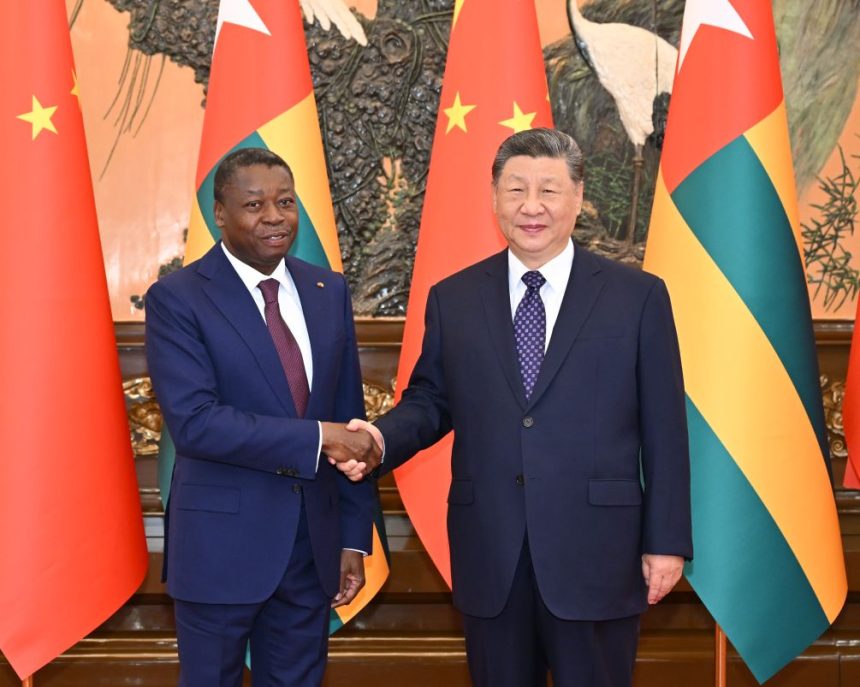
Chinese President Xi Jinping has proposed a four-pronged strategy to guide international efforts in resolving African conflicts. He underscored the importance of African leadership, fairness, peaceful dialogue, and long-term development as crucial foundations for lasting stability.
President Xi presented these principles during a meeting in Beijing this week with Faure Essozimna Gnassingbé, the President of the Council of Ministers of Togo.

“Addressing immediate security concerns should go hand in hand with long-term development planning,” Xi stated
The first principle, as outlined by President Xi, is to uphold African leadership in resolving conflicts on the continent. He argued that Africans are the rightful owners and custodians of their future and should therefore play a central role in decisions regarding regional affairs.
The second calls for fairness and justice in international engagement, with the Chinese leader stressing that all parties involved in conflict resolution should adhere to the purposes and principles of the UN Charter and respect the sovereignty and territorial integrity of the countries concerned.
Thirdly, President Xi emphasised ending hostilities through dialogue and consultation. He argued that neither war nor unilateral sanctions can provide lasting solutions to disputes between states. He urged countries to foster mutual respect, seek common ground despite differences, and practise mutual understanding and accommodation.
Finally, he urged a dual focus on both the immediate manifestations and the underlying causes of conflict, explicitly linking security interventions with long-term development planning. He suggested that where conflict disrupts livelihoods, weakens public institutions, and undermines economic activity, peacebuilding must extend beyond merely ending hostilities to create conditions for recovery and future prosperity.
Chinese Foreign Ministry stated that this approach aligns with China’s longstanding support for African solutions to African problems. China’s second Africa policy paper, published on 6 December 2015, affirmed that “China supports African countries in resolving the continent’s challenges independently and in accordance with their own priorities.”
The paper also committed China to playing a constructive role in African peace and security while upholding the principle of non-interference in internal affairs.
Beijing links these principles to President Xi’s Global Security Initiative (GSI), which advocates for common, comprehensive, cooperative, and sustainable security. The proposed framework, according to the document, reflects the initiative’s emphasis on sovereignty, territorial integrity, cooperation, and the accommodation of legitimate security concerns.
Beijing also points to its engagement with African peace and security institutions. This includes support for UN peacekeeping operations, dialogue with African countries and the African Union, and the work of its special representatives on African affairs and the Horn of Africa. The Ministry further cited China’s support for implementing UN Security Council Resolution 2719, which establishes a framework for financing African Union-led peace support operations authorised by the Council.
President Gnassingbé welcomed the principles and expressed support for China’s role in promoting international peace and stability, even as the two leaders agreed to elevate bilateral relations to a China-Togo community with a shared future in the new era.
President Gnassingbé stated that Togo was prepared to strengthen cooperation with China in trade, infrastructure, and science and technology, while learning from China’s experience in state governance.
The two leaders also discussed trade facilitation, industrialisation, digital cooperation, new energy, and the wider use of the Renminbi in cross-border transactions.