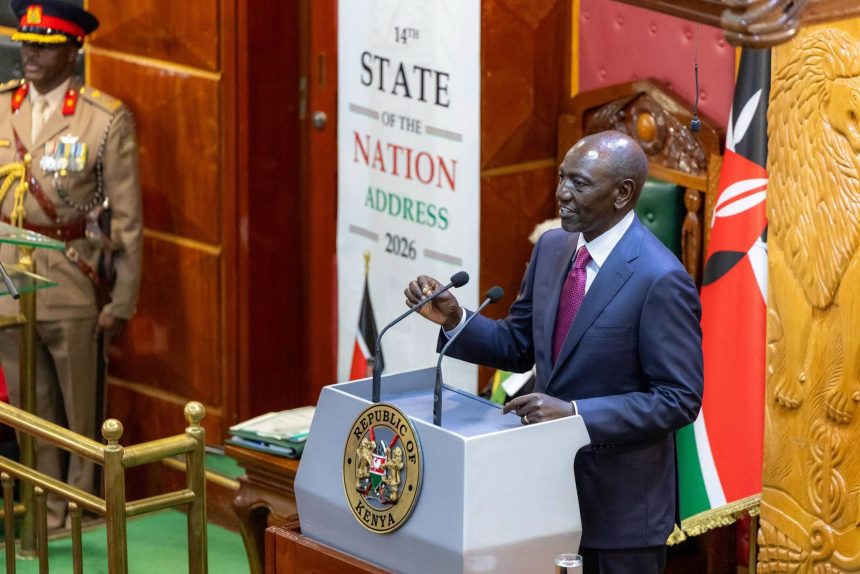
President William Ruto has affirmed his administration’s commitment to equitable development, stating that his government is deliberately dismantling long-standing regional inequalities. He said this is being achieved by extending infrastructure, public services, and economic opportunities to communities that have historically been excluded from national development.
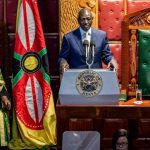
Addressing Parliament during his State of the Nation Address on Wednesday, the President outlined his administration’s development philosophy, anchored in the principle of “Usawa ni Sawa” (Equality is Right), saying it is to ensure that all Kenyans benefit from national resources, regardless of their geographical location or economic circumstances.

Ruto emphasized that economic growth and improved public services are insufficient measures of transformation unless their benefits reach every part of the country.
“For too long, national development was concentrated in places that already possessed the infrastructure, institutions, and markets necessary to attract further investment. Our responsibility is to change that pattern,” he stated.
He asserted that a Kenyan in Mandera should have the same claim to national development as one in Nairobi, and children in Turkana should enjoy the same opportunities as those in Eldoret.
The President clarified that equity does not imply identical needs across all regions, but rather that every citizen deserves equal consideration and a fair opportunity to participate in the nation’s economic progress.
He cited the expansion of healthcare coverage under the Social Health Authority (SHA) as one of the clearest illustrations of his administration’s commitment to inclusive development.
The President also pointed to the affordable housing programme, which he said was being implemented across all 47 counties, alongside the construction of student hostels in universities, TVET institutions and Kenya Medical Training Colleges.
He also highlighted the government’s initiative to construct 600 modern markets, designed to improve working conditions for small-scale traders by providing essential facilities such as shelter, sanitation, storage, and cold rooms.
“A modern market is not merely a building. It is an investment in people whose work sustains local economies but whose needs have too often been overlooked,” Ruto remarked.
On infrastructure, the President pointed to the 750-kilometer Northern Kenya Gateway Corridor, connecting Isiolo, Wajir, and Mandera, as evidence of efforts to address decades of underdevelopment in northern Kenya.
“When I first spoke about this road and named all the towns it would pass through, Kenyans had a field day. The jokes and parodies were everywhere. I saw some of them myself, and I must admit, some were quite hilarious,” he said
He noted that communities along this corridor have endured generations without reliable tarmacked road connections, hindering their access to markets, schools, hospitals, and other vital services.
“Some have lived their entire lives without a single tarmacked road reaching their communities. Their entire lives. What many of us take for granted has remained a distant hope for other citizens. That is the inequality we are correcting. That is the Usawa they deserve,” he said.
Ruto further cited education reforms, including teacher recruitment, classroom construction, and expanded student accommodation, as part of efforts to bridge inequalities in access to quality education.
He also mentioned the proposed Tertiary Education, Placement and Funding Bill, 2026, which aims to ensure that students admitted to universities, TVET institutions, and KMTCs are not denied education due to their parents’ inability to afford tuition fees.
The President said initiatives such as the Hustler Fund, NYOTA and the Access to Government Procurement Opportunities (AGPO) programme were also opening economic opportunities for small traders, young people, women and persons with disabilities.
On land rights, Ruto disclosed that nearly 1.8 million title deeds have been issued since August 2022, with over 400,000 in the Coast region. Community titles in Taita Taveta, Kilifi, and Lamu have helped families secure ownership rights after generations of uncertainty.
He also said the Government had ended discriminatory identification requirements in Northern Kenya and other border stressing that no Kenyan should face additional barriers to citizenship recognition or access to public services based on their community or place of origin.
As further evidence of tangible efforts towards national equality, Ruto presented resource allocation figures since he took office. he said county governments have received Ksh1.55 trillion in equitable share over the past four financial years, with an additional Ksh428 billion allocated in the current financial year.
He also stated that Ksh16.8 billion has been appropriated through the Equalisation Fund this financial year to support development projects in marginalized areas, specifically in water, roads, healthcare, and electricity.
The President stated that these interventions reflect a deliberate shift in the geography of national development, ensuring that opportunities are no longer concentrated in a few regions.
“That is the promise of Bottom-Up finding expression in Usawa ni Sawa: A Republic in which opportunity is not the privilege of a few regions, communities or families, but the rightful expectation of every Kenyan,” he declared.