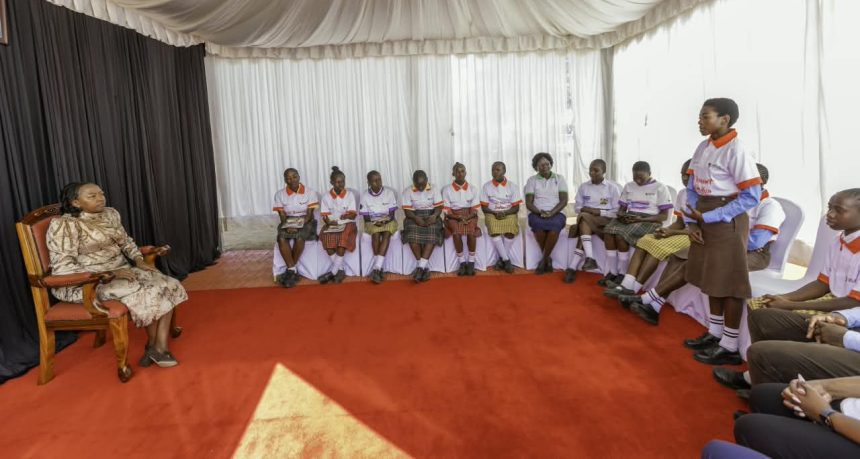
At Mawego Technical Training Institute in Homa Bay County, the question posed on a quiet Wednesday morning cut straight to the heart of the matter: what does it actually take to keep a child safe?
The First Lady Rachel Ruto, First Lady of the Republic of Kenya, did not open with statistics or slogans. She opened with a girl bright, hardworking, full of dreams and the everyday dangers that surround her: a boda boda rider who expects something in return for a lift, an older man offering money her family cannot, a familiar face who visits a little too often. It is a portrait many families in Homa Bay recognize all too well.

The occasion was “A Mother’s Conversation: Keeping the Dreams Alive,” a mentorship engagement bringing together Homa Bay Governor Gladys Wanga, Cabinet Secretary for Gender, Culture and Children Services Hanna Wendot Cheptumo, Principal Secretaries for Children’s Carren Ageng’o and Medical Services Dr. Ouma Oluga, officials from NSDCC, NASCOP, youths and the general public.
Kenya’s 2022 Demographic and Health Survey found that 23.2 percent of girls aged 15 to 19 in Homa Bay had already been pregnant, well above the national average of 14.8 percent. The county’s adult HIV prevalence stands at 16.2 percent, among the highest in the country, with an estimated 2,695 new infections recorded in 2022 alone, and 313 more among adolescents aged 10 to 19. Homa Bay’s own Sexual and Gender-Based Violence Policy adds a further layer: 54 percent of women aged 15 to 49 report having experienced physical violence since age 15, and 23 percent sexual violence. Taken together, the picture is unmistakable — HIV, teenage pregnancy and gender-based violence are not three separate problems in Homa Bay, but one interlocking crisis, fed by poverty, thin family support and silence.
It is this triad, what the First Lady calls the “Triple Threat,” that her office has committed to ending by 2027, through a national campaign launched under Kenya’s Commitment Plan to End the Triple Threat 2023–2030, developed with the Organisation of African First Ladies for Development. The campaign began in Meru and Narok before expanding to Homa Bay, Samburu, West Pokot and Uasin Gishu. Within six months, more than 220 health facilities across the four counties had come on board, and over 200 healthcare providers had been trained to deliver adolescent-friendly services — evidence, organisers say, that the ambition now has machinery behind it.
Yet the First Lady was careful to insist that a campaign, however well resourced, cannot do this work alone. Real protection, she said, comes down to people — a teacher who notices, a parent who listens, a health worker who welcomes a teenager without judgement, a chief who refuses to look away. Her message to Homa Bay’s young people was equally direct: stay in school, protect your dreams, and speak to a parent, a teacher, a health worker, anyone you trust rather than let silence become the price of survival.
For Cabinet Secretary Cheptumo, the answer must be structural as much as personal. She pointed to the Cash Transfer for Orphans and Vulnerable Children Programme, now supporting more than 440,000 households nationally, and the Presidential Secondary School Bursary Programme, reaching all 290 constituencies to keep vulnerable children in class. Newest among these is the Adolescent Cash Plus Programme, targeting 10- to 18-year-olds with a mix of cash support, life skills, health and psychosocial services with Homa Bay among the first nine counties to roll it out.
Ageng’o said Children are not simply people to be protected, but people to be heard. The Children Act, 2022 recognises their right to participate in decisions that shape their lives, and both speakers urged communities to treat young people as partners rather than passive beneficiaries deliberately drawing boys and men into a conversation too often left to women and girls alone.
The event closed not with more warnings, but with gestures meant to last: pledge cards signed, books and dignity kits distributed, young mentors recognised and sent back into their schools, churches and fishing communities carrying one message outward. As the First Lady put it, the task now is not to talk at Homa Bay’s children, but to walk with them until they reach the futures they were always capable of reaching.
Because behind every statistic recited that morning in Mawego was a name, a face, a young person still deciding who they will become. And for one day at least, Homa Bay was reminded that the surest protection any child can have is an adult willing to stay close enough to notice, and brave enough to act.
Dr. Yusuf Muchelule is a Senior Lecturer & a Consultant.