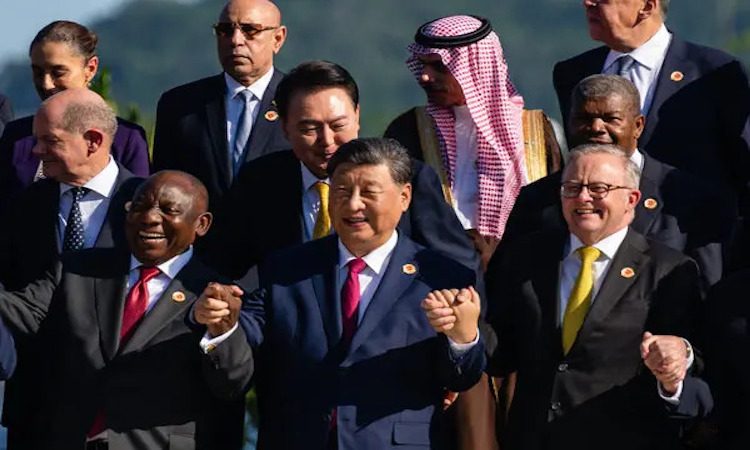
One year after President Xi Jinping introduced the Global Governance Initiative (GGI), China reports growing support for the framework internationally, with nations increasingly backing the GGI as they advocate for greater representation, fairness, and a stronger voice in international affairs.
President Xi proposed the GGI on 1 September 2025, ahead of the United Nations’ 80th anniversary, calling for international collaboration to build a more just and equitable global governance framework.

China’s Ministry of Foreign Affairs now states that the initiative has progressed from a national proposal to an international practice, garnering support and positive responses from nearly 160 countries and international organisations.
“More than 60 countries have joined the Group of Friends of Global Governance, engaging in intensive coordination on a wide range of global governance issues.” The Ministry highlighted
The expanding participation, the Ministry suggests, reflects a shared international commitment to multilateralism, increased representation for developing countries, and the reform of existing global institutions.
China says it has also been active in translating the initiative into concrete policy proposals and practical mechanisms.
Foreign Minister Wang Yi noted that China identified nine priorities for advancing global governance reform, with the primary focus on enhancing the efficiency of the United Nations and strengthening its role.
Through the GGI, he said China advocates for greater authority and capacity for the UN Security Council, including stronger representation for developing and small to medium-sized states.
China’s proposal explicitly states, “The voice of developing countries and the vast number of small and medium-sized countries should be strengthened, and the historical injustice faced by Africa should be addressed as a priority.”
China has called for improvements to the UNSC’s rules of procedure, promoting equal consultation and discouraging the “forced push” of controversial proposals.
“The five permanent members should strengthen communication and coordination on major proposals, seek consensus as much as possible, and reduce confrontation. Unilateral actions and sanctions that bypass the Security Council should be opposed,” the proposal states
Beijing also advocates for adapting UN peacekeeping operations to contemporary challenges and enhancing cooperation between the United Nations and regional organisations such as the African Union and the League of Arab States.
Additionally, China urges that development be reinstated at the centre of the UN agenda, calls for stronger fulfilment of development-financing commitments, and advocates for a fairer global climate governance system.
On human rights, Beijing seeks a fair, objective, and non-politicised approach grounded in sovereignty, equality, dialogue, and mutual respect.
China also proposes reforms to the international economic and financial system, including adjusting the representation of developing countries in institutions like the World Bank and the International Monetary Fund, as well as updating World Trade Organization rules.
Artificial intelligence has emerged as another key focus, with China advocating for people-centred AI governance, international cooperation, and measures to prevent the digital divide from widening. It has also proposed establishing a World AI Cooperation Organization and launched an AI capacity-building action plan.
The eighth priority covers emerging areas such as cyberspace and outer space. According to Wang Yi, China champions respect for cyber sovereignty, the peaceful use of outer space, and opposition to its weaponisation.
Furthermore, China urges greater dialogue among civilisations, arguing that international cooperation should transcend geopolitical rivalry, bloc confrontation, and ideological prejudice.
The Foreign Ministry notes that China has already taken practical steps to implement the GGI. It says the International Organization for Mediation has begun operations and resolved its first international maritime dispute, while the World Data Organization and World Artificial Intelligence Cooperation Organization have been established in China.
China also announced its 2035 Nationally Determined Contributions at the UN Climate Summit, and plans are underway to host the Global Governance Forum in Xiong’an this autumn.
Foreign Minister Wang Yi stated that China is prepared to work with the international community to implement the initiative and build what Beijing describes as a “more just and reasonable global governance system.”
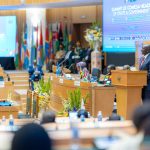
Speaking at the Lanting Forum on Improving Global Governance to Build a Community with a Shared Future for Humanity, Wang reiterated China’s readiness to “join hands with the international community” to fully implement the GGI and create a brighter future for humanity.
Beijing says the initiative’s first year demonstrates the importance of “extensive consultation, joint contribution, and shared benefits” and reinforces a shared commitment to multilateralism.
The country has pledged to continue supporting the UN-centred international system and strengthening multilateral and regional cooperation mechanisms.