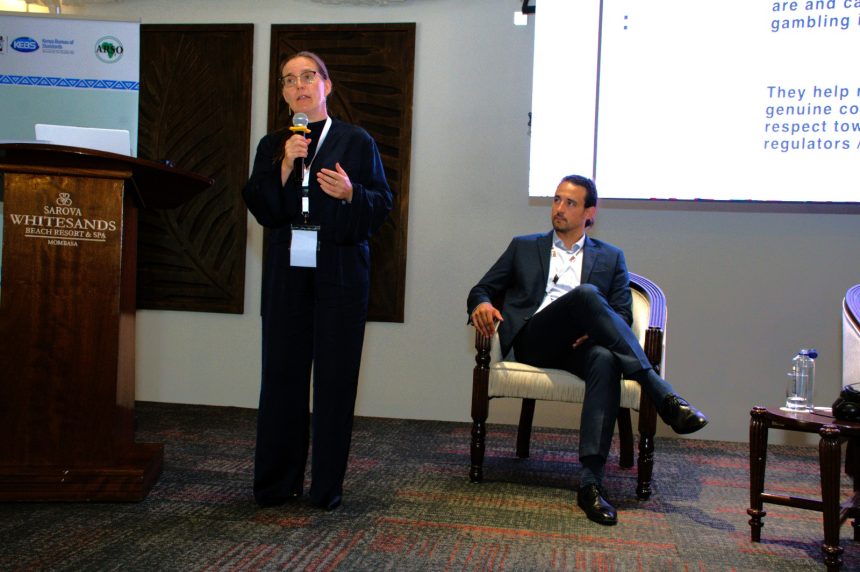
As online betting continues to grow across Africa, experts have called for the standardisation of self-exclusion systems in the gambling industry.
This following presentation of a proposal to develop clear standards for self-exclusion as a key tool for protecting people from gambling-related harm was presented during the 32nd General Assembly of the African Organisation for Standardisation (ARSO), held in Kenya from August 24 to 28.

The event which was organised in partnership with Kenya Bureau of Standards (KEBS), attracted experts on standardisation, delegates, industry leaders and policymakers from across the region and around the world aimed at driving continental trade integration under the African Continental Free Trade Area (AfCFTA) for which the Kenyan government is at the forefront.
The gambling industry was introduced as a new track among the regular industries that have traditionally been subjected to standardization over the years.
Africa has the youngest population on the planet and online gambling is accelerating very quickly, creating space for inappropriate integration of payments, games testing, platform integrations, operators’ oversight and also player protection.

Dr Margaret Carran of St George’s, University of London, and Šimon Vincze, Head of Sustainable and Safer Gambling at Casino Guru, presented proposals under the Self-Exclusion Standards Project, which seeks to establish clear guidelines for the implementation of online self-exclusion systems.
According to Vincze, current estimates suggest that more than 200 million Africans are gambling online, which represents 14% of the population, even though general statistics show that the majority of people are gambling without significant harm, games of chance have inherent risk for everyone engaging with them.
“Protecting those who might be at increased risk through responsible gambling is an essential part of a prosperous industry,” said Vincze.
Voluntarily Self-Exclusion as vital responsible gambling tool
Self-exclusion allows gamblers to voluntarily request to be blocked from accessing gambling services for a specified period. Depending on the system in place, the exclusion can apply to a single operator, multiple operators or different forms of gambling.
“One of the key tools for responsible gambling is self-exclusion, where players voluntarily ask operators or other authorities to be blocked from accessing their account with single or multiple operators, or from different forms of gambling for a set period,” noted Vincze.
The tool is essential at times where players cannot control their gambling behavior which can lead to significant harm. The operators’ responsibility is to respect the player’s decision and not allow access during the chosen period. “However, there are multiple points of possible misunderstanding, misuse or other issues during the process of self-exclusion,” he said.
Implementation details for self-exclusion are missing
Vincze noted that even though self-exclusion is key for players that are losing control, the regulation in most countries is vague on implementation details. Furthermore, requirements by different states vary significantly, as research facilitated by European Gaming and Betting Association shows.
Providing self-exclusion is commonly mandatory but miss specific provisions on the process. Operators are then left to implement the tool at their convenience, which does not necessarily mean an effective function.
Areas such as communication to players, operators’ responsibility, initiation of self-exclusion or return of player’s funds can represent trigger points resulting in flawed effectiveness. In such cases, it is not players only who feel the negative consequences, but operators too and consequently regulators and the public. Standardizing clear guidelines can improve the process significantly.
The team behind Self-exclusion Standards project has decided to come up with the set of rules covering all areas of the process to help all stakeholders nourish a sustainable gambling environment.
The creation of Self-exclusion Standards
He says the project was made on an academic principle and took on a robust methodology consisting of three stages: Literature review and research, consultation with the workgroup as well as broader consultation.
The systematic review of international literature was done alongside a thorough review of online self-exclusion requirements in five different jurisdictions and also analysed the almost 600 complaints on the subject posted on Casino Guru.
Working group consisting of 10 members, representing all stakeholders, six states and three continents then discussed all aspects of self-exclusion to find consensus.
Broader consultation saw feedback from industry experts to preliminary findings and resulted in almost 60 submissions from around the world.
The final recommendations seek to provide a framework covering the different stages of self-exclusion, including communication with players, operator responsibilities and procedures for managing excluded accounts.
“The feedback was reflected in a final paper that now offers best practices that are feasible to use. They cover every aspect of self-exclusion and was made with sustainable gambling approach in mind, which contributes to de-escalation of harm and regaining control, while aiming at using the right self-exclusion at the time,” he said.
The standards are designed to be applied across different countries and regulatory environments rather than being limited to a specific region.
The discussions at the ARSO General Assembly come as African countries continue to grapple with the rapid growth of digital gambling platforms, particularly among younger populations.
Experts say protecting players is a cornerstone of a well-regulated and reputable gambling industry which fulfills individual desire to gamble and contributes to the local economy adding that responsible gambling practices do not necessarily have to stand on the opposite direction of commercial interests.
They noted that the development of common standards could play an important role in reducing gambling-related harm while supporting a more sustainable and regulated gambling industry.
“If implemented correctly, they can increase overall trust and equip operators with predictable long-term profitability, while providing appropriate support to players,” said experts.
Adding that: “Standardization in this area can help regulators and policy makers to demonstrate their genuine commitment to safer gambling. Helps to gain public respect towards regulators and those that are shaping the landscape of gambling. Self-exclusion Standards project and its authors are ready to support this process.”