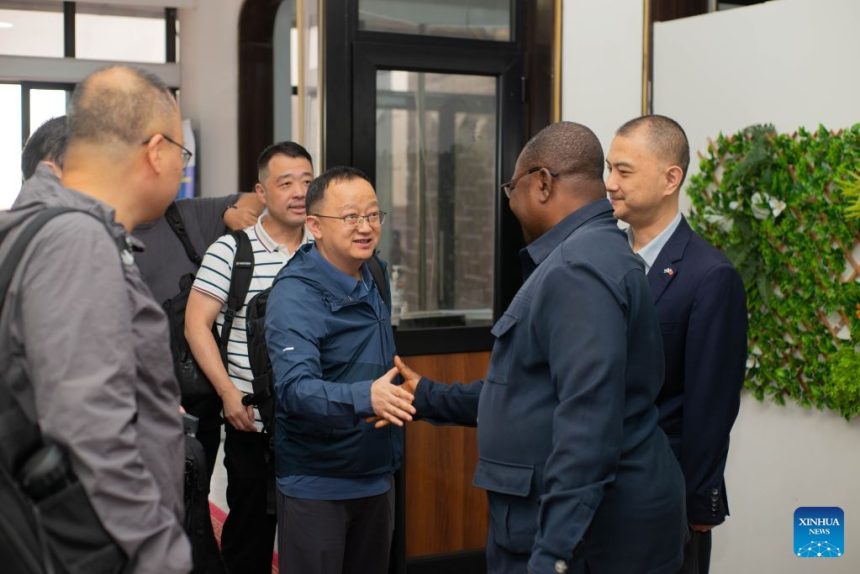
China has dispatched a third team of medical experts to the Democratic Republic of the Congo (DRC) to bolster the nation’s efforts against the ongoing Ebola outbreak. This marks a continued phase of Beijing’s sustained support for the Central African nation’s fight against the deadly disease.
The five-member team arrived in Kinshasa over the weekend, where officials from the DRC Ministry of Health welcomed them. Ministry representatives described the deployment as a significant boost to the country’s containment efforts.

Luku Maleyo Marius, representing the ministry, stated that the Ebola situation remains severe, placing considerable strain on the country’s public health system.
“The arrival of the Chinese experts will provide strong support for epidemic surveillance, patient treatment, and laboratory testing,” Marius said, adding that the DRC looks forward to expanding cooperation with China to strengthen its epidemic response capabilities.
Yang Xiaochen, who leads the latest team, affirmed that the experts would build upon the work of the two preceding Chinese medical missions, adapting their support to the evolving needs of the outbreak.
“We will continue providing technical assistance in line with practical response needs and deepen exchanges and cooperation with the DRC’s health authorities and relevant international partners,” Yang stated.
“We hope to contribute Chinese expertise to bringing the current Ebola outbreak to an early end.” he added
The latest deployment follows two earlier Chinese medical missions sent since the outbreak was confirmed in May.
The first expert team arrived in Kinshasa in early June for a three-month assignment, after the DRC confirmed its 17th Ebola outbreak since 1976. The World Health Organization declared the outbreak a Public Health Emergency of International Concern two days after the government’s announcement.
Led by Lu Ming, the initial team collaborated with Congolese health and disease control authorities. They provided technical support in epidemic assessment, case management, disease surveillance, and response planning, while sharing China’s experience in epidemic prevention and control.
At the time, Congolese health officials described China’s swift deployment as timely support that would help strengthen the country’s prevention, treatment, and disease control capacity.
A month later, China dispatched a second expert team to sustain the response as the outbreak remained complex. Led by Gu Zhiqiang, this team expanded technical cooperation in epidemiological investigations, laboratory testing, infection prevention and control, clinical case management, and the training of local health personnel.
Welcoming the second mission, Marius highlighted that the long-standing partnership between the DRC and China had yielded significant gains in the health sector, playing an important role in strengthening the country’s public health system.
DRC President Félix Tshisekedi has acknowledged China’s contribution to the fight, thanking Beijing and other international partners for supporting the country’s Ebola response. He emphasised that global cooperation remains essential, as infectious diseases do not respect national borders.
The arrival of the third medical mission underscores China’s ongoing commitment to supporting the DRC’s public health response through technical expertise, capacity building, and institutional cooperation, as Kinshasa works to contain one of the country’s recurring Ebola outbreaks.