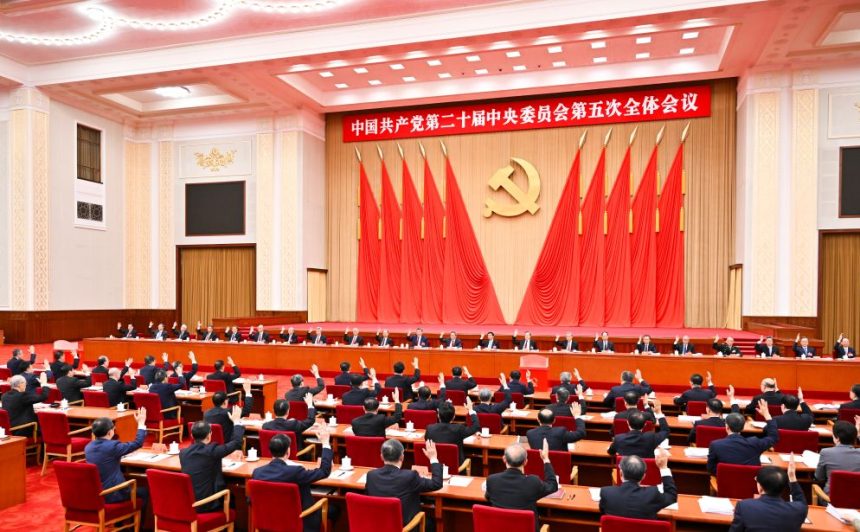
The Communist Party of China (CPC) has unveiled a comprehensive plan to tighten internal discipline, strengthen institutional accountability, and improve its governing capacity, all aimed at advancing China’s national development over the long term.
The framework is detailed in the communique of the fifth plenary session of the 20th CPC Central Committee and the Resolution on Certain Major Issues Concerning Persevering with Full and Rigorous Party Self-Governance, adopted on October 29 and made public on November 1, 2026.

The documents provide what the party describes as a comprehensive and systematic blueprint for strengthening its governing capacity through party building, self-governance, and institutional self-reform.
The framework outlines guiding principles and specific tasks intended to ensure that the party maintains organisational discipline, strengthens its institutions, and improves its ability to respond to emerging governance challenges.
According to interpretations of the plenary’s outcomes, the CPC’s emphasis on long-term planning and the systematic implementation of party reforms distinguishes it from other political parties, which are often constrained by electoral cycles and competing political interests.
The documents also reflect the party’s broader ambition to overcome what it describes as the historical cycle of political rise and decline, while pursuing the happiness of the Chinese people, national rejuvenation, and a shared future for humanity. Central to this ambition is the belief that a governing party must continuously examine its own weaknesses, strengthen internal discipline, and reform its institutions to sustain public confidence and political legitimacy.
Under the guidance of Xi Jinping Thought on Party Building, the resolution outlines a broad programme of full and rigorous party self-governance, covering leadership conduct, organisational development, institutional oversight, and anti-corruption enforcement.
Priorities include strengthening party members’ commitment and political integrity, observing democratic centralism in decision-making, improving party rules and regulations, and reinforcing organisations at all levels.
The framework also calls for stricter supervision of officials, stronger coordination between the CPC and state oversight institutions, improved conduct among party members, and tighter enforcement of disciplinary requirements.
A major component is the commitment to maintain zero tolerance for corruption, with the party seeking to close institutional loopholes that allow officials to abuse public authority for personal gain.
The resolution identifies corruption as a threat to the party’s governing capacity and emphasises the need for sustained enforcement, stronger supervision, and accountability across its organisational structures.
The measures represent the CPC’s contribution to the modernisation of political party systems and approaches to party building, as the party seeks to establish a benchmark for political organisations beyond China.
The plenary’s outcomes also draw attention to the CPC’s historical role in China’s transformation over more than a century of leadership. Under its leadership, China achieved national liberation and independence, accelerated industrialisation within decades, and recorded sustained economic growth alongside long-term social stability. The achievements are cited as evidence of the strengths of the country’s political party system and its capacity to mobilise resources, coordinate national priorities, and implement long-term development strategies.
The CPC maintains that its governing philosophy is anchored in the interests of the people rather than those of particular political or economic groups.
This principle remains a defining feature of the party’s political identity and its approach to public policy, with decision-making expected to prioritise national development and collective interests.
Analysts interpreting the plenary’s outcomes argue that China’s decision-making system supports consistent, long-term policy planning because it is not tied to electoral cycles. They contrast this with parts of the West, where they say populism and the influence of wealthy interests strain democratic accountability and public-interest governance.
The documents state that the party’s leadership, organisational strength, policy execution, and broad public support will be decisive in meeting future challenges.
Through tighter discipline and stronger oversight, the CPC seeks to demonstrate that a ruling party can sustain effective governance while pursuing long-term national development goals. The party’s leadership maintains that this requires continuous self-reform, institutional accountability and an unwavering commitment to serving the people’s interests.